Even after more than a century of mining history, the Yukon remains a region of untapped potential, according to one mining executive.
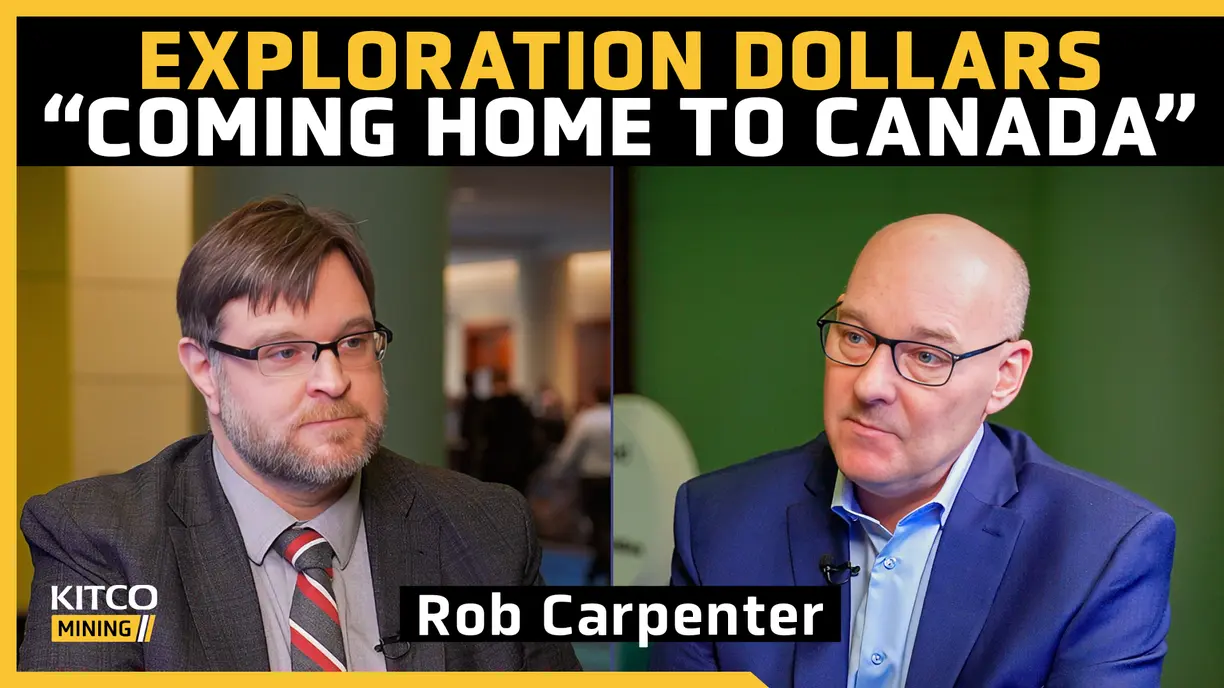
On the sidelines of the Prospectors & Developers Association of Canada (PDAC) 2026 convention in Toronto, Canada, Rob Carpenter, President and CEO of Prospector Metals, sat down with Kitco Mining to talk about his latest gold project in the Canadian territory.
At the start of the year, the junior explorer announced plans for an expanded drill program at its ML Project in northeast Yukon. The company notes that the property hosts one of the few remaining Tombstone-style intrusions in the region that has not been systematically explored.
Prospector Metals enters its exploration season well funded, with more than $45 million in cash and the backing of mid-tier gold producer B2Gold, which recently increased its stake in the company to 19.9%. Carpenter said the partnership provides not only financial support but also valuable technical expertise as the company works to advance what it believes could become a district-scale discovery.
The company first drilled the project in 2025, completing roughly 6,000 meters and intersecting new gold mineralization near Dawson City. Building on those early results, Prospector plans to significantly expand exploration this year, with more than 25,000 meters of drilling scheduled.
“Our objective is to expand that new discovery from last year and demonstrate the potential for this area to host multiple deposits,” Carpenter said.
Carpenter is no stranger to greenfield discoveries in northern Canada. He previously co-founded Kaminak Gold, which made the Coffee gold discovery in the Yukon—later acquired by Goldcorp—after drilling the first hole on the project in 2010.
He said the exploration strategy at the ML Project shares similarities with Kaminak’s early work. The company is targeting large structural corridors where fault zones can host significant gold deposits, a geological setting that has historically produced some of the region’s largest discoveries.
“The best gold deposits occur in the biggest structures,” Carpenter said, adding that identifying those large geological footprints is a key part of the company’s exploration strategy.
Despite Yukon’s long mining history dating back to the Klondike gold rush of the 1890s, Carpenter believes the region remains underexplored compared with other Canadian mining jurisdictions.
“With new technologies like satellite imagery and modern geological techniques, it still feels like Yukon is where Ontario was a hundred years ago in terms of how much work has been done,” he said.
Carpenter also noted that global geopolitical uncertainty is helping drive exploration capital back to Canada. Stable regulatory frameworks and well-defined mining rules make jurisdictions such as the Yukon increasingly attractive to investors.
“Exploration dollars are coming home to Canada,” he said. “Projects discovered here tend to get fully valued more quickly than those in jurisdictions where politics are more uncertain.”
Interest from investors has been building as gold prices rally alongside other metals. Carpenter noted that the company’s project sits within a high-grade gold-copper-silver district, giving it exposure to multiple commodities that are currently attracting strong market interest.
Still, he acknowledged that investors remain selective, particularly when it comes to early-stage exploration companies.
“You need more success stories,” he said. “Investors want to see proven management, good jurisdictions and strong backing.”
For Carpenter, the key objective remains making a discovery that can eventually attract a larger mining company capable of developing a full-scale operation.
“As an early-stage exploration company, our job is to make the discovery, demonstrate that it has the geometry and potential to become a resource, and then realize that value,” he said.
While developing a mine can take a decade or more, Carpenter noted that the discovery phase itself typically unfolds over the first few years of drilling. During that period, geologists work to “crack the code” of a new deposit by understanding its geological controls and expanding the mineralized footprint.
If successful, the next step is establishing a formal resource estimate under NI 43-101 standards—an important milestone that can significantly increase investor interest and project valuation.
For now, Prospector Metals is focused on the upcoming drill campaign and building on the early signs of mineralization already identified at the ML Project.
“There’s still tremendous opportunity in the Yukon,” Carpenter said. “We’re just scratching the surface.”

Kitco Spotlight Editorial
Kitco Spotlight Editorial is sponsored content, articles and announcements paid for by our advertisers that support our journalism. Our sponsored messages are targeted and hand-curated, highlighting the best of what's happening in the mining sector.
