

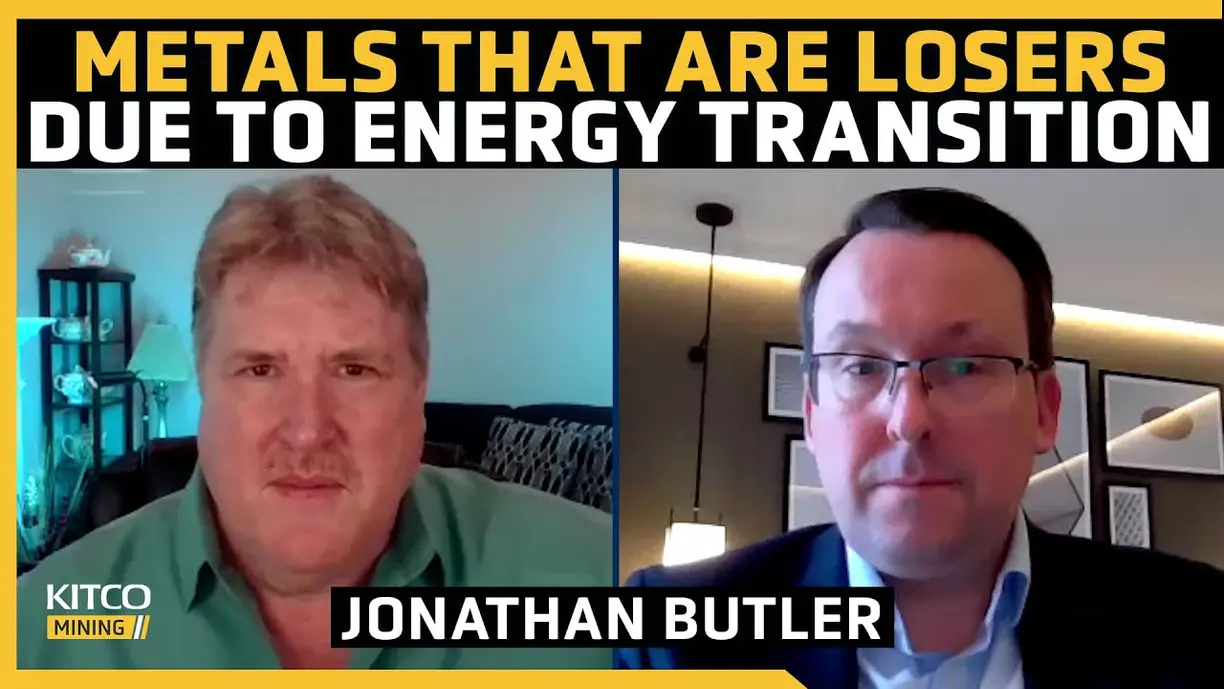
(Kitco News) - The platinum group metals (PGM) basket is under strain, but that’s due more to a decline in aggregate car sales rather than a shift toward electrification, says Matt Watson, founder of Precious Metals Commodity Management LLC., and host of Green Rush — a program that focuses on precious and critical minerals as they impact the clean energy transition.
In mid-March Watson spoke to Jonathan Butler, head of business development at Mitsubishi Corporation.
Platinum, palladium and rhodium are key metals used in autocatalysts, or catalytic converters, which reduce tailpipe emissions in vehicles. Palladium is typically used in gasoline engines whereas platinum is more often used in diesel engines.
Watson noted aggregate car sales are down about 23% and haven’t hit 93 million since 2017.
“Vehicle sales I think are the lever that's hurting the PGM basket at this point, more so than the EV penetration rate,” he said.
Butler agreed, listing the factors that have resulted in lower sales: the slowdown in China, the covid-19 pandemic, the semiconductor shortage, and now, higher interest rates deterring new car buyers.
“There's something like a 10-million-unit vehicle delta between where things
should have been had we not had the pandemic and the chip crisis and everything else, and where we actually are now,” he said. “Those are vehicles that just simply weren't made and incidentally that has quite an influence on the long-term recycling market because there's going to be a missing generation of vehicles that aren’t coming through the recycling stream.”
Lower internal combustion engine (ICE) sales have had an impact on palladium and rhodium, which have accumulated surplus and whose prices have fallen over the past two years. Eighty-five percent of demand for these metals is from gasoline and diesel engines.
“When you look at the long-term outlook palladium and rhodium are really going to be challenged,” Watson said.
Butler agreed, but warned not to discount the risk of supply shocks to PGM mines in South Africa, which are becoming depleted and face issues around labour and power.
He also said, “I think we've still got a little bit of life in the old internal combustion engine for quite a bit more time, in particular with in relation to increased hybridization.”
Hybrid vehicles, like ICEs, require autocatalysts.
Watson pulled up a chart showing up to 125 million troy ounces of material from autocatalyst recycling could hit the market by 2050 — the equivalent of 13 to 15 years of supply. “The market needs to develop more applications for palladium to take up this slack,” he said.
Watson and Butler both see increased demand for platinum, iridium and ruthenium, which are critical materials for the hydrogen economy — fuel cells and green hydrogen electrolyzers.
Butler said ruthenium is interesting because it can be used as a substitute for iridium, and has applications in fuel cells and ammonia cracking.
“In that sense ruthenium might be the sleeper in all of this, and it also helps that it's currently the most inexpensive of those three metals,” he said.
Butler noted more platinum will be demanded in the process of creating green hydrogen through electrolysis, in hydrogen storage, and fuel cells. “I think that long-term story is going to keep platinum well supported.”
Platinum supply will be challenged though, because of South African miners having to go deeper, and because newer PGM mines in North America, Russia and Zimbabwe tend to be palladium-rich deposits. “The supply downstream sure looks like there’s a lot of the wrong stuff,” said Watson. “We need more of the platinum and the ruthenium and the iridium. Palladium doesn't necessarily help the cause at this point.”
Regarding electric-vehicle penetration, Butler said after several years of double-digit penetration growth, battery electric vehicle sales have gone into reverse, at 14 percent of the global car market in 2023 versus 15 percent in 2022. He said there are challenges regarding raw material availability, electrification infrastructure and the higher sticker prices of EVs.
He referenced a KPMG annual survey of auto industry executives, who in 2021 said there will be a 50-60 percent EV penetration rate by 2030. In 2022 the rate expectation halved, and in 2023, it climbed a little bit but only to 30 percent for each of the main markets.
“A much slower growth rate going forward. Absolutely, agreed,” said Watson.
____________________________________________________________________
Green Rush is brought to you by Revival Gold. Revival Gold is one of the largest, pure gold, mine developers in the United States. The Company is advancing engineering and economic studies on the Mercur Gold Project in Utah and mine permitting preparations and ongoing exploration at the Beartrack-Arnett Gold Project located in Idaho.
Revival Gold is listed on the TSX Venture Exchange under the ticker symbol "RVG" and trades on the OTCQX Market under the ticker symbol "RVLGF". The Company is headquartered in Toronto, Canada, with its exploration and development office located in Salmon, Idaho.
____________________________________________________________________

Subscribe to Green Rush podcast on YouTube Music.
Listen to this podcast on Buzzsprout Apple Podcasts Amazon Music Spotify |