
(Kitco News) - The Federal Reserve finally made it official on Wednesday by cutting rates to 3.50–3.75% with a 9-3 vote. Governor Stephen Miran, appointed by President Trump, naturally requested a steeper 0.5% reduction.
Presidents Jeffrey Schmid of Kansas City and Austan Goolsbee of Chicago, who flipped from dovish to hawkish, were the only members in favor of holding.
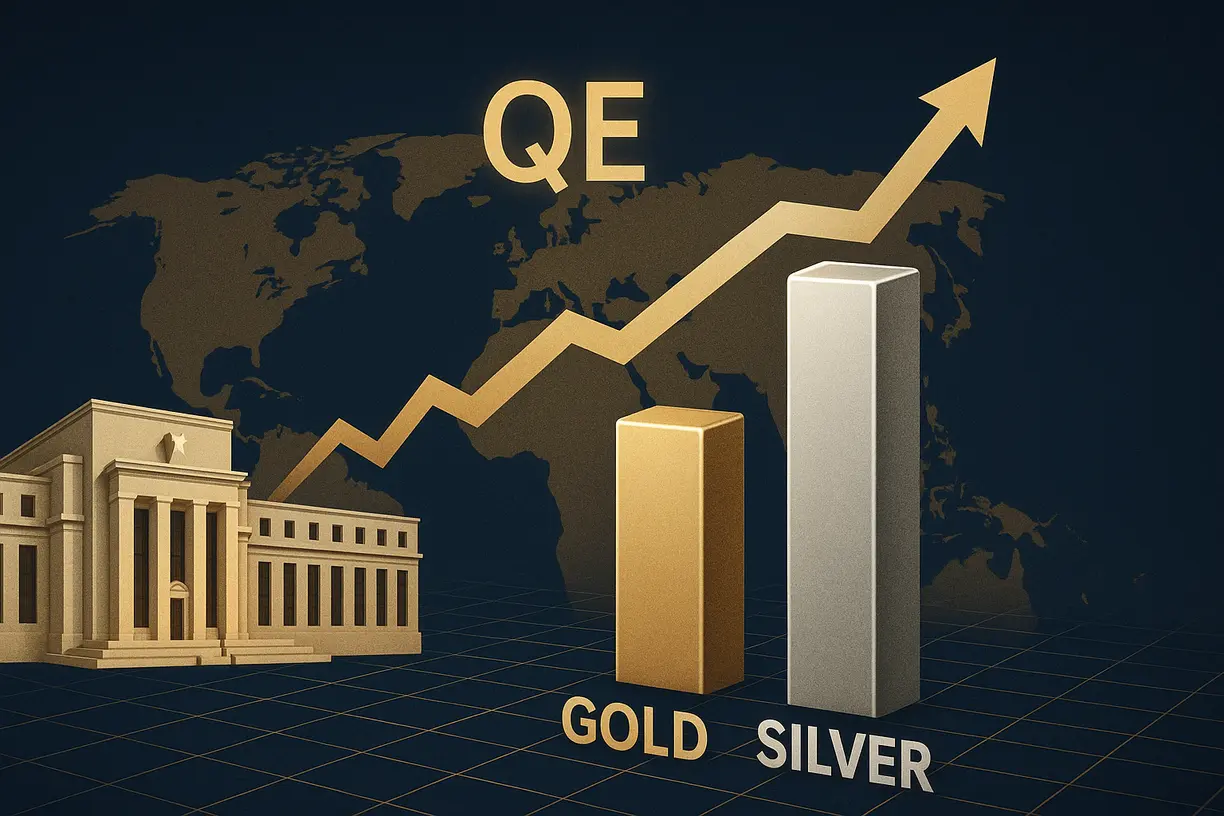
More importantly, the Fed also announced fresh balance sheet expansion by stating the central bank will begin buying $40 billion of Treasury bills per month starting today, which is another way of saying ‘quantitative easing’.
The New York Federal Reserve's operations desk plans to conduct about $14.4 billion in reinvestment purchases and an additional approximately $40 billion in reserve management purchases between December 12 and January 14, it said in a schedule released on Thursday.
As a result, the yield curve is likely to steepen as the Fed pivots toward Treasury bills and private investors absorb more duration risk. This means looser money conditions are on the way, which was positive news for both gold and especially silver.
Gold futures moved above $4300 and March Silver soared above $64/oz to fresh all-time highs on Thursday. Strong losses in the U.S. dollar index, driving the world’s reserve currency to a six-week low near 98, also supported buying interest in both precious metals.
This was the last FOMC meeting for 2026, and the final one in which Fed Chair Jerome Powell will have significant influence. President Trump is expected to nominate a "yes man" candidate to replace Powell and attempt to bring rates down to zero next year – likely Kevin Hassett – making the current Fed chair a lame duck.
During the subsequent press conference, Fed Chair Jerome Powell stuck to his pipe dream of getting inflation down to the Fed's mandated 2% level before his term ends in May 2026, despite the New York Fed’s inflation expectations survey pointing to 3.2% within a year.
With speculation of who Trump will appoint to replace him as Fed chair in the spring of 2026 heating up, Powell was asked what he would like his legacy to be. “I really want to turn this job over to whoever replaces me with the economy in really good shape,” he answered.
“That’s what I want to do. I want inflation to be under control, coming back down to 2%, and I want the labor market to be strong. That is what I want,” Powell added.
So, let me get this straight, soon to be former Fed Chair Powell want’s inflation to move down to the Fed's mandated 2% target, while cutting interest rates and initiating quantitative easing as the U.S. government runs a $2 trillion deficit amid growing fears of a sovereign debt crisis?
Powell’s response should have included a quote from Jefferson Starship by saying, "If only you believed in miracles like I believe, we'd get by".
If you think of the U.S. as being a company, USA Corp. had revenues of $5.2 trillion and an operating loss of $2 trillion in 2025. And if this company had debt of nearly $39 trillion (increasing $1 trillion every 80 days) and other off-balance-sheet liabilities of $200 trillion, its bond status would be junk.
While inflation is being driven by fiscal policy, not monetary policy, Congress has been running deficits ad infinitum and the Fed has no authority to stop them.
Therefore, the world's most powerful central bank raising or lowering interest rates will not change the fact that government spending has long blown past anything sustainable, which is being reflected in the rising prices of both gold and silver.
Meanwhile, the BRICS alliance, a bloc of 10 full members including Brazil, Russia, India, China, South Africa, Egypt, Ethiopia, Indonesia, Iran, and the United Arab Emirates, launched “The Unit” on Monday – a new currency backed partially by gold.
This new currency is backed 40% by gold held in vaults of member countries, and the rest is made up of a basket of currencies from some of the member countries.
BRICS has been publicly talking about launching its own currency since early 2022 – coinciding with the seizure of Russian dollar assets from international financial institutions as the country was being expelled from SWIFT for its invasion of Ukraine.
The new BRICS currency trades using blockchain technology, meaning it is completely outside of the traditional banking sector, SWIFT or any other levers of power the U.S. can influence.
With central bank bullion reserves having recently surpassed their holdings of U.S. Treasuries, the most obvious go-to safe-haven is now gold as real rates are getting squeezed.
When also considering this new partially gold-backed currency being introduced this week, led by some of the most powerful and growing world powers, the precious metals bull trend is expected to continue in 2026.
Bullion now represents about 15% of total central bank reserves on average, and with gold’s nearly 65% rally this year, the precious metal now represents about 4% of the total financial market.
When considering the gold price has doubled over the past two years, hesitant retail investors that have yet to participate in this strong up-leg should consider buying the dips with the gold price set to break out above over-head resistance at $4400 soon.
Although the gold price has remained technically overbought, Michael Widmer, Head of Metals Research at BofA, told Kitco this week that high-net-worth investors hold only 0.5% of their assets in gold.
Investment demand, particularly among retail investors, has surged in recent months with year-to-date inflows into gold-backed exchange-traded funds reaching their highest level since 2020.
Widmer noted that it would take only a 14% increase in investment demand for gold to reach $5000/oz. Investment demand has roughly averaged that level over the last couple of quarters.
Following two years of outsized gains in the gold complex, major financial institutions are beginning to advocate allocating capital to the precious metals complex for the first time in nearly half a century.
For decades, the dominant theme for portfolio construction was 60/40, meaning investors should allocate 60% of their portfolio to stocks and 40% to bonds.
Mike Wilson the CIO at Morgan Stanley recently encouraged a 60/20/20 allocation: 60% stocks, 20% bonds, and 20% precious metals. And even Bond King Jeff Gundlach is advocating a 25/25/25/25 portfolio: 25% stocks, 25% bonds, 25% precious metals and 25% cash.
With major financial institutions telling clients to buy gold for the first time in decades, and adding in the context of a new partially gold-backed BRICS currency, the precious metals bull market could last much longer and go much higher than most investors think.
Especially when considering a "new look" Federal Reserve is expected to cut rates further next year, while the Trump administration is pursuing easy-money policy with growing fears of a sovereign debt crisis.
But the real story has been silver, which has now doubled gold’s gains by being up over 120% this year. Although gold has already hit a record nominal high in inflation-adjusted terms earlier this year, silver’s CPI adjusted high is 3x higher at $200 per ounce after the Gold/Silver Ratio (GSR) moved down closer to 10-year support at 65-1 on Thursday.
Below there, 30 to 1 was the level reached at the peak of the 2011 bull market, and 15 to 1 was reached at the peak of the 1979-80 bull run.
The silver breakout above 45-year resistance at $50 in November has taken on a life of its own, as a supply squeeze has intensified post Fed-speak.
This supply squeeze has turned physical silver borrowing into a lender's dream, or a borrower's nightmare, depending which side of the trade you are on.
After LBMA lease rates spiked above 100% annually, up from just 1-3%, reports are circulating that major trading houses are now cold-calling mines directly, offering 20% premiums over spot for long-term contracts.
Meanwhile, the miners have also risen to fresh multi-year highs ahead of the gold price, with both GDX and GDXJ breaking out of 2-month cup & handle patterns post Fed-speak.
When considering the fact that financial institutions have only recently begun to recommend having exposure to precious metals, one begins to realize the potential upside.
Although the mining sector has already gained a blistering 125% with just a few weeks left in 2025, the higher-risk/reward junior space still has plenty of catching up to do with lower-risk late-stage juniors, miners, and royalty/streamers.
Despite rising 60% YTD, the high-risk TSX-Venture junior index (CDNX) remains over 60% from its highs seen in 2011 when gold peaked at $1925, and 70% below its all-time high at 3372 reached in 2007 when gold was trading near $1000.
When zooming out to look at the long-term setup in CDNX, the TSX-Venture has reached the neckline of an uber-bullish 10-year inverse head & shoulders accumulative basing pattern at 1000 with rising volume.
Once this level has been breached, the breakout target is over 150% higher at the 2011 high of 2465. When accumulating a basket of quality junior developer/explorers ahead of a probable significant breakout, one can have a life-changing experience as they gain doubles, triples, and even 10-baggers in a short time span.
The JMJ weekly newsletter is a one-stop shop for precious metals stock speculators. Along with providing detailed macro commentary and technical analysis for subscribers following the real-money JMJ junior portfolio, the letter also teaches its members risk management via successful buying and selling strategies.
After painstakingly accumulating positions in quality gold, silver, and copper related juniors heading into 2025, the recent price action is why being right and sitting tight is the best course of action following a confirmed significant breakout in this tiny sector.
The real-money JMJ Portfolio is up 250% thus far is 2025, massively outperforming both GDX and GDXJ. Trimming profits from large positions along the way, while holding core positions until the bull market matures, has been recommended.
Considering the length of the previous bear market, and the severely depressed levels seen in CDNX over the past 18-years in the junior space, a major top in this tiny sector may not be seen for 2-3 years.
If you require assistance in accumulating the best in breed precious metals related juniors, and would like to receive my research, newsletter, portfolio, watch list, and trade alerts, please click here for instant access.
