
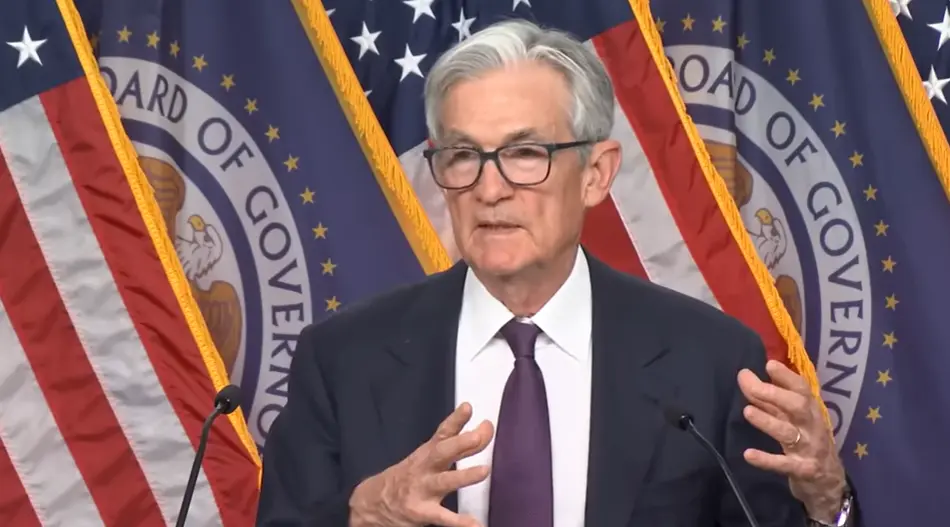
(Kitco News) – After the Federal Reserve delivered the 25-basis-point rate cut the markets were widely anticipating, Fed Chair Jerome Powell signaled that in his view, the central bank had achieved a neutral rate, and though a hike was nobody’s base case, further cuts would need to be justified by new data.
Powell was asked at the outset whether the addition of 'considering the extent and timing of additional adjustments' in the statement meant that the Fed was now on hold.
“Yes, the adjustments in September bring our policy within a broad range of estimates of neutral,” he replied. “The new language points out [that] we will carefully evaluate the incoming data. Also, I would note, having reduced our policy rate by 75 basis points since September, and 175 basis points since last September, the Fed funds rate is now within a broad range of estimates of its neutral value and well positioned to wait to see how the economy evolves.”
On the updated Summary of Economic Projections (SEP) showing higher growth in 2026 than the current 1.7% estimate for 2025, Powell said the end of the Federal government shutdown was a big reason. “You can take 0.2% and put it into next year, so it could be 1.9% and 2.1%,” he said. “Fiscal policy will be supportive and AI spending will continue, [and] the consumer continues to spend, so it looks like the baseline would be solid growth next year.”
Asked about the growing division within the FOMC – with 25% of voters dissenting from the decision to cut 20 basis points – Powell explained that the Fed is in an unusual position.
“The situation is that our two goals are a bit in tension,” he said. “Everyone around the table at the FOMC agrees that inflation is too high, and that we want it to come down. And [everyone] agrees that the labor market has softened, and that there is further risk.”
“The difference is, how do you weight those risks, and what is your forecast looking like, and ultimately, where do you think the bigger risk is?” Powell said. “It is very unusual to have tension between the two parts of the mandate, and when you do, this is what you expect to see, and we do see it.
“We came to a decision today, 9 out of 12 supported it, so fairly broad support,” he added. “But it is not like the normal situation where everyone agrees on the direction and what to do. It is more spread out.”
The Fed chair was also asked whether it is a foregone conclusion that the next rate move will be lower, or if policy risks are genuinely two-sided going forward.
“I don't think that a rate hike is anybody's base case at this point,” Powell replied. “I am not hearing that. What you see is some people feel we should stop here, that we are at the right place, and just wait, [and] some people feel we should cut once or more this year and next year. But when people are writing down their estimates of policy and where it should go, it is either holding here, or cutting a little, or cutting more than a little. So I don't see the base case as involving [a rate hike].”
Powell was pressed on why the majority of the Fed voted to cut in December when his October comments seemed to imply they were willing to wait until January.
“In October, I said that there was no certainty of moving, and that was indeed correct,” he said. “But I was careful to say, other people could look at it differently.”
The Fed chair said there were two reasons why they cut rates today. “First of all, gradual cooling in the labor market has continued,” he said. Unemployment is now up 0.3% from June through September. Payroll jobs [have been] averaging 40,000 per month since April. We think there is an overstatement in these numbers by 60,000, so that would be negative 20,000 per month.”
The second reason is moderating inflation – though only in services. “In terms of inflation, it has come in a touch lower,” he said. “I think the evidence is growing that what is happening here is, services inflation is coming down, and that is offset by increases in goods, and that goods inflation is entirely in sectors where there are tariffs.”
In a follow-up question, Powell expanded on how the Fed calculated the impact and duration of tariff-driven inflation.
“f there are no new tariff announcements – and we don't know that, but let's assume there are no new tariff announcements – inflation from goods should peak in the first quarter or so,” he said. “From here, it shouldn't be big. It could be a couple tenths [of a percentage point] or even less than that.”
“After that, if there are no new tariffs being announced, it will take nine months to get fully in – nine months is also an estimate – and then you should see that coming down in the back half of next year.”
Asked about the persistent weakness of the housing market – with the median age of first-time home buyers reaching 40, the highest on record – Powell had no encouraging words to share.
“The housing market faces some really significant challenges, and I don't know that a 25-basis point decline in the Federal Funds rate will make much of a difference for people,” he said. “Housing supply is low. Many people have very, very low-rate mortgages from the pandemic period, and they kept refinancing and caught the really low [rates], so it is maybe expensive for them to move. We are a ways away from that changing.”
“Also, we haven't built enough housing in the country for a long time, so a lot of estimates suggest that we just need more housing of different kinds,” he added. “Housing will be a problem. We can raise and lower interest rates, but we really don't have the tools to address a secular housing shortage, a structural housing shortage.”
With speculation of who Trump will appoint to replace him as Fed chair in the spring of 2026 heating up, Powell was also asked what he would like his legacy to be.
“I really want to turn this job over to whoever replaces me with the economy in really good shape,” he answered. “That’s what I want to do. I want inflation to be under control, coming back down to 2%, and I want the labor market to be strong. That is what I want.”
“I don't have time to think about bigger things,” he added. “I hope I have many years ahead to worry about that, but there is enough to do.
Powell also declined once again to say whether or not he intends to remain on the Fed Board of Governors after his term as chair expires.
“Again, I am focused on my remaining time as chair,” he said. “I haven't got anything new to tell you.”
Gold gained sharply during Powell's press conference, with the yellow metal rising from a low of $4,185 just after he concluded his prepared remarks to a high of $4,238 per ounce by 3:15 pm EST.
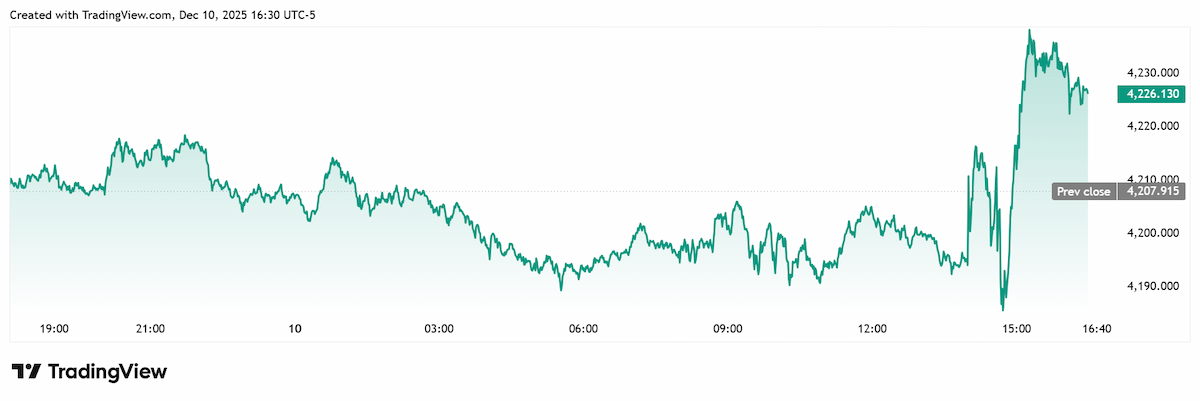 Spot gold last traded at $4,226.13 per ounce for a gain of 0.43% on the daily chart.