
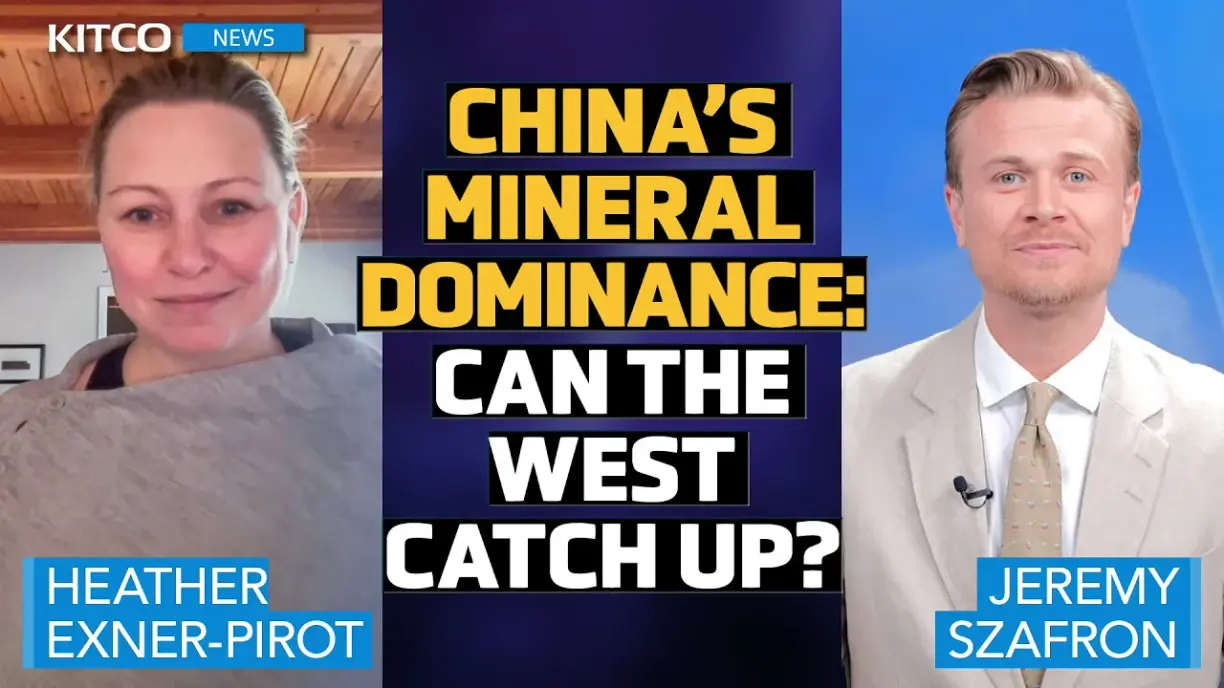
(Kitco News) - China's grip on the rare earth minerals market has profound implications for global resource management and geopolitics. These elements, crucial for high-tech applications like smartphones, defense systems, and renewable energy technologies, are controlled largely by China, which accounts for 70% of global rare earth ore extraction and 90% of processing. This dominance allows China to influence markets and geopolitical dynamics significantly.
Rare earth elements (REEs), though their market is valued at under $10 billion annually, are vital for modern technologies. They are used in electric vehicles, wind turbines, military applications, and consumer electronics. China’s manipulation of supply and prices maintains its competitive edge, as seen in 2010 when export limits caused global prices to spike. Although prices stabilized as other countries increased production, China's influence remains strong.
Heather Exner-Pirot, Director of Energy, Natural Resources, and the Environment at the Macdonald-Laurier Institute, explained in a recent interview with Jeremy Szafron, Anchor at Kitco News, "China has had a particular monopoly on rare earths and has used its monopoly as leverage in the past with export controls. These things are used in our smartphones, defense systems, and jet engines, making them very important, even though it's a small market. The Chinese, in my opinion, had a very explicit manipulation of the market strategy to undermine Western miners, making the rare earth commodity unviable. Vital Metals was about to go bankrupt before the Canadian government intervened".
The Vital Metals Deal and Canada's Strategic Response
In 2024, Canada blocked a deal where Australia's Vital Metals planned to sell rare earth stockpiles to China’s Shenghe Resources Holding Co. Instead, the Saskatchewan Research Council (SRC) purchased the materials for C$3 million, a 25% better offer than the Chinese deal. This strategic move aims to secure Canada's supply chains and reduce reliance on Chinese-controlled resources.
Despite these efforts, Canada’s mineral sector faces significant challenges. Exner-Pirot notes, "We're at least 10 years, probably 20 years behind China on processing critical minerals. They've been very strategic with their investments, and without Chinese buyers, Canadian junior miners struggle to find alternative funding and partnerships. This decision by Canada is crucial, but it underscores just how far behind we are and the need for a robust strategy to catch up".
Regulatory Challenges and the Need for Reform
The regulatory environment in Canada poses significant barriers to mining sector growth. "The regulatory environment in Canada has not improved. The average time from discovery to production is 18 years, which is a significant barrier. We need more proactive measures to make it easier and more profitable to get Canadian production out the door," Exner-Pirot emphasized.
Exner-Pirot advocates for strategic alliances among Western nations to counterbalance China's dominance. "As a Western alliance, IEA countries, OECD countries, we should be talking to each other about how we can protect our critical mineral supplies, just as we did with oil against OPEC," she suggests. This cooperation is crucial for developing a robust and independent supply chain for critical minerals.
China’s dominance is due to decades of state investment, export controls, cheap labor, and low environmental standards. "China has a supply chain that the rest of the world doesn’t, some decades of learning by doing, and so on. It’s entirely possible to catch up, but it will take effort," a report by the Oxford Institute for Energy Studies notes. This manipulation has allowed China to maintain control over rare earth extraction and processing.
For more detailed insights and Heather Exner-Pirot’s full analysis, watch the full interview above on Kitco News.
The Macdonald-Laurier Institute, where Exner-Pirot serves as a Director, is a leading Canadian think tank focusing on public policy issues that affect Canadians, with an emphasis on economic and environmental strategies.