
(Kitco News) - Gold's recent price movements are often attributed to central bank purchases, but there's a broader demand spectrum significantly influencing the market. As of June 27, 2024, gold is priced at approximately $2,335 per ounce, reflecting a 21.6% increase from the previous year.
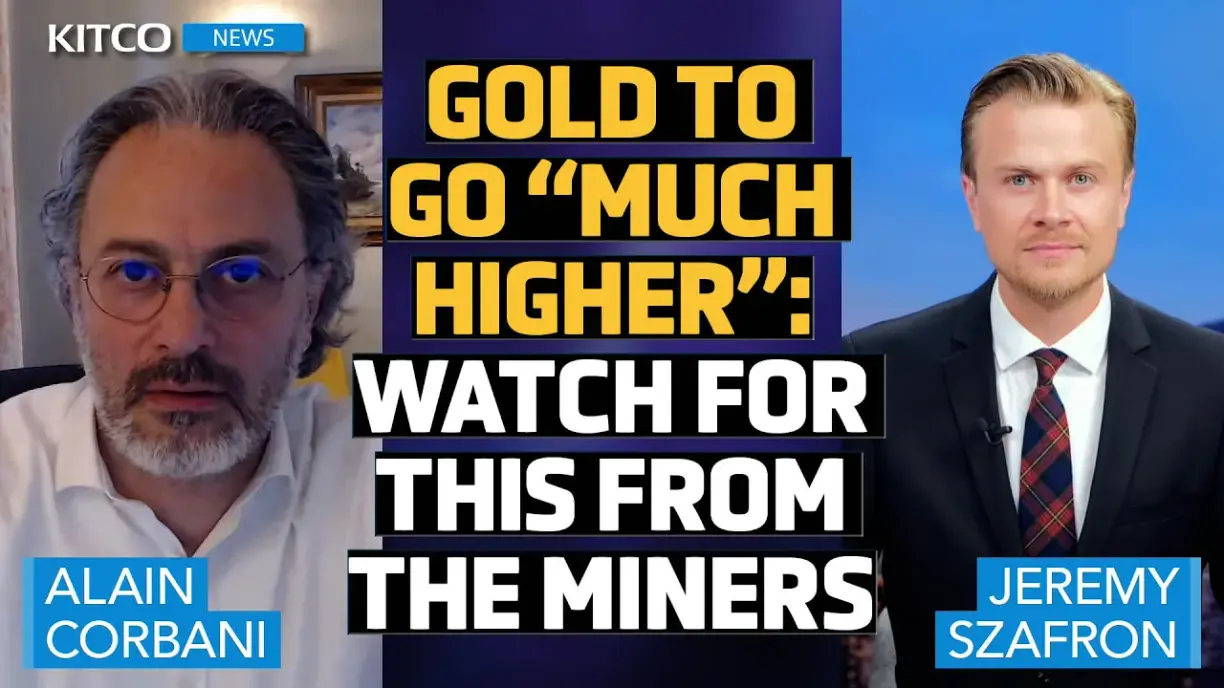
Alain Corbani, Head of Mining and Fund Manager at Montbleu Finance, sheds light on the various contributors to this demand in a recent interview with Jeremy Szafron, Anchor at Kitco News: "If you look at the components of demand for physical gold, you realize that a lot of people talk about central banks buying gold and this is often seen as the main reason behind the surge in the price of gold. The reality is that it's not only central banks. Retail is buying gold coins. American retail is buying silver. The Chinese retail is buying a lot of gold. So, it's really a basket of different players."
China's influence in the gold market has been particularly notable. The People's Bank of China (PBoC) has been on a buying spree, adding 225 tonnes of gold to its reserves in 2023 alone. This marked the largest annual increase by the PBoC outside of multi-year totals seen in 2009 and 2015. In addition to central bank activity, Chinese households have significantly increased their gold purchases. In 2023, Chinese retail demand for gold, including coins, bars, and jewelry, grew by 10.1%, reaching over 1,006 tonnes. This surge is attributed to the poor performance of other investment options, such as real estate and equities in China, pushing more investors towards gold as a safe haven.
Institutional Investors and Market Dynamics
Western institutional investors have yet to fully engage with the gold market, which could be a significant driver for future price increases. "The institutions haven't participated yet. I should be more precise by saying that the Western investors, institutional investors haven't really jumped into the wagon yet. And a lot of people who are bullish on the price of gold are waiting for these players to get involved, to move the price of gold higher. I don't think we need them for the price of gold to go higher, but that will definitely be a supplemental demand component that would help an increase in the price of gold," Corbani notes. This hesitance is often linked to expectations of Federal Reserve rate cuts, which historically boost gold prices once they occur.
In 2024, Western gold ETFs have seen significant outflows, with North American funds losing $4.3 billion year-to-date, primarily driven by heavy outflows in the first quarter. European gold ETFs also experienced substantial outflows, totaling $6.3 billion. Despite this, Asian funds have consistently seen inflows, capturing $2.6 billion so far in 2024, driven by strong demand in China and Japan.
Corbani is optimistic about gold's future, predicting substantial price increases as economic conditions evolve. "Gold can go much higher, and $3,000 is far from being far-fetched. If you ask me today, can gold hit $3,000? The answer is yes, absolutely. Because again, just look at the statistics I gave you earlier. Each time the Fed pauses, then we reverse into lower rates. Gold goes up by 50%. So, just run the numbers. $2,000, 50% of $2,000, you get your $3,000. That's more or less a ballpark figure. But the investors won't blame me for being $100 short or long," he asserts. This projection is supported by historical trends where gold prices surged following Federal Reserve rate pauses.
For more insights from Alain Corbani on gold's market dynamics and his forecast, watch the full interview on Kitco News above.