

(Kitco News) – With 100 tons in gold purchases in 2024, the central bank of Poland has become the number one sovereign buyer of the yellow metal. But the country is not alone, as the Russia-Ukraine war has forced the Czechs, Serbs, and Hungarians to also bolster their reserves.
While the focus for much of the year was on China’s massive central bank gold purchases – and then on their move to the sidelines as prices hit record highs – the nations of Eastern Europe have quietly emerged as the biggest buyers of the precious metal, and the biggest back stoppers of the gold rally.
“We need to reduce volatility,” Czech Republic central bank head Ales Michl told Bloomberg earlier this month following a visit to the country’s London gold stockpile. “And for that, we need an asset with zero correlation to stocks, and that asset is gold.”
Michl’s stated mission is to double the country’s 100-metric-ton gold reserve over the next three years. He has already increased the Czech Republic’s gold holdings five times over since taking office in 2022.
“Central banks around the world are stocking their gold arsenals as a shield against external shocks such as prospective trade wars brought on by Donald Trump’s second presidency and geopolitical tensions in Ukraine and the Middle East,” the Bloomberg report stated. “But eastern European monetary guardians have made a particular show of topping up their gold piles.”
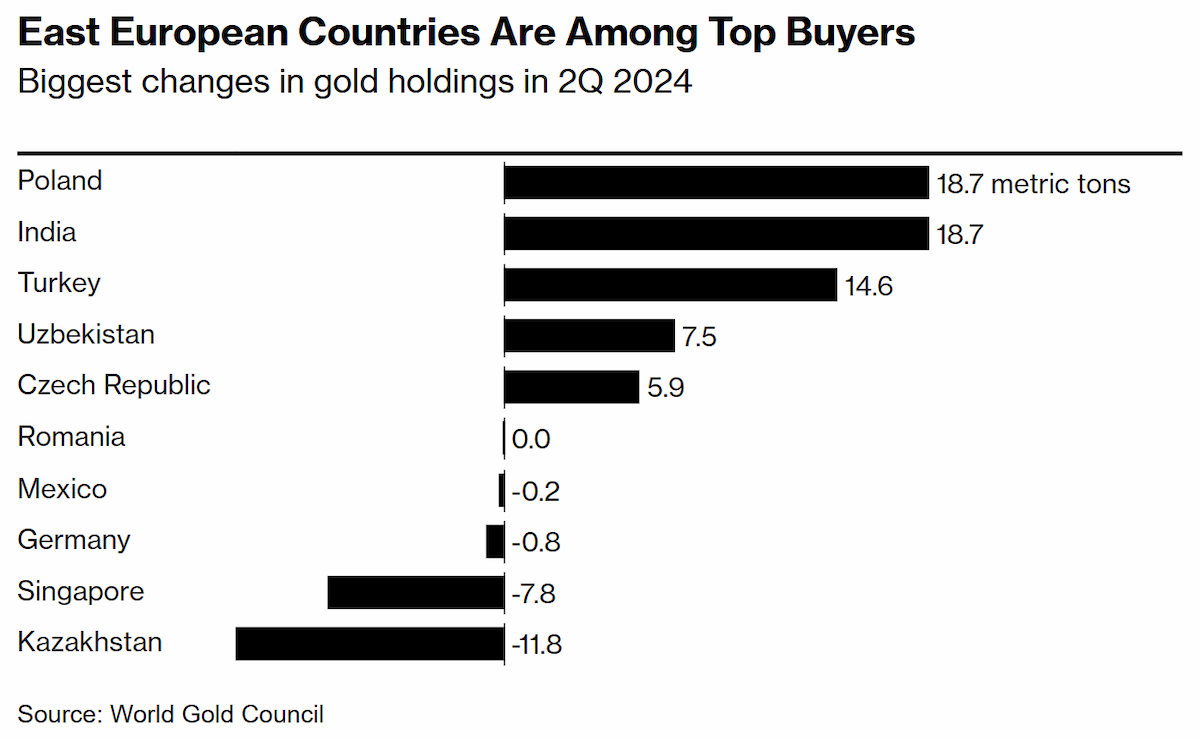
Poland was the largest buyer of gold among all central banks in the second quarter. The country shares a border with Ukraine, is a member of NATO, and is a staunch supporter of Kyiv against the Russian invasion.
Adam Glapinski, Poland’s central bank governor, has stated that gold and hard currency reserves are a crucial protection for the country’s economy. Under his direction, Poland has increased its bullion holdings to approximately 420 tons as of the end of September, equaling about half the total reserves of India or Japan.
“We are entering the exclusive club of the world’s biggest gold owners,” Glapinski said during a news conference in October, reiterating the goal to increase gold’s share of total reserves to 20%.
The Czechs are also ramping up their gold purchases. “The central bank in Prague boasts about $150 billion in foreign reserves — nearly half of gross domestic product — one of the world’s biggest by proportion,” the report noted.
The Hungarian central bank increased its gold holdings by more than 10% to 110 metric tons in 2024.
Meanwhile, Serbian President Aleksandar Vucic had the country’s foreign-held bullion stockpile repatriated in 2021. This year, he promised to buy bullion with “every surplus of money” that’s left in state coffers “to be safe and secure in hard times.”
Serbia’s central bank governor, Jorgovanka Tabakovic, has also overseen a tripling of the country’s gold reserves to 48 tons since taking office in 2012.
“Gold is gaining value and importance in times of global turbulences, especially in geopolitical conflicts and periods of high inflation,” Tabakovic said. “Unfortunately, in recent years, we’ve seen both factors at play.”
