
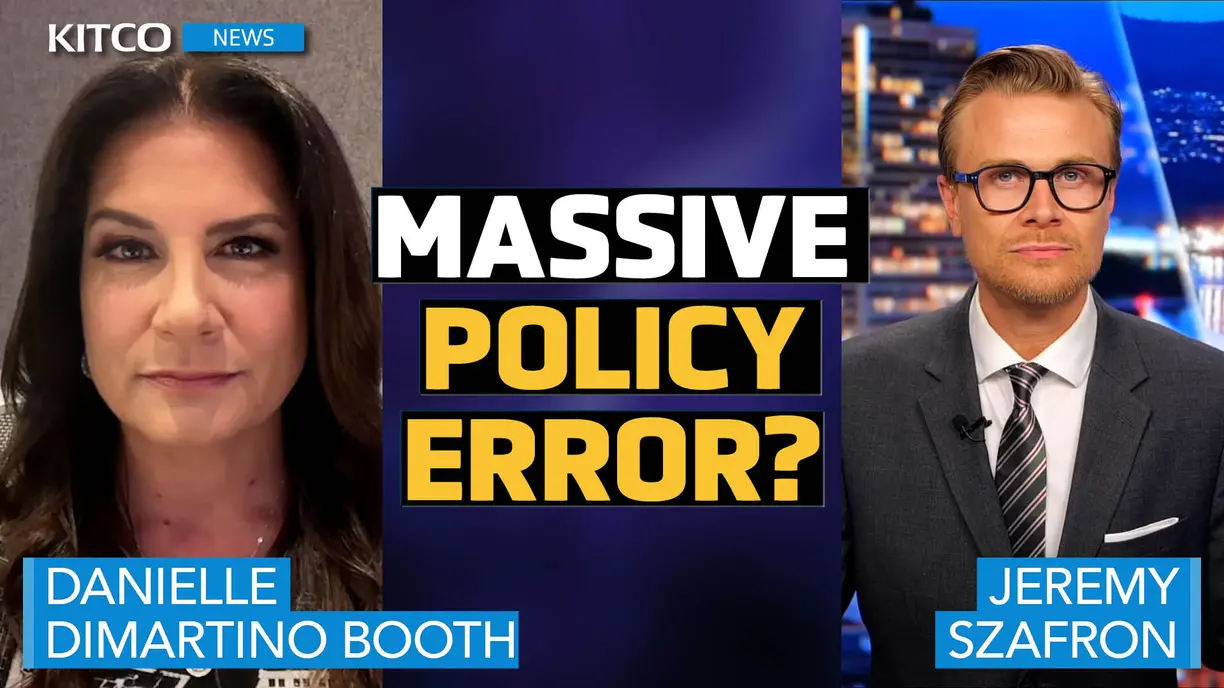
(Kitco News) - The Federal Reserve is underestimating mounting economic risks and may be setting up for a major policy misstep by keeping rates too high for too long, according to Danielle DiMartino Booth, CEO and Chief Strategist at QI Research and former Fed insider.
Speaking with Kitco News after the Fed held its benchmark interest rate steady between 4.25% and 4.50%, DiMartino Booth said the U.S. central bank is ignoring clear warning signs of recession, including rising unemployment, surging bankruptcies, and weakening consumer conditions.
“We could indeed see the Fed moving as soon as June,” DiMartino Booth said, adding that despite Chair Jerome Powell’s cautious stance, “we are going to see much more upside in the unemployment rate before we start to see any kind of an impact of the tariffs on inflation.”
Markets are currently pricing in three rate cuts for 2025. While Powell signaled patience and uncertainty regarding the Fed’s dual mandate, DiMartino Booth said data from the Fed’s own Beige Book and other internal research suggest the economy is already deteriorating.
“The economy is actually in worse shape than before last September’s meeting, when the Fed had to push through with a 50 basis point rate cut because it had failed to do so at the July meeting. I see a similar setup now,” she said. “We’re continuing to see companies reporting layoffs that are not abating, as well as a fast-quickening bankruptcy cycle.”
According to DiMartino Booth, in April alone, we saw seven large bankruptcies, including multi-billion-dollar filings and a freight company with up to 10,000 creditors. “These are not subtle signposts,” she said. “These are definitive signs that the Fed should be lowering rates right now.”
She also noted that small business closures and household bankruptcies have picked up, with household filings up 16% year-over-year in April.
Asked whether Powell’s admission that the Fed’s rate cuts in late 2024 “may have come a little too late” was significant, DiMartino Booth said the damage will be clearer in hindsight. “I would be shocked if we were to get to the September meeting without the unemployment rate being well above where the Fed’s current dot plot foresees,” she said.
On the global front, DiMartino Booth weighed in on China’s recent broad monetary easing package. “Global trade is going to contract for the full year of 2025,” she said. “This will slow down China’s economy, and its policymakers are right to be easing right now.”
She concluded by criticizing the Fed for ignoring its own internal survey data and credit market stress indicators. “The Fed’s biggest blind spot right now is not paying heed to its own internal research,” she said, pointing to data showing Americans increasingly paying only the minimum on credit cards and recession-level language in the Beige Book.
Could the next financial crisis start in regional banks or corporate credit? Watch the full interview above for more insights from DiMartino Booth.
