
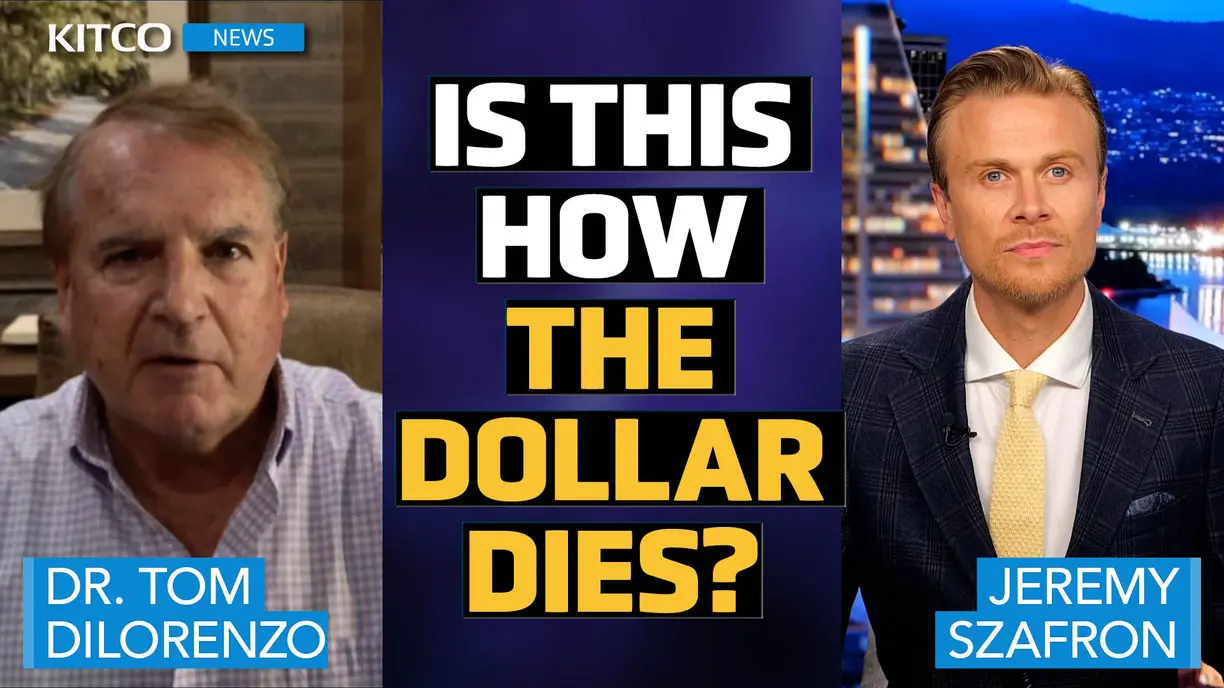
(Kitco News) - As U.S. debt surpasses $35.9 trillion and long-term Treasury yields breach 5.1 percent for the first time since 2007, critics of the Federal Reserve are renewing calls for monetary reform. In an interview with Kitco News, Thomas DiLorenzo, president of the Mises Institute, called the Fed “legalized counterfeiting” and warned that America's fiscal and monetary trajectory is “anti-constitutional” and dangerous.
“The Federal Reserve is legalized counterfeiting. If you and I did what the Fed does, we’d go to jail,” said DiLorenzo. “The entire system is based on monetary debasement. That’s what central banking is - it’s legalized fraud.”
According to data from the Treasury Department, the U.S. is now adding roughly $1 trillion to the national debt every 100 days, driven by rising entitlement costs, defense spending, and interest payments. Net interest on the debt is projected to exceed $1.1 trillion this year, outpacing defense and Medicare spending. Meanwhile, the Congressional Budget Office estimates the federal deficit will top $2.5 trillion in 2025.
“This week’s tax and spending bill, backed by President Trump, is projected to add nearly $4 trillion to the deficit. That’s not just fiscal irresponsibility. That’s monetary fraud made possible by the Fed,” DiLorenzo said.
‘Endless War, Inflation, and Surveillance’
According to DiLorenzo, the Federal Reserve enables Washington’s expansionist agenda by monetizing debt and masking the real cost of government. “Nobody got a tax bill for $100 billion to Ukraine, but you’re paying it in the supermarket,” he said. “They don’t tax you for it. They inflate the currency.”
He tied the central bank’s powers to broader structural issues. “The Fed makes it possible to have endless wars, welfare expansion, unconstitutional surveillance,” he said. “It’s monetary socialism.”
He also emphasized the historical turning point in 1971, when President Richard Nixon severed the last link between the dollar and gold. “Since 1971, it’s been pure fiat money, no limits on money creation,” said DiLorenzo. “It’s no coincidence that the 1970s were a wreck of stagflation.”
The Fed’s ‘War on Retirement’
DiLorenzo criticized the Fed’s post-2008 zero-interest rate policy and quantitative easing as deeply harmful to savers. “The war on retirement is real. For 20 years, savers got zero percent,” he said. “So what did they do? They piled into risky assets, and now inflation is stealing their purchasing power. It’s not just bad economics — it’s immoral.”
The Fed held rates near zero for most of the 2010s and resumed large-scale asset purchases during the COVID-19 pandemic. Since 2022, rates have risen sharply in response to inflation, pushing borrowing costs higher across the economy. As of May 2025, 30-year mortgage rates hover near 7.8 percent and credit card APRs exceed 22 percent on average, according to Bankrate.
Collapse Risk and the Case for Gold
“Collapse is absolutely a risk,” DiLorenzo said. “If China or any large creditor nation starts dumping U.S. debt, it would trigger a crisis that makes 2008 look mild.”
He cited rising gold prices, now trading around $3,300 per ounce, as a signal of systemic stress. “Even central banks don’t trust their own currencies anymore,” he said. “That’s why they’re buying gold. When gold moves like this, it tells you inflation is coming.”
Reintroducing Sound Money
DiLorenzo believes that reform must begin by ending the government monopoly on money. “We need monetary competition. Let the market decide,” he said. “Whether it’s gold, silver, Bitcoin, or something else — it should be outside government hands.”
He noted that momentum is growing at the state level. “More states are nullifying federal overreach and introducing tender laws for gold and crypto,” DiLorenzo said. “That’s how real reform starts — at the state level, not Washington.”
Reaching the Next Generation
DiLorenzo said the Mises Institute is seeing an upsurge in interest among younger Americans. “We’ve given away over 100,000 copies of What Has Government Done to Our Money? and now we’re giving away a new book on Hayek,” he said. “We’re seeing Bitcoin investors, students at top universities, and liberty-minded young people turning to Austrian economics.”
According to DiLorenzo, this new movement is as much moral as economic. “Inflation is a tax, and it’s regressive,” he said. “Price inflation is theft. It’s disguised and dishonest. Sound money is a moral imperative.”
Bitcoin: Volatile Now, But Not Forever
Asked whether Bitcoin could play a role in a post-Fed system, DiLorenzo was cautiously optimistic. “Gold didn’t become trusted overnight either,” he said. “Bitcoin is unstable now, but that doesn’t mean it always will be. What matters is that it’s outside the hands of government.”
‘End the Fed’ Is Not Radical, He Says
“We’ve abolished three central banks before,” said DiLorenzo. “It’s not radical. It’s constitutional. The only thing holding us back is political will.”
Watch the full interview with Thomas DiLorenzo on Kitco News, where he lays out the historical roots of central banking, gold’s role as honest money, and why he believes America must restore monetary freedom to avoid collapse.