
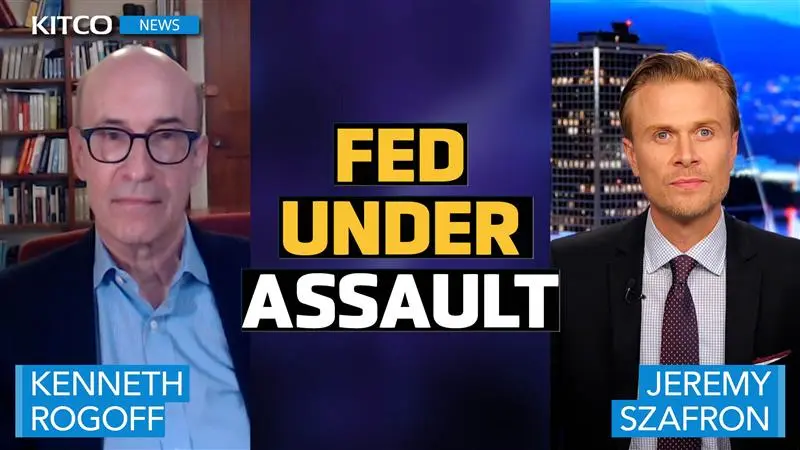
(Kitco News) - The Federal Reserve cut its benchmark interest rate by a quarter-percentage point on Wednesday for the first time in nine months, a move intended to shore up a weakening economy that one of the world's leading economists warns is a step down a dangerous path toward inevitable inflation driven by political pressure.
The Fed's decision comes after recent data showed slowing job growth and was preceded by months of public demands from President Donald Trump for a "big cut". In an extensive interview with Kitco News on Tuesday, Harvard professor and former IMF Chief Economist Kenneth Rogoff argued that such pressure represents a fundamental threat to the central bank's credibility, regardless of who is in the White House.
"Certainly the Federal Reserve's under assault," Rogoff said. "I think it would've been even if the Democrats had won". He described the current political dynamic as a "deeper structural problem" rooted in the nation's spiraling debt, which is growing by $1 trillion every 100 days.
This pressure, he argued, will ultimately force the Fed to accommodate government spending. "I promise you that will lead to higher inflation on average over 10 or 20 years than we would have otherwise," Rogoff warned.
Dollar to Become "King of a Smaller Hill"
The domestic political drama unfolds against a backdrop of increasing international skepticism of the U.S. dollar, a theme central to Rogoff's new book, "Our Dollar, Your Problem". He predicts a significant decline in the dollar's global dominance, fueled by what he calls American "unforced errors".
"The dollar may be king, but king of a smaller hill," Rogoff stated. He projects the dollar's share of global reserves, currently just under 60%, could plummet over the next decade to "a number like 35 or 40%".
This shift is being accelerated by the aggressive use of financial sanctions, which incentivizes other nations to seek alternatives. "If you trade in dollars, the US controls much too much information. That's just unacceptable for them," Rogoff said in reference to China. "They know that someday they may want to acquire Taiwan... and when that happens, of course, we're gonna put on financial sanctions and they don't want to be as vulnerable as they are now".
In response, global central banks have purchased over 2,000 tons of gold in the last two years, the largest such buying spree in modern history. Rogoff sees this trend continuing as countries seek assets they can physically control.
"The Chinese Crisis is Here"
While the dollar faces these long-term headwinds, Rogoff offered a dire assessment of its primary rival, declaring that China's long-feared economic crisis has already begun.
"Oh goodness. The Chinese crisis is here," he said bluntly. "China's in a crisis. They're looking like Japan and they'll be lucky if they get out with half Japan, and half Japan is still terrible".
The simultaneous struggles of the world's two largest economies paint a picture of profound global instability. While markets may cheer today's rate cut, Rogoff's analysis suggests it could be a Pyrrhic victory, solving a short-term problem while validating long-term fears about the Fed's independence.
Asked about the ultimate safe haven in this new era, Rogoff was unequivocal. "I know everybody says Bitcoin's the new gold," he concluded. "I like to say gold is the new gold".
For Professor Rogoff's complete, in-depth analysis - watch the full, unfiltered interview with Kitco News' Jeremy Szafron here.