
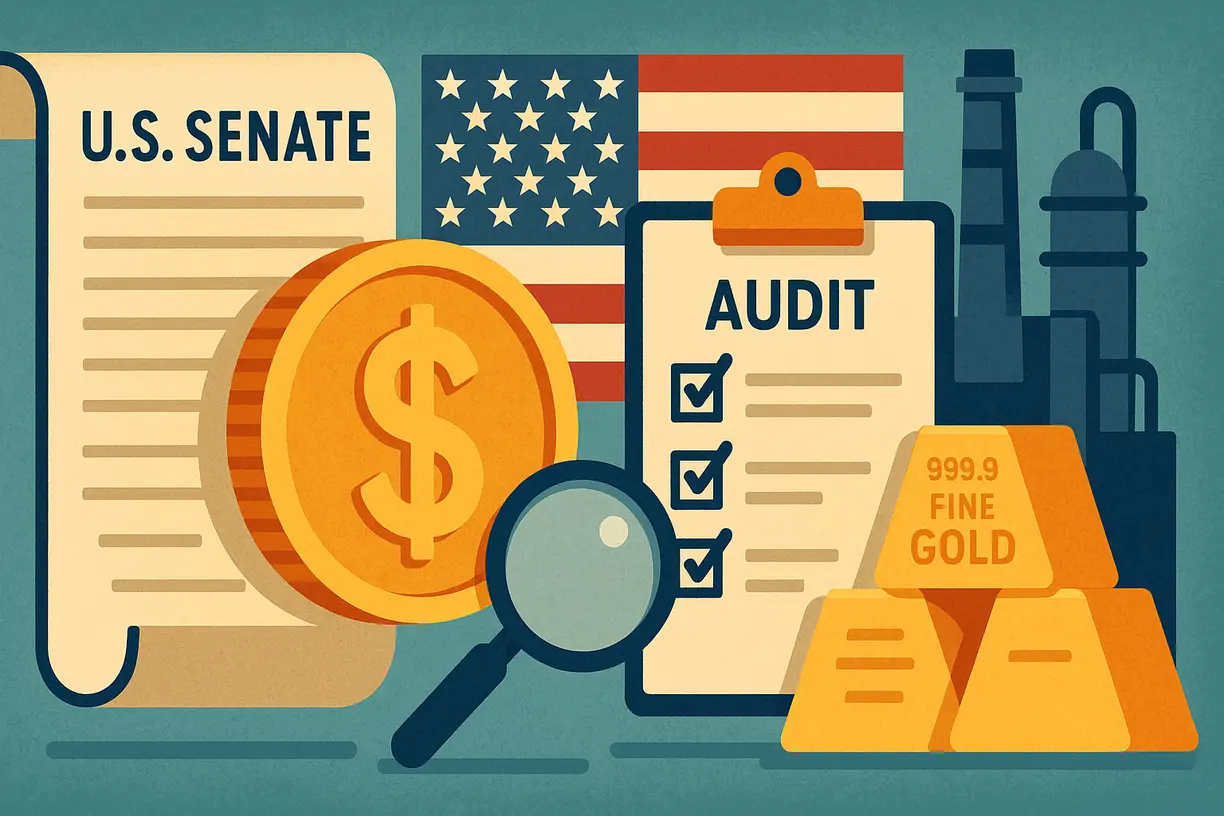
(Kitco News) – U.S. Senator Mike Lee (R-Utah) introduced a bill on Wednesday which, if passed, will trigger the first comprehensive audit of America’s gold reserves in decades.
The senate version of the Gold Reserve Transparency Act demands a full inventory, audit, and accounting of all transactions involving U.S. federal government gold. It also calls for a new process for refinement of the gold so that it meets global market standards – as the majority of U.S. gold currently does not.
Representatives Thomas Massie, Warren Davidson, Addison McDowell, and Troy Nehls also recently introduced a similar bill in the House.
The Act will also require full disclosure of all transactions involving America’s gold reserves, including any purchases, sales, loans, pledges, leases, swaps, and other encumbrances, dating back 50 years – a degree of public accounting that has never been undertaken to date.
"For over half a century, there has not been a comprehensive audit of America’s gold reserves,” Senator Lee said. “Americans should know whether their literal national treasure is safe and accurately accounted for. That means passing the Gold Reserve Transparency Act, opening Fort Knox, U.S. Mint Facilities, and the Federal Reserve Bank of New York to an audit, and then making the results public.”
Lee’s press release listed a number of individuals and groups supporting the measure, including Money Metals Exchange, the Sound Money Defense League, former Federal Reserve board nominee and Independent Institute Senior Fellow Judy Shelton, the Club for Growth, and the Gold Anti-Trust Action Committee.
Stefan Gleason, CEO of Money Metals Depository, said in a statement that the measures are long overdue.
“The U.S. Government's poor stewardship of America's gold reserves wouldn't pass muster in the private sector and has undermined confidence,” he said. ““Even if a credible audit, inventory, assay, and accounting had been conducted decades ago, proper auditing is an ongoing process; it’s never ‘one and done' affair.”
Former Congressman Ron Paul has long campaigned for greater transparency and oversight of the country’s gold reserves. “The Federal Reserve and Treasury should not be permitted to operate in secrecy, especially when it comes to the most important monetary asset on the planet, i.e. gold,” he said. “Restoring trust as to America's gold holdings is more important than ever when foreign central banks are scrambling to stockpile gold at incredible rates.”
Jp Cortez, executive director of the Sound Money Defense League (SMDL), said he advocates a thorough and complete accounting of U.S. bullion stockpiles.
“As gold is the ultimate form of money recognized the world over, safeguarding the U.S. Treasury Department’s holdings of the only money mentioned in the U.S. Constitution is very much a national security issue,” he said. “Only a thorough audit, not a public-relations stunt such as the ‘live walkthrough’ as Elon Musk and others proposed, will suffice. This situation requires far more than a fun one-day field trip by politicians to Fort Knox, West Point, and other U.S. Treasury vaults.”
To fulfill their obligations under the Gold Reserve Transparency Act, the Government Accountability Office and external independent auditors would gain access to any depository or other public or private depositories where gold reserves are kept, along with any related records. According to the bill, the process would take up to a year to complete, and it calls for the audit to be repeated every five years.
The Gold Reserve Transparency Act also proposes a process and timeline for refining America’s gold so that it meets ‘good delivery’ standards required by the global marketplace.
“While we do not desire for the U.S. to divest of any portion of its gold position, it’s vital America’s gold be fully liquid and universally accepted given the asset’s strategic importance,” Cortez said.
According to the SMDL, the majority of U.S. gold reserves are held in the form of impure ‘coin melt’ bars of roughly 90% pure gold created following President Franklin Roosevelt’s 1933 executive order making gold ownership illegal and requiring citizens to turn over their gold coins for paper notes at the $20 per ounce exchange rate – immediately before devaluing the dollar and resetting the gold exchange rate to $35 per ounce.
