
(Kitco News) As markets head into 2026, investors are facing a growing contradiction: Equity markets remain near record highs, yet credit markets are quietly repricing risk.
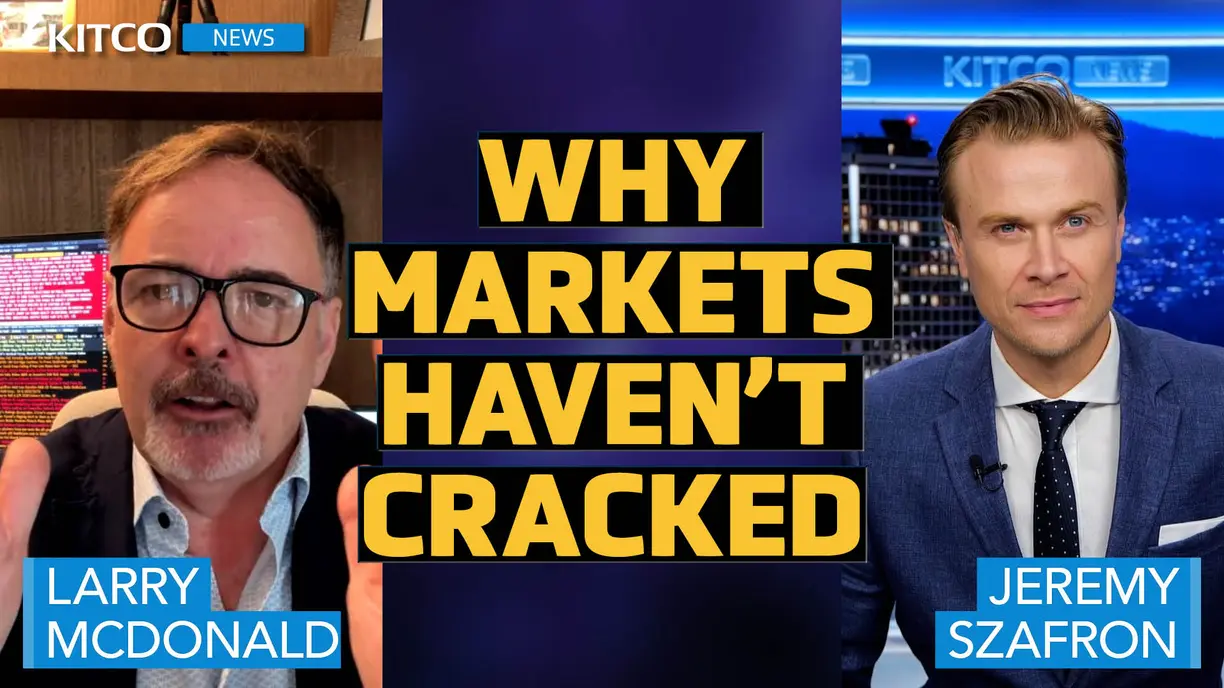
Larry McDonald, founder of The Bear Traps Report and a former Lehman Brothers trader, says that disconnect is becoming increasingly difficult to ignore.
Speaking with Kitco News for Outlook 2026, McDonald said renewed liquidity injections, elevated inflation, and mounting stress in private credit are combining to create the conditions for a significant market rotation next year.
Liquidity Returns as Inflation Remains Elevated
McDonald pointed to the Federal Reserve’s recent liquidity operations as an early signal that financial strain is building beneath the surface. While year-end funding pressures are common, he said the current response stands out given the inflation backdrop. “They’re restarting quantitative easing with Core CPI inflation up near 2.8%,” McDonald said. “The last time they were restarting QE was 2019, and Core CPI was down at 1.6%.”
He argued that this policy stance is colliding with historically large fiscal deficits and aggressive capital spending tied to artificial intelligence. Looking ahead, McDonald believes inflation risks will remain unresolved as fiscal stimulus, monetary accommodation, and AI-driven CapEx overlap.
Private Credit Emerges as a Central Risk
The clearest warning signs, McDonald said, are coming from credit markets, particularly private credit. He warned that many vehicles promised liquidity on inherently illiquid assets, creating a structural vulnerability if redemptions accelerate.“Private credit has offered quarterly liquidity to all these wealth managers,” McDonald said, calling it “the big problem for next year.”
In his view, the risks are no longer theoretical, suggesting that “conditions for a credit accident are forming, and starting to foam at the mouth into 2026.” McDonald pointed to stress already visible in corporate bonds and bankruptcy-related financing, describing it as “the credit crisis that has already started,” adding that, “it’s already breaking.”
Capital Concentration Sets the Stage for Rotation
McDonald said extreme capital concentration in U.S. equities has amplified the potential impact of any shift in sentiment. “There’s $32 trillion in the Nasdaq 100,” he said. “Three years ago today, it was $12.3 trillion. And the energy stocks are down to $2.8 trillion.”
That imbalance, he argued, means even modest reallocations could drive outsized moves in under-owned sectors. As credit risk becomes harder to ignore and liquidity conditions shift, McDonald believes capital could begin rotating toward value-oriented and hard-asset-linked sectors in 2026.

While enthusiasm around AI remains strong, McDonald warned that markets may be underestimating the physical and financial constraints tied to AI expansion. He pointed to permitting challenges, power availability, and infrastructure bottlenecks that are already influencing financing conditions. “The credit markets are already sniffing this out,” he said.
Those constraints could redirect capital away from pure growth narratives and toward the physical inputs required to support AI buildouts. “Artificial intelligence needs a whole new energy infrastructure,” McDonald argued, adding that “natural gas fits right into that.”
Hard Assets, Bitcoin, and Liquidity Sensitivity
McDonald remains constructive on gold and silver over the longer term, but said positioning matters after the strong rallies seen in 2025. He described Bitcoin as highly sensitive to liquidity conditions rather than a traditional hedge, warning that sharp drawdowns remain a defining feature of the asset. He expects volatility across both digital assets and commodities as policy and credit dynamics evolve in 2026.
Risks and the 2026 Outlook
Looking ahead, McDonald said the key risk is a systemic credit event that forces correlations across asset classes to converge. “If there’s a credit shock that’s anywhere near like a Lehman situation, correlation starts to drive to one,” he said.
He added that such an outcome would likely prompt aggressive policy intervention. “The Fed will have to cut rates, do QE, get a weaker dollar, and the commodity space will come out of it just like COVID,” he said.
McDonald forecasts that 2026 is shaping up as a year where balance sheet strength, liquidity awareness, and exposure to under-owned sectors may matter more than staying anchored to crowded growth trades.
Watch the full interview with Larry McDonald on Kitco News for his complete breakdown of credit market stress, Fed liquidity signals, private credit risks, and what the shift toward hard assets could mean for investors in 2026.
Sponsored by Discovery Silver Corp. Visit https://discoverysilver.com/ to learn more about the company, its latest news, and investor materials.
Sponsored by Discovery Silver Corp. - Learn more about the company, its latest news, and investor materials.
Visit https://discoverysilver.com/
