
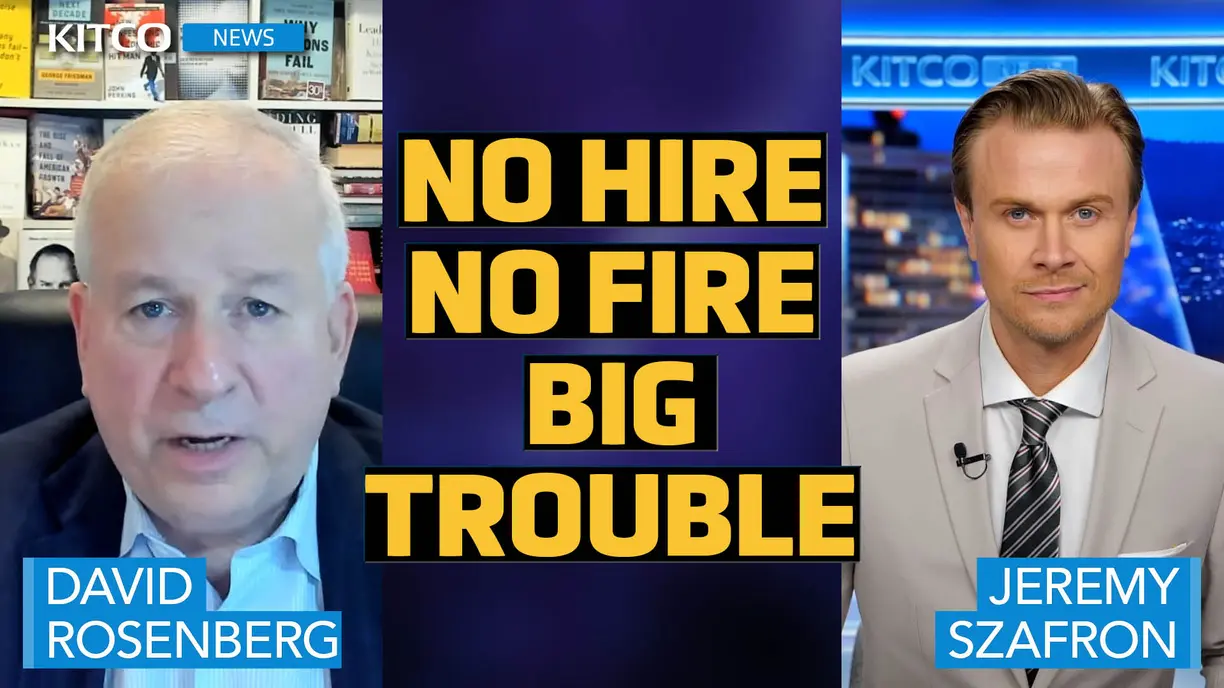
(Kitco News) As investors look ahead to 2026, markets are largely pricing continuity, with equity valuations assuming earnings growth remains intact, credit markets expecting refinancing to stay orderly, and policymakers continuing to project stability. David Rosenberg says that confidence rests on a narrow foundation.
Speaking with Kitco News, the founder and president of Rosenberg Research said that when labor trends, income growth, credit conditions, and capital flows are examined together, the U.S. economy is already weakening beneath the surface. He said the disconnect is being masked primarily by equity-driven wealth effects concentrated among higher-income households. “The only reason why everything looks okay is because of the stock market,” Rosenberg said. “It all comes down to the stock market.”
A Consumer Economy Driven by the Equity Wealth Effect
Rosenberg said the imbalance between income and spending has become central to his outlook. Since April, real personal disposable income after taxes and inflation has been contracting, while real consumer spending has continued to rise. He said that the gap is not being filled by wage growth or productivity gains. “It’s that top 10% of the income echelons that is driving the whole system,” Rosenberg said, adding that those households “spend off the equity wealth effect,” in turn, “keeping the glue together right now.”
Rosenberg warned that the economy has become dependent on equity market performance, and if that support fades, “then there’s no doubt in my mind that we’re going to have a recession next year,” adding that “nothing is priced for it.”
Valuations and Sentiment Leave Little Room for Error
Rosenberg said markets are vulnerable not because earnings are collapsing, but because expectations have become extreme, pointing to valuation measures such as the Shiller CAPE ratio approaching historically rare levels. “That is technically a bubble,” Rosenberg said, noting that “this represents the sixth mega bubble of the past 100 years.”
He said market drawdowns are driven more by valuation resets than earnings declines, and that “80% of the drawdown in the stock market historically is the compression of the PE multiple.”
At elevated multiples, Rosenberg said markets do not require overtly negative news to reprice. “When the news doesn’t fit the narrative, when it’s not good enough, people are going to be in for a very big surprise,” he said.
Labor Market Signals Are Shifting
Rosenberg said labor market conditions are showing strain that may not yet be reflected in headline employment figures, and while layoffs remain limited, hiring has slowed markedly.
He described the current environment as a “no-hire, no-fire economy,” noting that the hiring rate has fallen below pre-pandemic levels. “The hiring rate has gone down to such a low level that even a modicum of layoffs will lead to successive monthly declines in nonfarm payrolls,” Rosenberg said.
He added that small businesses are already under pressure, with employment among smaller firms down for four consecutive months, describing it as a leading indicator.
Credit Markets Are Pricing an Optimistic Outcome
Rosenberg said complacency extends beyond equities into credit markets, particularly private credit and upcoming refinancing schedules. “The markets are telling you they expect the default rate to go from 6% down to 3% next year,” Rosenberg said. “I don’t know what planet anybody is from that thinks that’s going to happen.”
He said both equity and credit markets appear to be pricing out recession risk, noting that “Zero recession is priced in.”

Rising Fixed Costs Pressure Households
Even as inflation measures have cooled, Rosenberg said households continue to face rising non-discretionary expenses, including insurance, utilities, healthcare, and electricity. “These are things that you can’t substitute away from,” Rosenberg said, adding that they “act as a tax on the consumer.”
With unemployment trending higher, Rosenberg said those cost pressures are more likely to weigh on real wages and corporate margins than generate sustained inflation. “You don’t get final inflation out of it,” he said. “You always have to look at the labor market.”
Liquidity Risks Reinforce the Case for Defensive Assets
Rosenberg cautioned against complacency around global liquidity conditions heading into 2026, saying recent policy signals from the Bank of Japan highlight how sensitive markets are to expectations rather than money supply alone. He described liquidity as a function of confidence and trust, warning that when confidence erodes, markets can reprice quickly even without dramatic policy shifts.
Rosenberg said his positioning for 2026 favors defensive assets and areas where expectations remain restrained, with gold remaining central to that view, driven primarily by central bank demand. “This is the great reallocation of global central bank reserves out of greenbacks and into bullion,” Rosenberg said, adding that he does not believe that process is complete.
He also said precious metals equities offer optionality, noting that miners remain conservatively priced relative to spot prices. “Gold stocks are only priced for gold just over $3,000 an ounce,” Rosenberg said.
Investor Positioning Raises Concerns
Rosenberg said extreme investor positioning is another risk heading into 2026, with sentiment stretched across both institutional and retail markets. “Everybody is all in all at the same time,” he said.
He contrasted that positioning with the actions of veteran investors, pointing to Warren Buffett holding roughly $400 billion in cash and JPMorgan CEO Jamie Dimon increasing Treasury exposure. “I think I’m going to put my money behind Jamie Dimon and Warren Buffett,” Rosenberg said.
The Outlook for 2026
Rosenberg said 2026 is shaping up as a year when valuation discipline, liquidity awareness, and downside protection may matter more than momentum-driven returns. “The biggest risk ahead isn’t volatility,” he said. “It’s misreading this cycle and staying positioned for an economy that no longer exists.”
Watch the full interview with David Rosenberg on Kitco News for his complete Outlook 2026 analysis, including labor market trends, valuation risks, credit stress, global liquidity dynamics, and his views on gold and other defensive assets.
Sponsored by Discovery Silver Corp. - Learn more about the company, its latest news, and investor materials.
Visit https://discoverysilver.com/
