
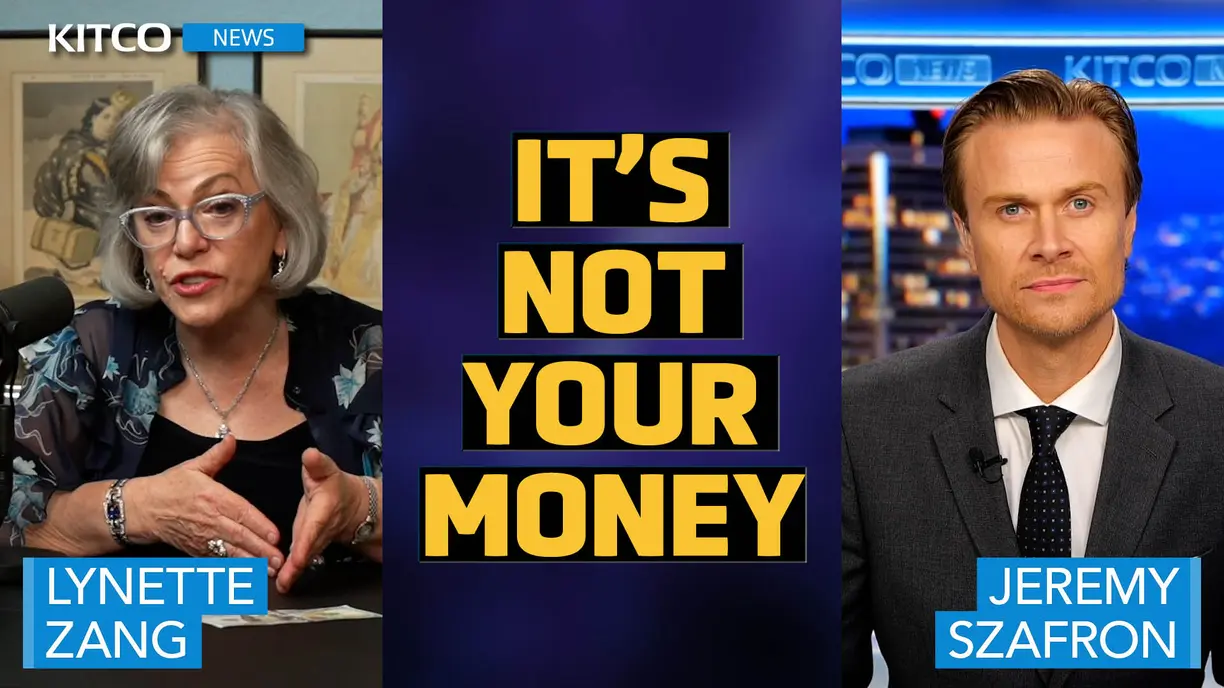
(Kitco News) As 2026 progresses, Lynette Zang says investors should spend less time focusing on short-term moves in gold and silver prices and more time questioning whether confidence in the financial system can be sustained. Rising debt levels, geopolitical escalation, and expanding policy intervention, she argues, are creating conditions where access and ownership may matter as much as valuation.
Speaking with Kitco News, the Founder and CEO of Zang Enterprises, described the current environment as a move away from predictable rules toward what she calls the “rule of might.” In that setting, she said, contracts and price signals can become less reliable as pressure builds across markets and governments.
“The markets are not reflective of what’s happening on Main Street,” Zang said, adding that affordability pressures and currency devaluation are increasingly shaping economic behavior beneath headline data.
Debt expansion and one-sided optimism define the backdrop
Zang said the surge in borrowing across financial markets reflects urgency rather than underlying strength, with issuers seeking liquidity while conditions still allow. “I think it is the money grab while that window is open,” she said.
She argued that expectations for 2026 appear unusually one-sided, with little recognition of downside risk. “There does seem to be an awful lot of optimism,” Zang said. “You don’t even have one Wall Street analyst talking about a negative 2026.”
That optimism, she said, masks deeper stress across the economy. According to Zang, confidence rather than economic resilience is what continues to hold the system together. “The only thing that’s holding this whole thing together is public confidence,” she said, adding that rising unaffordability is the pressure point that eventually forces those strains into view.
Banking system stress and the growing bail-in concern
Zang said vulnerabilities remain embedded in the banking system, driven by bond exposure tied to “15 years of zero interest rate bonds.” “All of those bonds that 15 years of zero interest rate bonds, meaning all the banks are zombie banks, they’re. All underwater,” she said.
She argued that policymakers are constrained by the need to prevent a visible loss of confidence. “They have to avoid a run on the banks,” Zang said, warning that forced selling would quickly expose balance sheet stress. “Everybody will know the emperor has no clothes.”
On bail-ins, Zang said past episodes show how authorities test public tolerance gradually rather than all at once. “They dip a toe,” she said. “Can they get away with it? If they get away with it, then it’s bigger and bigger and bigger until it is so in your face and it doesn’t matter anymore.”
From rule of law to rule of might
Zang said recent geopolitical developments reflect, in her view, a broader change in how power is exercised globally, particularly during periods of financial transition. “That so sure seems to be what we’re entering,” she said.
She argued that the implications extend beyond markets into questions of sovereignty and control. “I think that this is part of the shift into a completely new regime,” Zang said, warning that escalating confrontations could redefine how ownership and enforcement are treated internationally.
For investors, she said the key issue becomes understanding who ultimately controls assets when stress rises and legal protections weaken.
Confiscation risk builds quietly through policy and inflation
Zang said confiscation rarely begins with a single dramatic action. Instead, she argued, it unfolds through regulatory changes and policies that often appear technical or indirect. “They’re gonna do it more subtly,” she said.
She described inflation as a long-running form of confiscation that steadily erodes purchasing power. “Inflation is a huge form of confiscation,” Zang said.
Zang also said her research reshaped her understanding of U.S. gold history. “My research actually showed deeper research that there were five, the last one being 1971,” she said.
Asked about U.S. gold reserves, Zang said, “Oh, my bet would be, no, it’s not still there.”
She pointed to Italy’s debate over gold ownership as an example of how definitions can change, arguing that central banks are not meaningfully independent. “They want you to think that central banks are independent, they’re not,” Zang said.

Physical markets regain influence over price discovery
Zang said a structural shift is underway as physical supply and demand begin to exert more influence over gold and silver pricing. She described this as “the shift from the paper” markets that long dictated prices toward physical markets, setting a more accurate signal.
According to Zang, the transition is visible across multiple indicators. “It’s all of the above,” she said, pointing to elevated premiums and periods of backwardation.
She summarized the risk investors face as one of access rather than headline pricing. “The risk isn’t that the price disappears,” Zang said. “It’s that the price you see can no longer guarantee access to the metal.”
Gold and silver outlook: consolidation or escalation in 2026
Zang said both metals remain “technically overbought,” though she emphasized that this does not mean they are overvalued.
If geopolitical conditions remain contained, she expects a period of consolidation. “I think we could see spot gold and silver stay within a range,” she said, allowing “the technicals a chance to catch up” before another leg higher.
If geopolitical stress accelerates, Zang said prices could move sharply. “We could easily see silver… maybe $150 or even $200 on the spot market,” she said, and “gold, maybe $6,000. On the spot market.”
She added that even those levels would still be “far below their true fundamental values.”
Why physical ownership matters in this cycle
Zang said gold and silver only function as protection when held outright. “You’ve gotta hold this physical,” she said. “If it’s in the paper markets, then it doesn’t really mean anything.”
She said her focus is not on daily pricing but purpose. “For me, it’s really not about pricing,” Zang said. “I care about the fundamental value, but I also care about the function.”
“You have to have it in your possession because that’s the only way that it’s invisible,” she added.
What Zang is watching as 2026 unfolds
Looking ahead, Zang said she is watching for signs that capital has identified a bottom in income assets. “When I see that cup formation,” she said, “that is an indicator… smart money has witnessed a bottom.”
She is also monitoring property taxes as a policy pressure point, warning that rising tax burdens can undermine ownership even when assets are paid off. “If you cannot pay your property taxes, you will lose that property,” Zang said.
For Zang, the defining question for 2026 is not whether markets remain volatile, but whether the systems investors rely on remain dependable when stress increases, she said.
Watch the full interview with Lynette Zang on Kitco News for her complete Outlook 2026 analysis, including her views on system confidence, ownership risk, physical metals, and the scenarios she sees shaping gold and silver this year.
Sponsored by Discovery Silver Corp. - Learn more about the company, its latest news, and investor materials.
Visit https://discoverysilver.com/
