
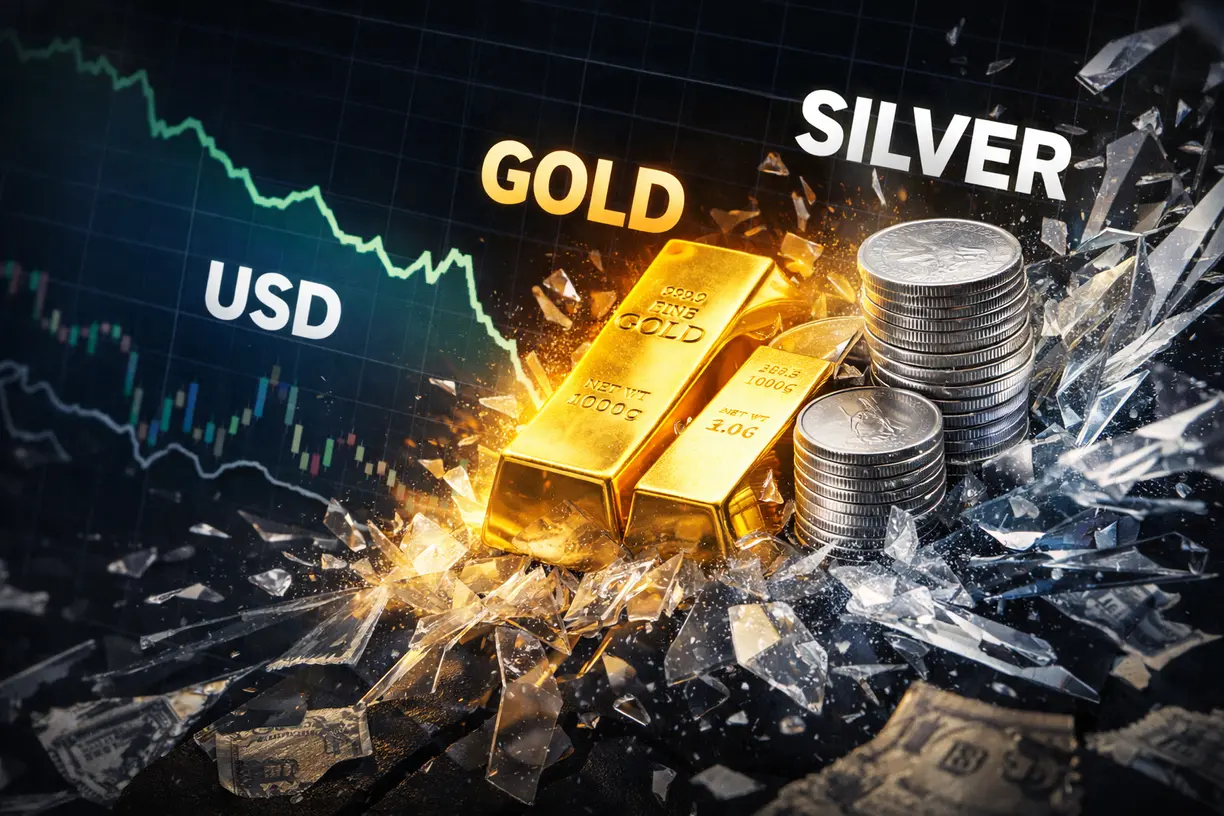
(Kitco News) - Gold and silver prices remain firmly supported despite appearing overextended at record highs, as continued weakness in the U.S. dollar reinforces a broader shift in investor sentiment toward hard assets.
Both metals have benefited significantly from the greenback’s decline, with analysts increasingly questioning the long-term role of the U.S. dollar as the world’s primary reserve currency. Silver has surged past $110 an ounce, while gold is trading around $5,300 an ounce, as markets continue to absorb heightened geopolitical uncertainty and economic volatility stemming from President Donald Trump’s policy agenda.
Julia Khandoshko, CEO of Mind Money, said that while gold may be vulnerable to a short-term pullback, the broader trend remains firmly intact.
“We see an acceleration of de-dollarisation, steady demand from developing countries, and continued global monetary issuance. Plus, there remains the issue of US debt sustainability and growing geopolitical tensions, such as new tariffs or the purchase of Greenland. Add to that the pressure on the Fed’s independence, and we have support for interest in gold as a safe-haven asset,” she said.
Analysts also note that gold and silver continue to benefit from a renewed wave of “Sell America” sentiment that first emerged in April 2025, when Trump implemented aggressive global tariffs aimed at reducing the U.S. trade deficit.
Linh Tran, Market Analyst at XS.com, said that gold’s rising importance is increasingly reflected in the composition of global reserves.
“When viewed within the broader context of the global financial system, it becomes clear that gold is rising not merely due to market anxiety, but also because confidence in the global monetary–fiscal order is shifting toward a more cautious stance. This does not appear to be a short-lived shock, but rather a process of re-positioning gold’s role within the system.,” Tran said in a note. “it becomes clear that gold’s future trajectory will not hinge on a single variable such as interest rates or the U.S. dollar, but rather on the overall stability of the global monetary and fiscal framework.”
The dollar’s weakness has been pronounced. In 2025, the U.S. dollar index posted one of its poorest performances in more than 50 years, falling roughly 9.4% from a December 2024 close near 108.5 to around 98.3 by year-end.
That downward momentum has carried into the new year, with the dollar down nearly 2% in January. This week, the index slipped to a fresh multi-year low of 95.55 points.
The decline came as Trump indicated that he is unconcerned about the currency’s slide.
“I think it’s great,” Trump told reporters in Iowa on Tuesday when asked if he was worried about the currency’s drop. “I think the value of the dollar — look at the business we’re doing. The dollar’s doing great.”
However, analysts caution that the implications of a weaker dollar are far from straightforward and continue to strengthen gold’s appeal as both an inflation hedge and a wealth preservation tool.
“While a softer USD benefits exporters – it costs foreign buyers less to purchase dollars – it can increase inflationary pressures. Think about it like this: the problem is that when the USD declines, if you want to buy something abroad, it will cost more as the dollar buys less. For business, for those who import materials, for example, they will also face higher costs, which they can pass on to customers, hence inflation,” said Aaron Hill, Chief Market Analyst at FP Markets, in a note. “The issue right now is Trump’s unpredictability. From threatening tariffs to designs on Greenland, his actions continue to rattle the markets, prompting investors to reduce exposure to US assets. This adds fuel to USD downside and could ultimately bolster inflation.”
Beyond the U.S. dollar, some analysts warn that confidence in fiat currencies more broadly is eroding. Markets remain sensitive to recent turmoil in Japanese bond markets, which has raised concerns about liquidity risks across the global financial system.
Guy Wolf, Global Head of Market Analytics at Marex, said fears of global currency debasement could support higher gold prices for years, as portfolio reallocation into the metal remains a gradual process.
“Private investors are returning to gold as both a hedge against currency debasement and a form of insurance against geopolitical risk, equity market overvaluation, and broader macro uncertainty. Gold’s rise is not simply a function of US dollar weakness; rather, it reflects a broader erosion of confidence in fiat currencies globally, with gold appreciating in virtually every currency.”
Looking ahead, Nitesh Shah, Head of Commodities & Macroeconomic Research at WisdomTree, said gold prices could push well beyond current levels before year-end.
He noted that his models continue to suggest investors allocate between 15% and 20% of their portfolios to gold. Given the sheer size of the global bond market, he added, even modest shifts in asset allocation could have an outsized impact on prices.
“I can see why gold prices are where they are,” he said. “There is a massive threat to the status quo and the global monetary system if the U.S. dollar remains the world’s reserve currency.”
