
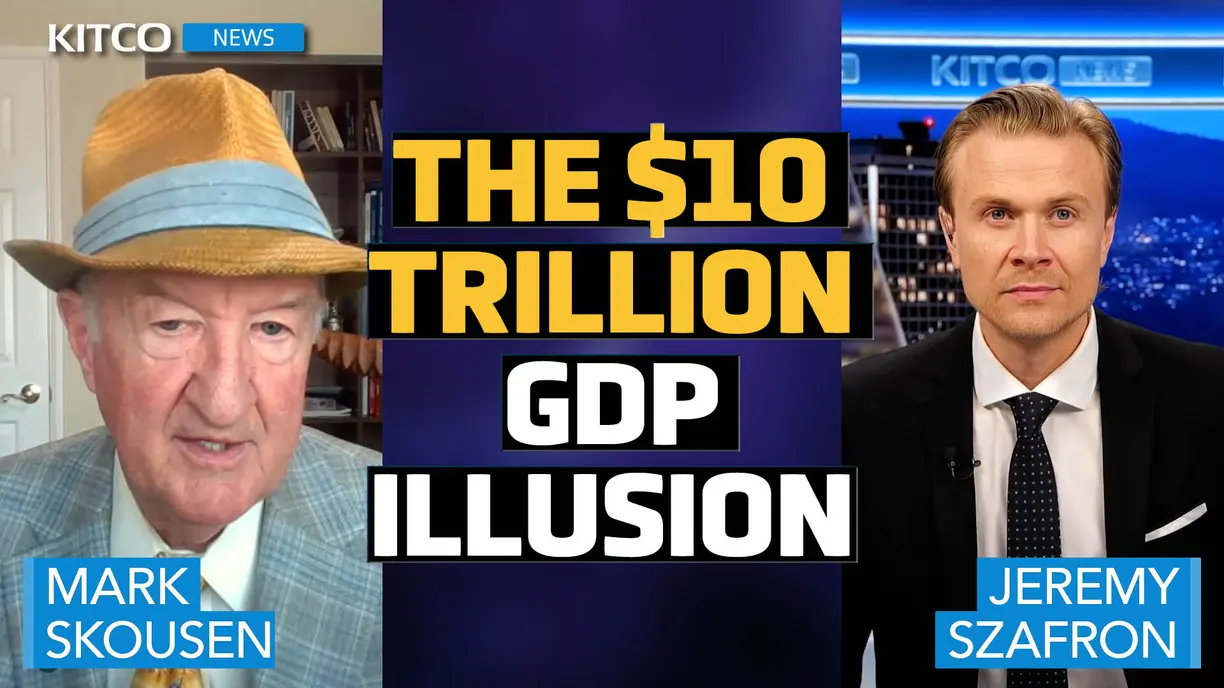
(Kitco News) - Investors are entering a structural inflationary regime that is reshaping how commodities, currencies, and financial assets are valued, with silver potentially establishing a long-term price floor well above historical norms, according to Mark Skousen.
Speaking with Kitco News in early April 2026, Skousen, a presidential fellow at Chapman University and macroeconomic strategist at the Oxford Club, said the current environment reflects a fundamental shift rather than a temporary post-crisis cycle.
“We've entered an era of permanent inflation,” he said. “There's no real deflation.”
The shift comes as gold trades within the $4,700 to $4,800 range and silver consolidates near $75 following a rally that has seen the metal gain roughly 100% over the past year. Skousen said those levels reflect sustained demand tied to both monetary and industrial drivers.
Inflation becomes structural, not cyclical
Skousen said multiple long-term forces are reinforcing inflation, including persistent deficit spending, supply constraints, geopolitical conflict, and the legacy of prolonged ultra-low interest rates.
He argued that the Federal Reserve’s 2% inflation target effectively embeds a steady loss of purchasing power into the system. “I tell all investors, you need to make 10% a year just to keep up with the higher cost of living in this country,” he said.
That dynamic, he believes, challenges traditional portfolio strategies built around cash and fixed income, and instead supports assets tied to scarcity and production.
Silver’s role shifts beyond a monetary metal
Skousen said silver is increasingly driven by industrial demand linked to AI chips and energy systems, rather than functioning purely as a monetary hedge.
“My prediction is that it's back over $50 headed to a hundred again,” he said. “It's never going to go back under $50.”
He notes the metal’s dual role as both a monetary and industrial asset is tightening the supply-demand balance, particularly as new mine supply remains limited.
Gold, copper, and uranium are part of the same broader trend, where constrained supply is meeting long-duration demand tied to infrastructure and energy systems, according to Skousen.
Growth risks temper copper, but long-term demand remains
Copper remains more sensitive to economic cycles than gold, particularly if geopolitical tensions or trade disruptions weigh on growth, with Skousen noting recent softness in copper-linked equities reflecting short-term concerns about economic momentum, but not a change in the longer-term demand outlook.
“What is least undervalued? Well, maybe the copper stocks,” he said.
He also pointed to uranium as another market with room to move higher, noting that prices remain below prior cycle highs despite growing demand for alternative energy sources.
Dollar alternatives emerge in global trade
Skousen also highlighted developments in the Strait of Hormuz, where reports indicated some energy-related transactions were being conducted in alternative currencies, including yuan and cryptocurrencies.
He said those developments point to a gradual shift in how global trade is settled, particularly in politically sensitive regions. “There are legitimate uses for the cryptocurrencies and Bitcoin and so forth,” he said. “People are looking for an alternative to the dollar.”
While he did not suggest a near-term displacement of the dollar, Skousen said the trend reflects increasing fragmentation in the global monetary system.
Technological strength masks underlying economic weakness
Skousen said the current cycle is also being shaped by rapid technological advancement, particularly in artificial intelligence and data infrastructure, which he described as a major source of economic resilience.
“I think we're in a golden age of technology,” he said.
However, he argued that traditional economic indicators may be overstating overall strength by focusing heavily on consumer spending while overlooking weakness in production and supply chains.
“Do not look at consumer spending. Do not look at retail sales,” he said. “The key indicator is the supply chain, and it's business-to-business spending.”
He said that the imbalance suggests the underlying economy remains more fragile than headline data implies.
Asset allocation shifts toward scarcity and alternative systems
Skousen said the combination of structural inflation, geopolitical friction, and technological change is driving capital toward assets linked to real economic output and alternative financial systems.
He maintained that digital assets and blockchain-related investments have a role within that framework, particularly as parallel systems for transferring and recording value.
“I think it's pretty clear that Bitcoin and other cryptocurrencies have bottomed and are starting to move higher,” he said.
Skousen said the broader trend reflects a repricing toward scarcity, production capacity, and monetary alternatives, rather than a short-term reaction to market volatility.
Watch the full video on the Kitco News YouTube channel.
This content is sponsored by Swan Bitcoin. Start your Bitcoin journey today at Swan.com/Kitco.