

(Kitco News) - The cryptocurrency market ended the last official trading day of 2023 mixed as Bitcoin (BTC) continued to consolidate below $43,000 while some altcoins corrected lower as others surged higher.
Stocks found themselves trying to battle back from early pressure that pushed them into the red shortly after the opening bell on Friday. But it appears that bulls spent their reserves in the run-up earlier in the week, leading to a negative close for the major indices.
As 2023 trading officially came to an end, the S&P, Dow, and Nasdaq were down 0.28%, 0.05%, and 0.56%, respectively.
Data provided by TradingView shows that Bitcoin bulls were battling bears from the open of the daily candle, with the top crypto hitting a daily high of $43,140 near midday before reversing course to hit a low of $41,650 just three hours later. At the time of writing, BTC trades at $42,200, a decrease of 1% on the 24-hour chart.
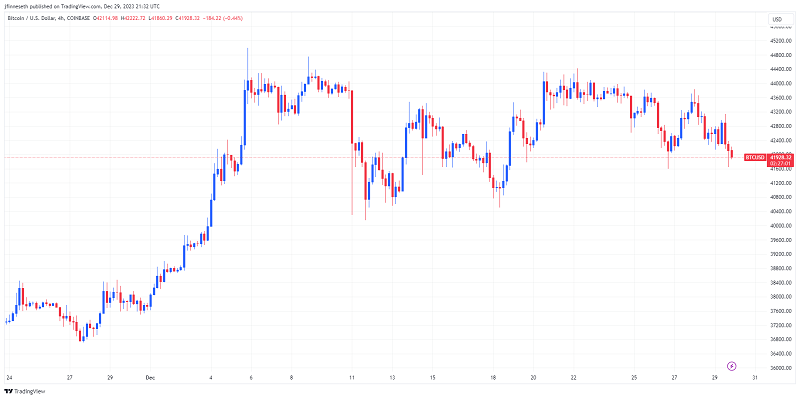
BTC/USD Chart by TradingView
“On these very last days of 2023, Bitcoin is at a crossroads around $43k. It has zoomed 160% over the year, but is still 14% below where it was at the end of 2021,” said David Lifchitz, chief information officer at Tellurian-ExoAlpha, in a note shared with Kitco Crypto.
“Until mid-October 2023, Bitcoin has had just 2 positive impulses: one mid-January and one mid-March,” Lifchitz said. “Between mid-March and mid-October, Bitcoin was essentially sideways in a $4,000 range (between $24k and $28k). It was only by mid-October 2023 that Bitcoin began its tremendous growth from $28k to $43k (about 50% in just 2 months) as the first Bitcoin ETF was becoming more probable with industry giants such as Blackrock and Fidelity getting involved.”
“Also, at the same time, clarification and asset recovery about last year's FTX bankruptcy has been a positive catalyst for the digital assets over that period,” he said.
“The expected approval of a Bitcoin ETF by January 10th, 2024 according to the latest notice from the US SEC (notice about its decision deadline, not about the outcome) is the big event that everybody is waiting for,” Lifchitz noted. “Such an instrument will give seamless access to the digital asset to investors from their regular trading accounts but also allow them to store it in their IRAs, instead of having to deal with cumbersome digital assets exchanges and storage accounts (wallets). Institutional investors will be able to access Bitcoin in the form of a regulated liquid instrument.”
Making the straightforward case for a rise in BTC price, Lifchitz said, “The logic is then that even if a small percentage of US investors add 0.5% of BTC into their global portfolio now that they will have an easy tool for doing so, this will lead to a massive inflow of money into the digital asset compared to its currently existing market cap, leading thus it to a significant price increase.”
“But this is for the mid-to-long term as most investors won’t flock day one into that new ETF,” he said. “Moreover, if Bitcoin were to correct hard, investors won’t rush into it immediately.”
“This leads to the classic ‘buy the rumor/sell the news’ event where Bitcoin has already been pumped up proactively from mid-October to mid-December on the ‘rumor’ and could correct shortly after approval of the Bitcoin ETF news breaks,” he warned. “However, a last pump could take place in the very early days of 2024 from $43k at the time of writing to $45k-$47k on New Year fund inflows. A ‘sell the news’ event could take it back down to $38k-$40k afterward.”
Lifchitz also noted an interesting parallel that has arisen since the launch of the first Gold ETF (GLD).
“Before that, investors could only access gold either through derivatives (futures contracts which are essentially reserved for professional traders) or to physically buy and store gold,” he said. “Leading up to the Gold ETF inception, the same logic of easy access to the commodity by a large swath of ‘buy and hold’ investors led to a significant price increase of the commodity… but its price actually felt in the following months: investors took time to get into it and as its price was declining, they had no rush to get in.”
While many analysts have suggested that Bitcoin could behave similarly, Lifchitz noted that the top crypto has another approaching development in its favor: the halving.
“2024 is a ‘halving year’ for Bitcoin, which has always been bullish up to the halving event – scheduled next April – so a post-ETF dip may be quickly bought leading up to the halving,” he said. “But this is just one scenario and history has shown, especially with Bitcoin, that anything can happen… so I will refrain from making the usual ‘1 year ahead price projection,’ and just highlight some possible price action scenarios in the short term.”
The likelihood of a spot BTC ETF approval in early January just got a little stronger, according to Bloomberg Intelligence senior ETF analyst Eric Balchunas, who noted that on Friday, Blackrock released its updated S-1 form naming the authorized participants for its application as Jane Street and JPMorgan.
“Looks like we have our first horse at the starting gate,” Balchunas tweeted.
Altcoins finish in the red
A majority of tokens in the top 200 traded in the red on Friday.
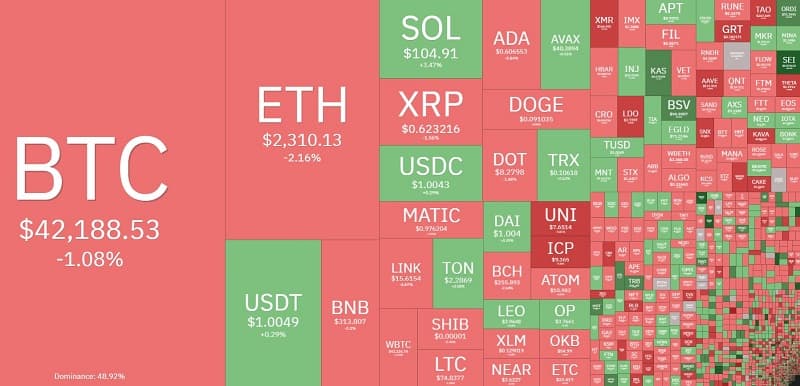
Daily cryptocurrency market performance. Source: Coin360
Moonriver (MOVR) was the biggest gainer with an increase of 30.3%, while Sei (SEI) climbed 25%, and Holo (HOT) gained 13.5%. Dash (DASH) recorded the biggest loss with a decline of 10.7%, followed by Zcash (ZEC), which fell 10.5%, while SKALE (SKL) dropped 8.15%.
The overall cryptocurrency market cap now stands at $1.65 trillion, and Bitcoin’s dominance rate is 49.9%.
