
The launch of multiple spot Bitcoin (BTC) exchange-traded funds (ETFs) in the U.S. has broadened the adoption prospects for the world's top cryptocurrency and is set to usher in a new era for financial markets, according to analysts at WisdomTree.
Blake Heimann, a quantitative researcher and senior associate at asset manager WisdomTree, said making Bitcoin available to investors via an EFT will help boost adoption rates as they cut out the technical know-how needed to navigate the complex world of digital asset transactions and provide a “straightforward ‘plug and play’ method for entering this burgeoning asset class.”
“For US crypto investors, the pre-approval landscape was fraught with less-than-ideal choices: managing crypto wallets directly, entrusting assets to unregulated exchanges, investing in futures-based strategies that underperform due to roll costs, or illiquid fund structures prone to significant price deviations from Net Asset Value (NAV),” Heimann said. “This dilemma stalled investor allocation decisions, fostering a ‘wait and see’ perspective – not just domestically, but globally, as investors navigated unclear international regulation, frequently cueing from the U.S. regulator.”
He said the SEC’s approval “has opened the gates for a broader US investor base to seamlessly invest in Bitcoin, circumventing the cumbersome onboarding processes, sidestepping new counterparty risks, and forgoing the additional compliance paperwork.”
With more than $30 trillion in funds currently held in U.S. retirement accounts, Heimann said the digital asset space could see “substantial capital inflows in forthcoming years,” and WisdomTree’s long-term outlook “remains optimistic” despite the initial response from the market, which turned into a ‘buy the rumor, sell the news’ development.
“In many cases, US platforms that would never consider approving direct digital asset investments can now consider beginning their due diligence on an exchange-traded product (ETP), a familiar structure that can fit into their current systems more simply,” he said.
Heimann cited the total global assets under management (AUM) for cryptocurrencies as proof that “the allure of ETPs and ETFs as viable investment vehicles for cryptocurrencies is not just conjecture.”
“As of January 2024, Bitcoin ETPs boast over $35 billion in AUM, with nearly $2 billion in net inflows for the year,” he said. “This is on a base of overall Bitcoin market capitalization of approximately $800 billion, at current prices. Ether, the next largest digital asset by market capitalization sat at approximately $300 billion, for reference.”
Another sign that the future looks promising is the fact that “established asset managers with diversified businesses are attracting the lion’s share of AUM,” he said. “This trend underscores a fundamental investor behavior, reliance on familiar and trusted institutions.”
“With the diversified providers at the forefront, capturing significant Bitcoin inflows, adding to their expansive global AUM across diversified asset classes, this shift in investor preference is at the expense of specialized managers who solely concentrate on niche markets such as digital assets or technology,” he added.
Heimann suggested that the trend of digital assets being integrated into multi-asset portfolios will continue to expand globally, saying investors will “vote with their assets” by “opting for the most robust solutions at the fairest prices and favoring asset managers with a diversified business model and a proven track record in protecting and managing their hard-earned cash.”
He cited the collapse of FTX and the damage it caused to investors and the broader cryptocurrency ecosystem as an example of why investors will start to gravitate towards more established asset managers. “Trusted providers with a long-standing experience in offering institutional-grade solutions appear to be the direction of travel,” he said.
Paul Veradittakit, managing partner at Pantera Capital, said two additional catalysts are “driving a renaissance” for Bitcoin in 2024 aside from the launch of spot ETFs. This includes “the fourth Bitcoin halving due for April 2024,” and “a rise in programmability features, both on the base protocol (such as Ordinals), as well as Layer-twos (L2) and other scalability layers such as Stacks and Rootstock.”
“On the infrastructure level, we believe we will see a proliferation of Bitcoin L2s and other scalability layers to support smart contracts,” he said. “The Bitcoin ecosystem should coalesce around one or two Turing-complete smart contract languages, with top contenders including Rust, Solidity, or the extension of a Bitcoin-native language such as Clarity. This language will become the ‘standard’ for Bitcoin development, similar to how Solidity is considered to be the ‘standard’ for Ethereum development.”
Veradittakit also sees the possibility of a “‘DeFi summer 2.0’ on Bitcoin,” as the demand for incorporating Wrapped BTC (BTC) into more decentralized finance applications is expected to increase dramatically.
“As Bitcoin DeFi infrastructure matures, we could potentially see Bitcoin DeFi Total Value Locked (TVL) rise from the current $300M (<0.05% of market cap) to ~1-2% of bitcoin market cap (~$10-15 billion at current prices),” he said. “In this process, many Ethereum DeFi practices are likely to be transferred and ‘naturalized’ on Bitcoin, such as the recent rise of BRC-20 inscriptions and ideas such as staking.”
And Pantera Capital CEO Dan Morehead said that Bitcoin will continue to increase its value relative to publicly listed companies, just as it has for the past decade.
“At the second Pantera Blockchain Summit, March 2014, I compared the total market cap of Bitcoin to a similarly-valued public company – Urban Outfitters,” he said. “I updated that comparison in 2020 – L’Oréal. Waterproof mascara is undoubtedly an amazing invention, but Bitcoin seemed to have more legs. Bitcoin passed Berkshire Hathaway a while ago. It’s now tied with Meta (f.k.a. Facebook).”
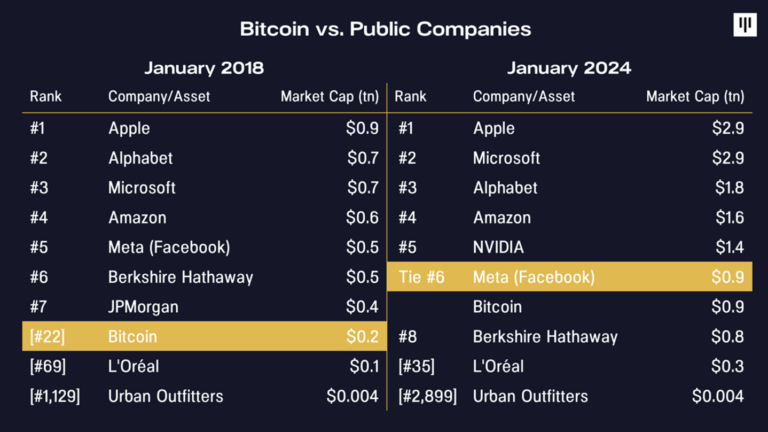
Bitcoin vs. public companies. Source: Pantera Capital
“Photo sharing is really cool and all, but I think that financial inclusion for everybody with a smartphone on Earth is gonna be bigger,” Morehead concluded.
