
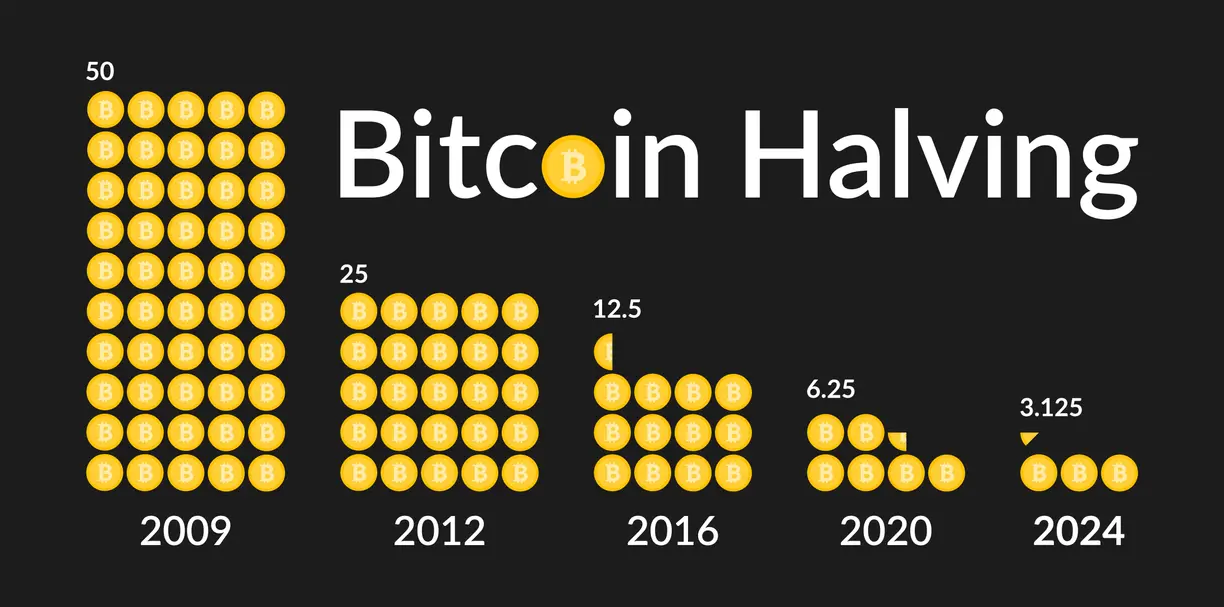
The quadrennial Bitcoin (BTC) halving has a history of being a market-moving event as the three previous reductions in new BTC supply led to a price surge in the months that followed.
A recent survey conducted by the Bitget cryptocurrency exchange showed that out of 9748 respondents, 84% expect Bitcoin’s price to surpass the 2021 bull market all-time high near $69,000 following the halving, with investors in the MENA region showing the highest level of positivity.
Respondents in Latin America (84%), East Asia (82%), and South East Asia (81%) were the most optimistic that the Bitcoin halving would significantly impact BTC price.
While investors in Western European countries were most optimistic about where Bitcoin would top out in the next cycle, with 41% saying it would surpass the $100,000 mark, this cohort doesn’t see the halving as being the main driver of rising price.
“It may indicate that these investors are 'short-term cautious, long-term optimistic,' as some Western European investors do not believe the Bitcoin halving will trigger a new bull market,” the report said.
To gain further insight and predictions into the halving and the effect it will have on the crypto market, Kitco Crypto spoke with several experts in the field for an inside take.
“The ‘halving’ stands out as a pivotal and strategic force in the world of Bitcoin,” said Clem Chambers, CEO of Online Blockchain plc. “It represents a fundamental shift guided by the principle of ‘code is law,’ and contrasts with the intricate complexities associated with ETFs, which are entangled in the whims of people.”
“The halving stands as an immutable event; an event free from human intervention, immune to contradictory opinions, rugs, or pivots,” he added. “The significance of this fact – for me – has far greater implications for the price dynamics of Bitcoin.”
“The previous halving had a grinding effect that propelled Bitcoin into a vertical ascent,” Chambers said. “However, the current Bitcoin market reflects increased efficiency, where the impacts of such events are being integrated into the price dynamics. In the realm of efficient markets, today's Bitcoin price is a composite of discounted future values projected out to an event horizon. During the earlier phase of emerging crypto infrastructure with market participants winging it this process was notably primitive.”
“The evolution witnessed in the lead-up to the SEC’s approval of 11 spot bitcoin ETFs on January 10th suggests that the market is increasingly mirroring classical financial markets with the capacity to absorb more value wave functions into its current valuation,” he concluded.
Kerel Verwaerde, CMO of Cryptology.com, said “The Bitcoin halving typically exerts a positive influence on its price, though not immediately evident, usually taking a few months to manifest.”
“While the reduction in block rewards may seem insignificant, all miners experience its effects, especially considering a significant portion of the cryptocurrency remains unsold by major holders, notably Satoshi Nakamoto,” he said. “Moreover, this upcoming halving coincides with a more favorable regulatory environment and the approval of ETFs, factors that are likely to attract institutional investors to the market, as seen in the previous bull run.”
The challenging part is “predicting precise price movements post-halving,” he said, calling the effort “speculative.”
“I believe it will take several weeks, if not months, to observe significant effects, potentially accompanied by bull traps along the way,” Verwaerde said. “The bullish trend is expected to unfold gradually over several months, if not longer. It's essential to acknowledge that these market cycles are cyclical and not perpetual, but there's an anticipation that new highs and lows will surpass previous ones.”
For Mauricio Di Bartolomeo, co-founder and Chief Strategy Officer at Ledn, the 2024 halving will have a similar impact on Bitcoin’s price as previous halvings, “But the reason is not as simple as the Bitcoin block reward halving and miners earning less.”
“Bitcoin halvings are also aligned with liquidity cycles and the U.S. presidential election,” he said. “There are several papers that highlight the relatively positive performance of financial assets/stock market in the 4th year of a presidential cycle. An example is the 2004 paper ‘Presidential Elections and Stock Market Cycles’ written by Marshall Nickless, which found that ‘no major declines occurred during the third or fourth year [of a presidential cycle].’
“And so, Bitcoin benefits both from a structural liquidity boost in the U.S. economy and a shock to its supply from the halving,” he said. “Sprinkle 9 new Spot Bitcoin ETFs and you have the ingredients for a rally.”
Rather than the reduction in BTC emission serving as the driver of price action, Di Bartolomeo said he “thinks the halvings will continue being impactful but the impact on price will be more driven by macroeconomic factors, i.e. demand vs block reward size (mining supply).”
When asked if the new supply is somewhat negligible when considering the supply already in the market and trading volumes, he said the amount of Bitcoin minted with each block will “become increasingly less relevant over time [and] should play a smaller and smaller role in the overall supply profile relative to markets/trading volumes.”
Di Bartolomeo doesn’t see this altering the four-year market cycle, however, as it is “also driven by political reasons. As long as the halving continues to be aligned with the U.S. presidential cycle, I believe it should continue impacting markets in a similar fashion,” he said.
As for the effect the halving will have on miners, he said “The halving usually ‘washes out the weak.’”
“Leading up to the halving miners do very well,” he noted. “This gets many of them ‘intoxicated’ with returns, and they start ‘doubling down’ at the peak – typically overpaying for machines, sites, and power – only to face a reckoning when their revenues halve. This makes entire generations of equipment economically obsolete overnight, and there is no secondary market for them. The halving forces inefficient miners out of the market, and allows the strong to get stronger.”
Because of this fact and the need for a large bankroll to fund a successful mining operation, Di Bartolomeo said he sees the Bitcoin mining industry becoming more centralized over time.
“I’ve seen this play out in real-time. I used to have friends that had mid-sized Bitcoin mine operations and they could make a living out of it,” he said. “Now the only miners are effectively either hobbyists, publicly traded companies, or niche operators (like gas flaring, etc.).”
While Di Bartolomeo refrained from giving a BTC price prediction post-halving, he did say that he expects it could trade “north of $50k in the weeks after the Super Bowl.”
According to Kadan Stadelmann, CTO of Komodo, “The upcoming halving will have a major impact on BTC price considering the current wave of increased demand from institutional investors and increased accessibility to purchase BTC through spot Bitcoin ETFs.”
Similar to Di Bartolomeo, Stadelmann sees the reduction in newly minted BTC as having less of an impact on price than previously and expects demand from institutional investors to drive the price action.
“With less BTC being released with each block, the new supply is somewhat negligible when considering the supply already in the market and trading volumes,” he said. “Bitcoin halvings will certainly have less of an impact on the crypto market over time. Perhaps by the 2028 halving, the market’s reaction will be rather minuscule compared to earlier halvings such as 2012 or 2016.”
“As halving events continue in the future, we could see the current 4-year market cycle of ‘boom and bust’ go away or morph into a more unpredictable cycle timeline,” he said. “We’re likely to see a crypto market increasingly aligning with global macroeconomic conditions. As the BTC mining reward decreases with each halving, even large-scale mining farms may focus on other proof-of-work coins that provide higher profitability.”
“The combination of rising electric costs and greater mining difficulty has already led to fewer solo mining operations and the centralization of Bitcoin mining,” he concluded. “Huge mining operations will only continue to dominate the landscape.”
Lucas Kiely, CIO of Yield App, said “The halving is a major event, and price action has historically reflected this, with hikes of over 120% during previous halving years.”
“The 2024 event comes alongside unprecedented institutional and retail interest in the space that is already pushing demand, so as Bitcoin supply decreases, we may see even higher growth rates in the months following the halving,” he said. “If growth rates during previous halving years are anything to go by, and given Bitcoin’s stellar performance over the past couple of months, we will reach that coveted $100K all-time high within 2024.”
Addressing the shift in miners’ earning potential, Kiely noted that “With Bitcoin prices on the rise, the majority of mining fees are collected through transaction costs, so, despite the reduced amount of BTC available to mine, the coinbase reward will remain meaningful in dollar terms. In 2028, a single Bitcoin might be worth double or even triple its value, making that 1.5625 block reward no less tempting than its 2024 equivalent. That’s the beauty of provable scarcity.”
“As we enter the next bull market and edge toward mainstream adoption, an increasing portion of miners’ total revenues will come from transaction fees, replacing coinbase rewards as a key driver,” he said. “The halving will therefore have a limited effect on their earnings.”
“As long as there is demand, reduced supply will continue to drive BTC prices higher,” he added. “Given that long-term Bitcoin investors are at an all-time high and holding a solid 75% of the supply, any BTC trickling into the market after this halving or the next will be of significance.”
“Looking beyond revenues, however, the competition for the last remaining Bitcoins ensuing from the halving will likely impact the mining industry’s landscape, with smaller miners swallowed up or pushed out by conglomerates,” he concluded.
For Ryan Grace, Head of tastycrypto, the upcoming halving will lead to a surge in the price of BTC.
“Historically, the price of Bitcoin has skyrocketed following a halving event with the inflation rate decreasing,” he said. “While the first halving may have gone unnoticed, subsequent events garnered much attention. As halving contributes to Bitcoin’s scarcity, many investors believe it significantly impacts its price.”
He noted that the Bitcoin chart shows “major peaks in price have occurred about a year after each halving,” and said, “Immediately following a halving, the price of Bitcoin typically undergoes some correction.”
“Price charts related to halving events are similar and demonstrate the following behavior: (1) An initial post-halving bullish run that lasts from 12 to 15 months; (2) A major correction lasting for more than a year; and (3) A moderate run until the subsequent halving, lasting for over a year,” Grace said.
Touching on the popular stock-to-flow (S2F) model that was originally proposed by X user PlanB, Grace said, “The S2F ratio reflects the relationship between a commodity’s existing supply and the amount produced in a specified period, such as monthly or annually. It shows the number of years required to achieve the current supply, considering the current output rate. The scarcer a commodity is, the higher the S2F ratio.”
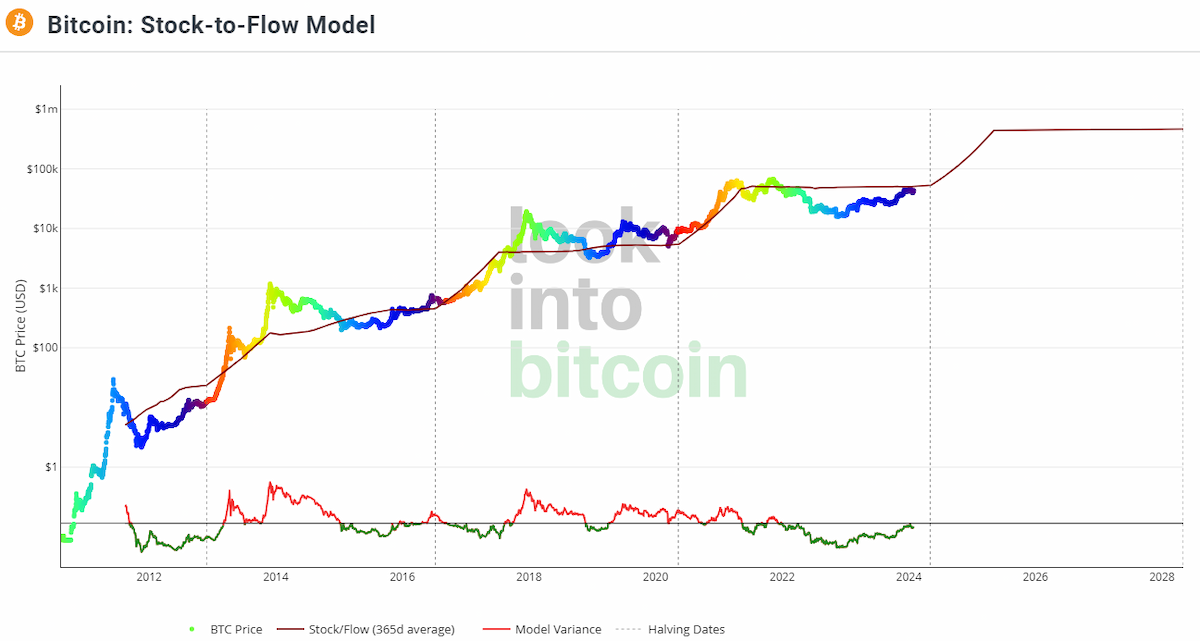
Bitcoin stock-to-flow model. Source: Lookintobitcoin
“For example, gold has the highest S2F ratio among commodities,” Grace said. “PlanB argued that there is a direct relationship between the Bitcoin price and its S2F ratio, which increases gradually as the issuance rate slows due to of halving. So far, this model has been incredibly accurate, but it has deviated since the ‘crypto winter’ in 2022.”
“The next Bitcoin halving is expected to occur at block 840,000, likely around April 2024,” he said. “This event will likely create significant buzz, increasing BTC’s volatility and influencing its price. Despite the similarities between previous halving events, it’s difficult to guarantee halving will lead to a new all-time high for BTC, especially given its recent deviation from the S2F model.”
“In the past, Plan B argued that the Bitcoin cryptocurrency should hit $288,000 after the 2024 halving, but that seems unrealistic given its price in late 2023,” Grace said. “While predicting the price is a difficult task, we know for sure that halving will affect Bitcoin miners.”
“Reduced rewards and increased costs may force around 30% of all mining operations to shut down post-halving due to profitability concerns,” he warned. “For miners, every halving event doubles the production costs per generated coin. Previously, this was offset by the massive bullish spikes that came after each halving event.”
“If the next bull market is delayed, a good chunk of mining operations will be gone for good,” he concluded. “It remains to be seen what impact this will have on the Bitcoin protocol’s security.”
Taras Kulyk, founder and CEO of SunnySide Digital, a leading provider of data center hardware and infrastructure servicing the Bitcoin mining industry, told Kitco Crypto that the halving will likely lead to “distress” for higher cost miners, “based on their input costs.”
“If the economy stays robust, mergers and acquisitions will be a major theme as the sector consolidates and matures,” Kulyk said. “Additionally, power generation companies will likely become even bigger players in the next 4 year cycle as they start to leverage ‘the offtaker of first resort’ economic models in overbuilding new power generation, knowing there’s a stable 24/7 power offtaker that is sustainable.”
Newer sources of revenue will also help make up for the earning potential lost by the reduction in Bitcoin emissions, he said. “Growth of transaction fees is proceeding far faster than many analysts are expecting. I think that with the ongoing increased usage and adoption of BRC40, ordinals, etc., transaction fees may rapidly become the main source of economic compensation for digital miners.”
When asked if the four-year market cycle could shift as the BTC emission rate becomes negligible, Kulyk replied in the affirmative, saying, “The commodities scarcity is really starting to hit market and pricing dynamics. With the ETF/ETP’s taking more and more BTC out of circulation, the scarcity of BTC will become top of mind for investors seeking direct exposure.”
“Given the ETF/ETP listings in the US and HK the amount of freely trading BTC is starting to reduce materially, additionally, ongoing macro support and adoption of BTC as a store of value should also impact the spot price in the positive,” he said.
Due to these and other factors, Kulyk said that by year-end, “we should see at least $60k to $100k, based on the historical pricing impacts of halvings.”
Bucking the consensus opinion was Rishabh Gupta, Director of Operations at TDeFi, who said he doesn’t see this halving as being as impactful on Bitcoin’s price as the previous ones.
“It's a mixed sentiment here from the fundamental analysis point of view,” he said. “It's the fourth halving, and as the markets mature, these kinds of bound-to-happen events should already be included in the pricing of that asset. It's not something happening abruptly, it's something that is supposed to happen. Everyone is expecting it to happen. Therefore, that phenomenon has already been included in the current pricing.”
“However, being in the nascent stage, there will be FOMO and positive sentiment around it,” he added. “But we cannot expect the same upward movement in the past three halvings; therefore, this will be slightly less impactful.”
Gupta also sees a potential shift coming to the expected four-year market cycle.
“The four-year cycle will change because the institutions are expressing more belief and participation,” he said. “Therefore, I believe [this cycle] will be different. I don't think the halving will impact the market. So many BTCs are already held up in wallets that are yet to be traded. Releasing those BTCs would have a more significant impact than the halving itself. The four-year cycle will change because of institutional participation, not just the halving.”
Gupta refrained from giving a price prediction but did say that he expects another bull run following the halving in April, at which point BTC will surpass its previous all-time high of $69,000.
And analysts at Bitfinex said that while “Predictions for Bitcoin’s price post-halving are variable, a rally always ensues.”
“However, it must be noted that each cycle has noted diminishing percentage-wise returns post-halving, mostly due to the sheer amount of the capital involved in moving a larger asset (BTC in comparison to its market cap in previous cycles),” they said. “A major impact is a reduction in new supply added as less BTC is mined after the halving. This makes existing supply inherently more valuable than when more supply was added on a regular basis.”
“Specific price predictions and timelines for BTC following the halving are in a wide range, but we’ve always had a move beyond the current all-time high after the halving,” they said. “Timing this is very difficult but a move to $54,000 is a good estimate for [BTC] price to tag in Q2 of 2024, it is also a good yardstick for price post-Q3 when the market could see a much more exponential move than in early 2024.”
