
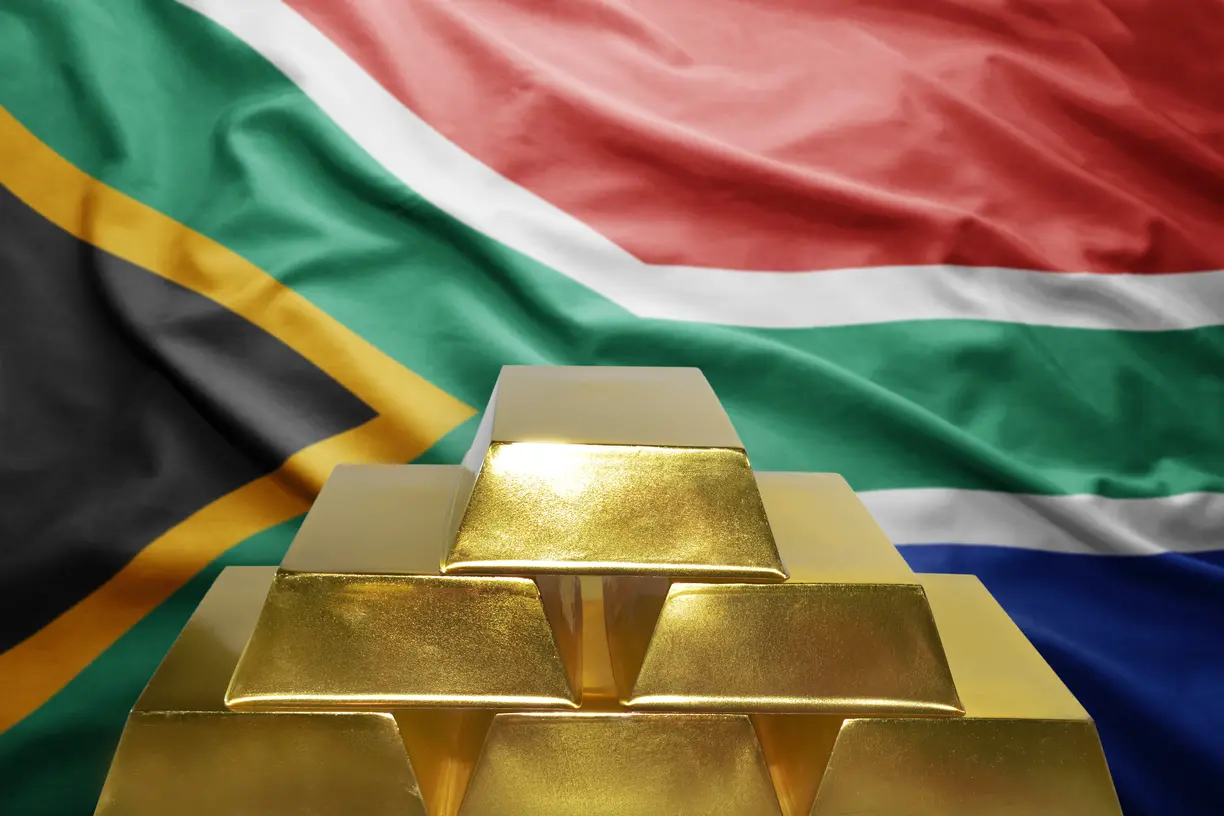
(Kitco News) - South Africa has taken the plunge and done what many nations may be forced to do in the coming years: the country will draw from its gold and foreign-exchange reserves to increase government spending on healthcare, education, and welfare programs while still managing its massive debt.
On Wednesday, Finance Minister Enoch Godongwana tabled his final budget before the country heads to the polls on May 29. Godongwana’s ruling African National Congress party is at risk of losing its national majority for the first time since 1994, and the Finance Minister told lawmakers in Cape Town that he plans to restructure the South African Reserve Bank’s (SARB) reserves to free up 150 billion rand, equivalent to $7.9 billion, over three years to fund the scheme.
As of last month, the central bank’s Gold and Foreign Exchange Contingency Reserve Account (GFECRA) had a profit of 507.3 billion rand ($26.5 billion), way up from the 1.8 billion rand ($94 million) it showed in 2006, driven largely by the South African currency’s depreciation against the greenback.
According to the World Gold Council, at the end of Q4 2023, South Africa had 125.41 tonnes of gold in its reserves, worth a total of $8.38 billion.
“Near-term, the focus will be on the positive market reaction,” Razia Khan, head of research for Africa and the Middle East at Standard Chartered Bank told Bloomberg. “Longer-term, there’s still a lot of heavy lifting to do to reassure on growth and a more meaningfully positive debt outlook.”
Under the plan, 250 billion rand will be withdrawn from GFECRA, but 100 billion rand will be allocated to protect the central bank’s balance sheet from losses, and then returned to the government over time as the SARB generates its own buffer. The remaining 250 billion rand will remain in the account to protect the country’s reserves against currency losses.
The move is designed to reassure investors that the funds are being used judiciously and the SARB’s gold and currency reserves aren’t being consumed simply to buy votes at the expense of the long-term. The plan enables a decrease in the amount of debt auctioned at weekly sales and means South Africa will now borrow less to fund budget deficits.
SARB Governor Lesetja Kganyago told the media that the actual reserves won’t be sold to raise the government funds. Instead, the central bank will create a new liability which it will then need to service.
“Printing money is not free. It costs 8.25% per annum, the repo rate,” he said, explaining that it also entailed sterilization costs, which is why the central bank needed the buffer until it can build up its own protective cushion of funds.
The new plan will provide immediate relief to South Africa’s strained public finances and will enable the government to avoid a debt blowout, as the Treasury predicts that debt-service costs will decline by 30 billion rand over the medium term. Debt as a share of the overall economy is now expected to peak at 75.3% in 2025-26, below the 77.7% estimated in November without the plan, it said.
