

(Kitco News) – Political division in the U.S. is at its highest level in decades as each side prefers to stay in their respective news bubbles while ‘crossing the aisle’ has become almost non-existent. But there is one thing that a majority of voters in swing states can agree on – the U.S. financial system is outdated and in need of an overhaul, but crypto might not be the proper solution.
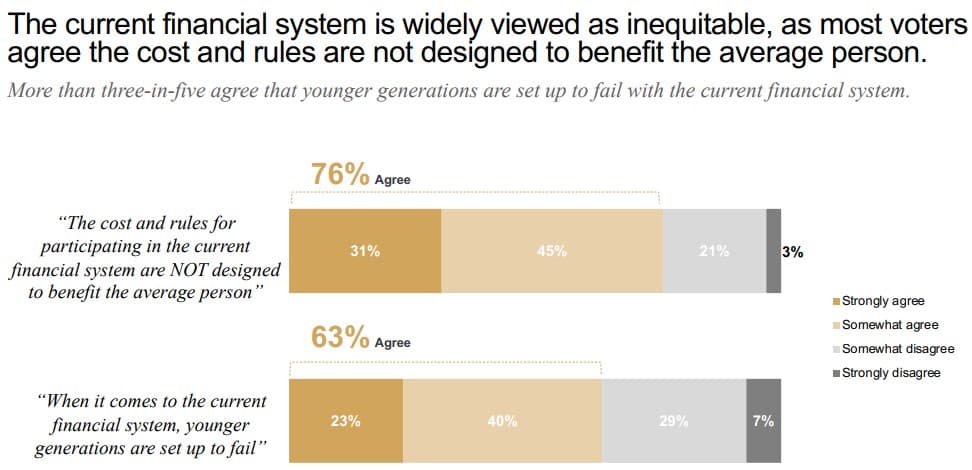
According to the results of a study conducted by the Digital Currency Group and the Harris Group that surveyed 1,201 people in six swing states that could vote either way in the upcoming election, “The current financial system is broadly unpopular, with widespread voter agreement that that system is inequitable and that younger generations in particular, are disadvantaged.”
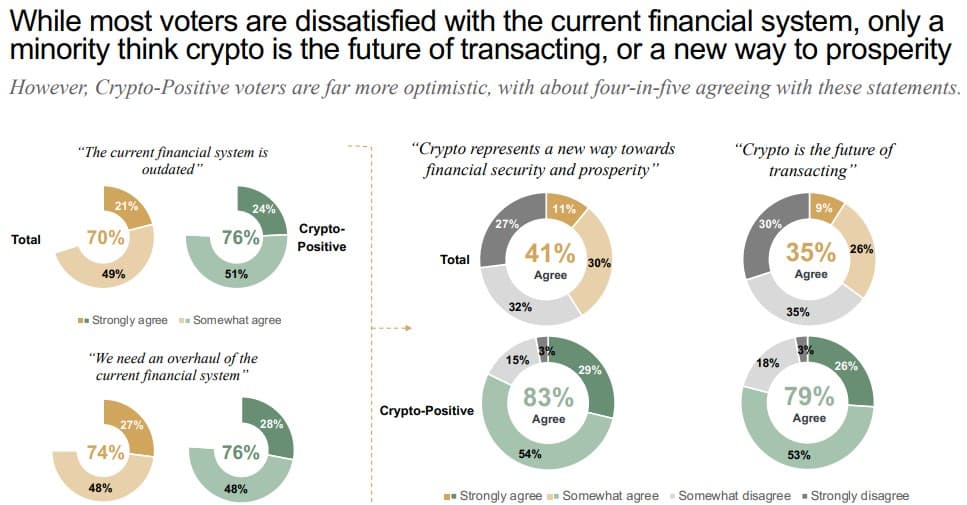
That said, most do not see crypto as the solution, although current crypto holders and those in the “Crypto-Positive” crowd are more likely to see it as a viable alternative.
A majority of respondents (80%) said the system favors elites over regular people, lacks transparency (79%), is difficult to understand (67%), and that younger generations are set up to fail (63%). Only 38% think the system “Is meant for people like me,” while 26% said its “Fair for all.”
“Interestingly, the majority (60-65%) are generally positive regarding their own current and future personal financial health (60-65%) and their understanding of the financial system (77%),” the report said. “However, this positivity does not translate into positive feelings towards the current financial system as a whole.”
When asked about their general perception of crypto, 31% of registered voters surveyed said they had a very positive (7%) or somewhat positive (25%) perception of the industry. Current crypto ownership among voters is relatively low (14%), and most (69%) said they do not feel knowledgeable about crypto.
Despite the low adoption rate, nearly a third of voters have positive feelings towards crypto. Roughly one-fifth of those surveyed said they plan to own crypto in the next six months.
For those who hold a positive view of the industry, 62% called it innovative, 50% said it was promising, and 45% highlighted its accessibility. The majority of these voters “agree that crypto represents a new way towards financial security and prosperity (83%), is the future of transacting (79%), levels the playing field for financial health (77%), and is meant for people like me (70%),” the report said.
Even with a high level of skepticism, “about half of voters overall and the majority of Crypto-Positive voters would be more likely to purchase crypto if crypto assets were offered by an established or regulated firm (50% overall, 76% Crypto-Positive), or if the government has consumer and investor protection laws in place (48% overall, 69% Crypto-Positive),” the survey found.
Recently, multiple candidates running for various positions – including Presidential candidates like Donald Trump and Robert Kennedy Jr., along with those running for Congress – have included crypto in their platforms as its prominence rises in voters' minds.
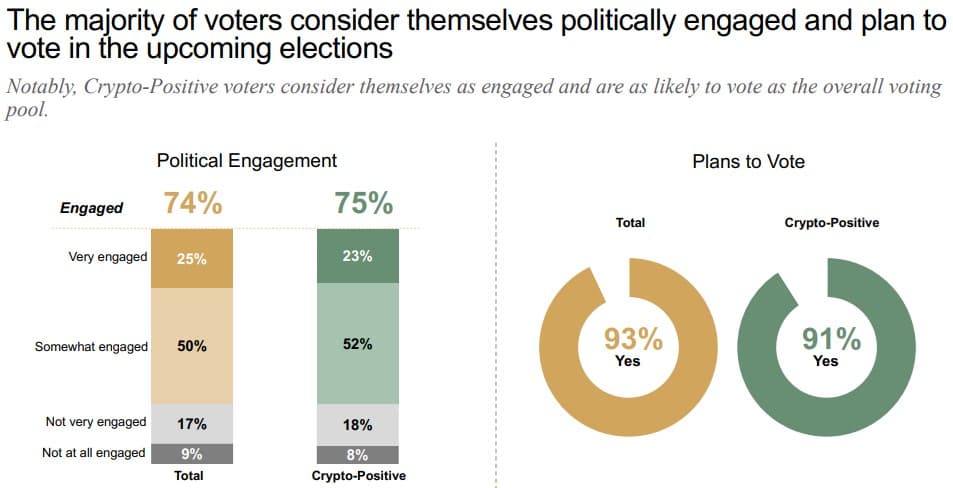
“The vast majority of voters overall and Crypto-Positive voters plan to vote in the upcoming 2024 elections (90%+) and are closely split in party lean,” the report said.
40% of respondents said they wish political candidates talked more about digital currency. At the same time, “Most voters do not trust elected officials to understand innovative technology like crypto, and more than half are concerned about policymakers stifling innovation via overregulation,” DCG said. “The vast majority want policymakers to be sure they understand crypto before regulating.”
One-quarter said enthusiasm towards crypto would make them trust a political candidate more, and 30% said they would be more likely to support a political candidate who is friendly to crypto. Nearly half of respondents said they do not trust political candidates who have said they would interfere with crypto.
“Of note, crypto regulation does have broad support – the majority of voters overall and nearly half of Crypto-Positive voters are in favor of an overhaul of crypto,” the report said. “Similarly, about 20-25% of voters and one-third of Crypto-Positive voters want elected officials to focus on crypto regulation or protections for crypto investors.”
Demographically speaking, crypto-positive voters “are more likely to be male, younger, Black or Hispanic, and are less likely to have a four-year college degree compared to voters overall.”
“Compared to the overall voting pool, Crypto-Positive voters do not show any major differences in household income and political party lean,” the survey found. “Of the states surveyed, Ohio voters are more negative towards crypto.”
And holding a positive view of crypto wasn’t limited to those who hodl as “about 40% of Crypto-Positive voters have never owned crypto.”
The biggest barrier to crypto ownership was a lack of education, with a majority saying they do not feel knowledgeable about crypto, and even the crypto-positive crowd saw a high level of responses indicating that crypto is difficult to understand.
“When probed on reasons for negative perceptions, some indicate they aren’t familiar or don’t have much experience with crypto, suggesting a possibility to be converted with more information or experience,” the report said.
The DCG said crypto has become increasingly included in campaign rally speeches due to the demographics of Crypto-Positive voters (younger and people of color), which is an attractive audience for candidates, especially Democrats.
“In a highly polarized political environment, crypto could be a relatively non-partisan issue with support among a portion of the electorate,” they said. “Talking about crypto in an informed way could help candidates for office stand out.”
While there is substantial interest in having candidates talk about digital currency, trust is low that they will actually understand crypto, so “A politician who demonstrates an understanding of crypto could separate themselves from the pack,” DCG said. “Voters who would support a pro-crypto candidate say they’d see the candidate as forward-thinking and open-minded, suggesting a possible halo effect.”
And with bipartisanship at an all-time low and regulators attacking the crypto industry with full force, the survey found that voters overall “support an overhaul of crypto,” and “More would buy crypto if government protection laws were in place, suggesting that hesitancy towards crypto could be mitigated with a trusted authority.”
“Measured suggestions to regulate crypto in an overall pro-crypto message could assuage voters who are skeptical of crypto, while simultaneously appealing to the Crypto-Positive segment,” the report said.
