

(Kitco News) – The rate of cryptocurrency adoption in the U.S. is a key metric that provides insight into the public’s perception of the asset class. The sector has struggled to gain legitimacy in the eyes of many investors following years of negative headlines and a focus on the small, yet impactful, criminal element within the ecosystem.
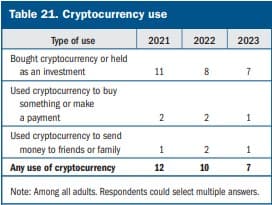
Coinbase previously claimed that 52 million Americans own cryptocurrency, which indicates an adoption rate of 15.5% based on the Census estimate of 336.5 million Americans. However, according to a survey conducted by the Federal Reserve, only 7% of respondents bought or held crypto in 2023, and only 1% actually used it to buy anything or make a payment.
On Tuesday, the Fed released the latest results of their annual Survey of Household Economics and Decisionmaking (SHED), which measures the economic well-being of U.S. households and identifies potential risks to their finances.
The survey was conducted in October 2023 and received responses from 11,488 U.S. adults aged 18 and older. It included modules on a range of topics relevant to financial well-being including credit access and behaviors, savings, retirement, economic fragility, and education and student loans.
The “Banking and Credit” section of the report covered the topic of digital assets, and the Fed found that the use of cryptocurrency for investment purposes or for making financial transactions “continued to fall in 2023,” with the seven percent figure “down three percentage points from 2022 and down 5 percentage points from 2021.”
“Buying or holding cryptocurrency as an investment remained more common than using it for financial transactions,” the report said. “Seven percent of adults bought or held cryptocurrency as an investment in the prior 12 months. In contrast, 2 percent of adults said they used cryptocurrency to make a financial transaction: 1 percent used cryptocurrency to buy something or make a payment, and 1 percent used it to send money to friends or family.”
The survey found that among the adults who used cryptocurrency to send money to friends or family, one in four “indicated that at least one transfer was made internationally,” highlighting the use of crypto in making cross-border transfers.
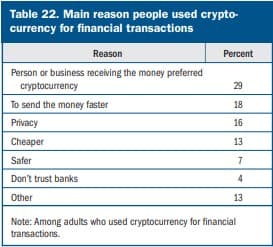
As for the main reason why participants used crypto to make financial transactions, the most cited reason (30%) “was that the person or business receiving the money preferred cryptocurrency, followed by ability to send the money faster and for privacy concerns,” the report said. “Relatively few transactional cryptocurrency users indicated that either safety (7 percent) or a lack of trust in banks (4 percent) contributed to this choice.”
The survey also found notable differences across demographic and socioeconomic characteristics.
“Use was more common among younger-to-middle age adults and among men, both for investment and transactions,” the report said. “In contrast with age and gender, patterns by income, race, and ethnicity differed by whether the cryptocurrency was used for investment purposes or to conduct financial transactions.”
Adults with income of $100,000+ were more likely than adults with lower incomes to hold cryptocurrency as an investment, whereas those with income less than $25,000 were more likely than those with higher incomes to use cryptocurrency for financial transactions.
“Looking across race and ethnicity shows that holding cryptocurrency as an investment was most likely among Asian adults,” the survey found. “In contrast, use of cryptocurrency for financial transactions was more common among Black and Hispanic adults than White adults.”
Unbanked adults and those who used nonbank check cashing and money order services also showed a higher utilization of crypto for financial transactions.
“Four percent of unbanked adults used cryptocurrency for financial transactions, compared with 2 percent among banked adults,” the report said. “Regardless of bank account ownership, those who used nonbank check cashing or money orders had a greater propensity to use cryptocurrency for transactions – 5 percent among those who used nonbank check cashing or money orders compared with 1 percent among those who did not.”
Even accounting for this, “the use of cryptocurrency for financial transactions remained very low, even among groups who were more likely to use cryptocurrency in this way,” the Fed said.
Some of the other higher-level findings from the survey include 72% of adults reporting that they are doing “at least okay financially,” which was “similar to the 73 percent in 2022 yet remained well below the recent high of 78 percent in 2021.”
Financial well-being was generally unchanged from 2022 for most population segments, with the main exception being parents living with their children under age 18, where the share doing at least okay financially fell 5 percentage points from 2022.
Inflation continues to be the top financial concern for respondents, “despite the inflation rate falling over the prior year,” the report said.
“65% of adults said that changes in the prices they paid compared with the prior year had made their financial situation worse, including 19% who said price changes had made their financial situation much worse,” the survey found. “In contrast, 4 percent of adults said that price changes compared with last year had made their financial situation better, while 31 percent said price changes had little to no effect on their financial situation.”
One of the knock-on effects of rising inflation is a rise in the use of buy now, pay later programs. “14% of adults used Buy Now, Pay Later (BNPL) in the prior 12 months, up 2 percentage points from 2022,” the report said. “The top two reasons for using BNPL were wanting to spread out payments (8%) and for convenience (8%). Additionally, over half of BNPL users said it was the only way they could afford their purchase.”
When it comes to income, “34% of adults said their family’s monthly income increased in 2023 compared with the prior year, while a higher 38% said their monthly spending increased,” the survey found. “48% of adults reported spending less than their income in the month before the survey. The share of adults who saved money in the month before the survey was similar to the share in 2022 but down from highs in 2020 and 2021, and below pre-pandemic levels.”
And on the retirement front, “Progress toward retirement savings goals improved slightly in 2023,” with 34% of non-retirees reporting that “their retirement savings plan was on track, up from 31% in 2022, but down from 40% in 2021,” the report said. “80% of retirees said they were doing at least okay financially—a higher share than for U.S. adults overall.”
Additionally, “45% of adults said they were mostly or very comfortable choosing and managing their investments, while 55% of adults said they were not comfortable or only slightly comfortable,” the survey found.
