

(Kitco News) – It has been an eventful first half of 2024 for the cryptocurrency ecosystem as the launch of spot Bitcoin exchange-traded funds (ETFs) and the approval of spot Ether ETFs in the U.S. have helped ignite a bull market and created a new way for institutional investors to get access to the asset class.
The ETFs are expected to usher in a new era of legitimacy for digital assets, which have already been enjoying a rise in global adoption amid a backdrop of escalating global tensions, non-stop debt printing by central banks, and an overall increase in economic uncertainty as the financial system shows signs of faltering.
According to a new report from digital currency payment provider Triple-A, the global user base for digital currencies climbed to 562 million people in 2024, up from 420 million in 2023. That represents an increase of 33.8% – and is equivalent to 6.8% of the global population.
“‘Crypto’ may stem from the Greek word for ‘hidden,’ but today, cryptocurrency is stepping into the spotlight like never before,” the report said. “Global demand for digital currencies is exploding, raising questions about the future role and opportunities they offer businesses worldwide.”
The younger generations show a higher level of crypto adoption, with 34% of cryptocurrency owners between the ages of 24 and 35, which is “the largest share among all age groups,” Triple-A said.

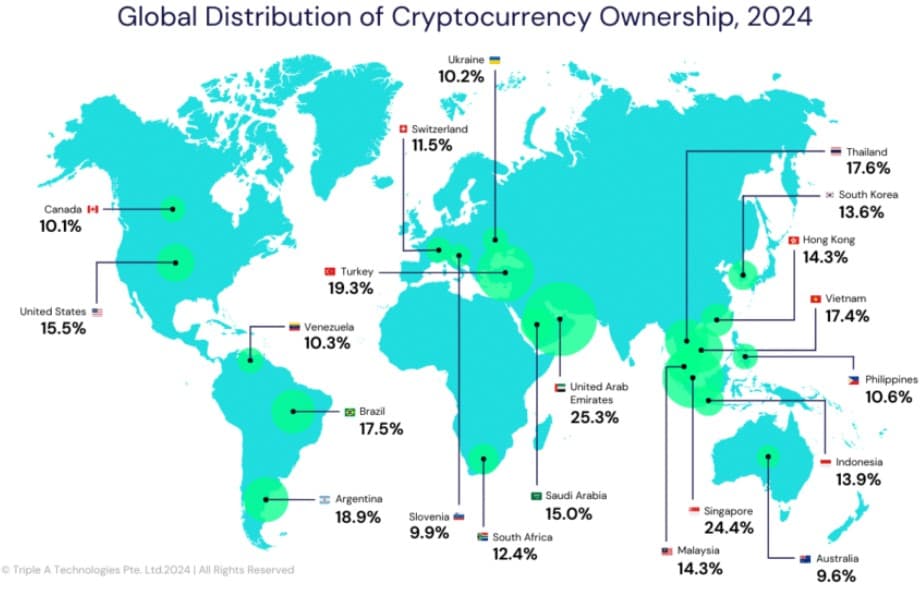
When it comes to which countries have the highest rate of adoption, the United Arab Emirates led the pack among the top 30 economies with a 25.3% adoption rate, followed by Singapore (24.4%) and Turkey (19.3%).
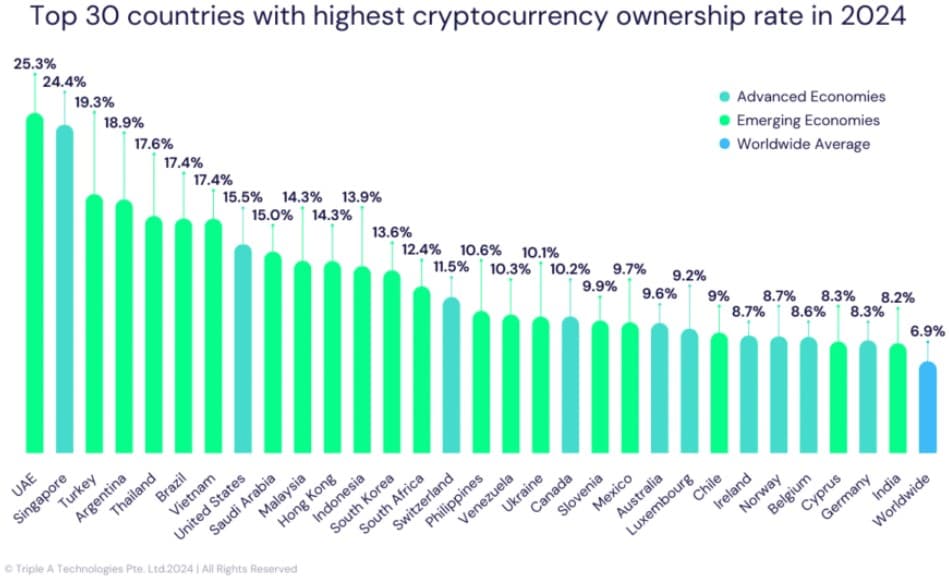
“Among the top 30 countries with the highest ownership rate, we find countries from various continents and economic standings – ranging from emerging markets like Turkey and Argentina to smaller economies such as Slovenia and Luxembourg,” the report said. “Asia maintains its lead in crypto ownership, increasing from 268.2 million to 326.8 million, followed by North America with 72.2 million.”
Ten out of the top 30 countries are located in Asia, highlighting the region’s “reputation as a hub for digital currency adoption and innovation,” Triple-A said.
As for the driving forces behind the increase in crypto adoption, the report cited “regulatory changes, media sensation, and education resources.”
“In 2024, clearer regulations transformed cryptocurrency from a niche market into a significant player in global finance,” the report said. “This regulatory evolution bolsters investor confidence and paves the way for groundbreaking products like Bitcoin Spot ETFs.”
“Events like the Bitcoin halving spark market activity and fuel discussions everywhere, from online forums to casual chats,” they added. “The buzz centers on the potential for huge gains, fueled by FOMO – the fear of missing out on the next big thing. This irresistible mix of financial opportunity and cutting-edge tech keeps attracting new investors eager to ride the crypto wave.”
The report noted that “educational resources like Binance Academy, Crypto.com University, and Coinbase Institute” have “expanded to meet the growing demand for information about this cutting-edge technology.”
Triple-A also cited “various macroeconomic factors, such as inflation and currency devaluation,” as another reason behind the rising adoption of cryptocurrencies.
“With half a billion users globally, increased regulation, and technological advancements, cryptocurrency adoption and use rates will continue to rise,” the report concluded.
A report from Insider Monkey broke down crypto adoption by raw population numbers and found that India leads the world in terms of the number of hodlers.
“India tops the charts regarding the highest cryptocurrency adoption in the world, with around 93.5 million people from its population of 1.42 billion owning cryptocurrency as of 2023,” the report said. “Despite the Indian government’s inclinations to impose a flat-out ban on the trading and use of digital currencies, the country has taken hold of the first spot in our index rating due to its population’s increasing interest in digital currencies backed by a thriving IT industry.”
Unsurprisingly, China ranked second on this metric as it boasts a population of 1.425 billion. “About 5.5% of China’s gigantic population of 1.42 billion own cryptocurrency as of 2023,” Insider Monkey said. “The country is placed second on our list of countries with the highest crypto adoption. The numbers have increased to 59 million in 2023, showing a positive crypto adoption in the country.
The U.S., Brazil, and Vietnam rounded out the top five, with U.S. recording 52.9 million crypto holders out of a population of 339.9 million (15.56%), Brazil having 26 million hodlers out of a population of 216.4 million (11.99%), and Vietnam boasting a crypto contingent of 20.95 million out of a population of 98.8 million (21.19%).
When the figures are adjusted to find a population adoption rate, Vietnam led the pack with a rate of 21.2%, followed by the U.S. (15.56%), the Philippines (13.43%), and Brazil (11.99%).
And according to a report from Statista, adoption is also on the rise in Africa as multiple countries on the continent grapple with failing currencies and geopolitical turmoil.
“Consumers from countries in Africa, Asia, and South America were most likely to be owners of cryptocurrencies, such as Bitcoin, in 2024,” said Statista Research Expert Raynor de Best. “This conclusion can be reached after combining 55 different surveys from Statista's Consumer Insights over the course of that year.”
“Nearly one out of three respondents to Statista's survey in Nigeria, for instance, mentioned they either owned or used a digital coin, rather than six out of 100 respondents in the United States,” he said. “This is a significant change from a list that looks at the Bitcoin (BTC) trading volume in 44 countries: There, the United States and Russia were said to have traded the highest amounts of this particular virtual coin. Nevertheless, African and Latin American countries are noticeable entries in that list too.”
The report from Insider Monkey shows that Nigeria has 13.26 million crypto holders out of a population of 223.8 million, representing an adoption rate of 5.93%. “Nigeria ranks eighth on our list of countries with highest crypto adoption, and is well on the path to becoming one of the key players of digital currencies in Africa,” the report said. “About 6% of the total population of Nigeria owns cryptocurrencies as of 2023.”
Morocco was also included in the list. “1.92 million Moroccans own cryptocurrency, making up 5.08% of the total population,” the report said. “However, the country has had a turbulent relationship with digital currencies in the past. There is a dire need for financially inclusive regulations to allow seamless regulation and use of such currencies in the country. Morocco is ranked 20th among the countries with the highest crypto adoption.”
