(Kitco News) - Geopolitical uncertainty has provided significant safe-haven support for gold, and investors should expect this trend to continue as adversaries continue to chip away at the U.S. dollar’s role as the world’s reserve currency, according to one risk management executive.
On the sidelines of the annual The Conference of Montreal by the International Economic Forum of the Americas, Chad Lesch, Senior Vice President of Strategic Projects at Crisis24, the world’s leading risk intelligence, crisis management, premier medical, and personal security company, said in an exclusive interview with Kitco News that aside from ongoing conflicts around the world, one of the greatest threats to the global economy is the further weakening of the U.S. dollar.
Prior to joining Crisis24, Lesch spent 15 years at the Central Intelligence Agency as a Covert Action Officer in their Special Activities Center. Lesch now uses his skills to help businesses manage risks and identify revenue opportunities.
Lesch explained that the growing multipolar world is helping to fuel geopolitical uncertainty as nations like China try to exert more control over the global economy. This is not just among the expanded BRICS nations—Brazil, Russia, India, South Africa, Iran, Egypt, Ethiopia, and the United Arab Emirates—as Lesch said that China is now starting to further push its influence in South America.
“The trend of de-dollarization is a concern, but the best way to counter it is through a strong U.S. and Western economy,” Lesch said. “A strong Western-aligned economy is one of our greatest defenses against further turmoil.”
Lesch said that one strategy he would like to see is for the U.S. to improve its relationship with India.
He noted that improved economic ties with the world’s largest democracy would significantly support the U.S. dollar’s role as the world’s reserve currency. He added that India has more in common with the US than with China, both governmental and culturally.
“Building upon our relationship with India is huge for a variety of reasons. I think we can get there and it’s in the best interest of both countries,” he said.
A Diversified Global Supply Chain Could Ease Geopolitical Tensions
Lesch added that while geopolitical uncertainty creates obstacles for the global economy, it also creates opportunities. He noted that Crisis24 uses Artificial Intelligence to monitor threats to the global supply chain and economy. The company monitors a complex mix of reporting factors, some of which include weather patterns, elections, civil unrest, labor strikes, corruption, upcoming industry regulations, armed conflict, devaluation of currency, and vetted social media posts from governments and state services.
Crisis24 compiles all the data to provide companies with up to six-month outlooks on potential commodity supply disruptions around the world. Lesch used titanium as an example, as the market saw a massive supply disruption when Russia invaded Ukraine. Because of economic sanctions, Russia’s titanium exports dried up.
“A lot of companies that were reliant on Russia for titanium took an enormous hit,” he said. “But you can’t say that it’s not like we didn’t see that one coming. For two months before, Russia was lining up on the border of Ukraine with its military. Businesses had a two-month head start to try to find other sources. Prior to the invasion, Russia was not a top 10 exporter of the world’s titanium supply, so there are other sources out there that companies could have explored before the war if they were using the right forward-looking intelligence tools, which the US intelligence community calls Anticipatory Intelligence.”
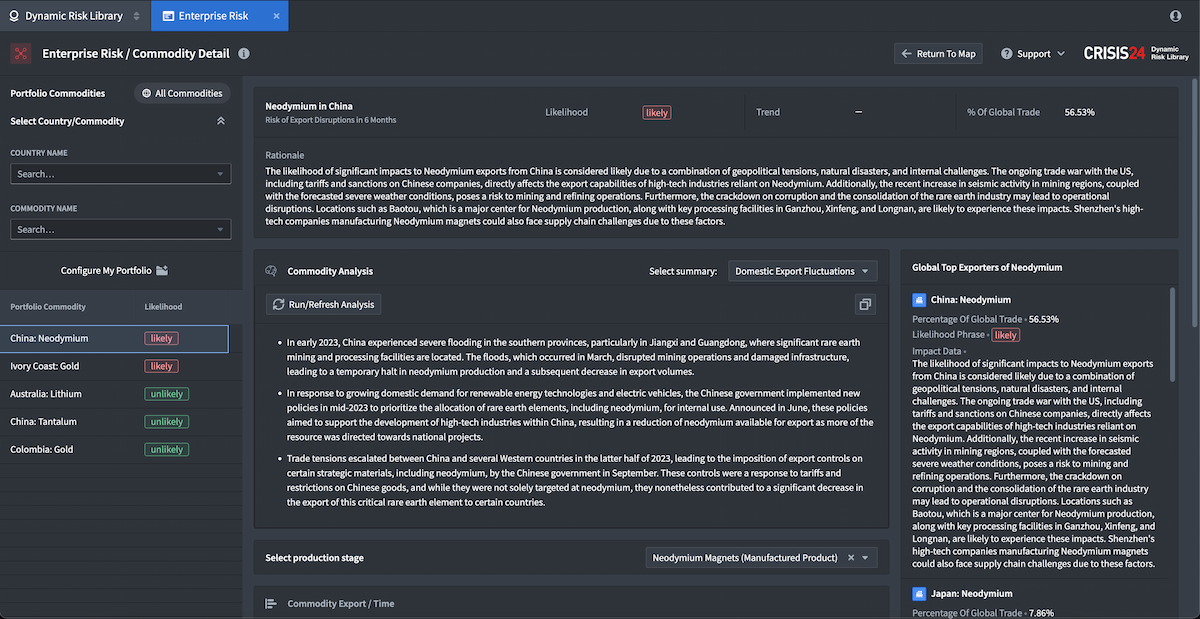
A screen shot of Crisis24's platform that provides in depth analysis of commodity supply chains
Lesch used neodymium, an essential critical metal because of its magnetic properties, as another example. He noted that China produces 50% of the world’s supply; however, Crisis24 has flagged a potential market disruption in that supply. Lesch said companies relying on neodymium could start looking for new sources to protect their supply chain.
“Japan produces only 8% of the world’s neodymium, but it could be a place to start making inroads and connections. Malaysia is just under 7%, so you could start investing in resources there,” he said. “There are options out there. The world economy is quite resilient, but businesses need to stay agile and adopt proactive measures to mitigate risks.”
While there is a delicate balance in the supply chain, Lesch said he is optimistic that diversity in the global commodity supply chain could ease geopolitical uncertainty. Nations could use more diplomacy to resolve international issues so they don’t spook investment capital, potentially hurting their economy.
“Countries are less likely to go to war if everyone is making money and countries have the commodities and security their nation needs,” he said. “Businesses need to look ahead with actionable and reliable intelligence to diversify their supply chains when needed and build resilience. This approach not only ensures continuity but also reduces the likelihood of conflicts escalating due to resource scarcity.”
Conversely, Lesch added that taking these economic threats too far could lead to heightened tensions.
“If nations are completely cut off from the global supply chain and lack access to key commodities, they are backed into a corner. They have no other recourse but to take a harder line,” he said.
While there is hope that global economic tensions could ease, Lesch said that nations and companies need to be aware of a growing global threat: state-sponsored cyber terrorism.
In a panel discussion at the IEFA Conference of Montreal, Lesch said that cyber-attacks by state players have doubled in the past year and will only get worse. “I predict the longer the wars in Ukraine and Israel continue, the more covert action initiatives Russia and other adverse state actors will execute with cyber-attacks, critical infrastructure sabotage, and targeting western businesses. It’s going to get worse before it gets better.”
