

(Kitco News) – Flows into U.S.-listed spot Bitcoin (BTC) exchange-traded funds (ETFs) have dominated the headlines since their launch in January as pension funds and other large institutional investors have revealed their holdings. But in the background, the adoption of blockchain technology by Fortune 100 companies shows that it's not just King Crypto that has captured the attention of investors around the world.
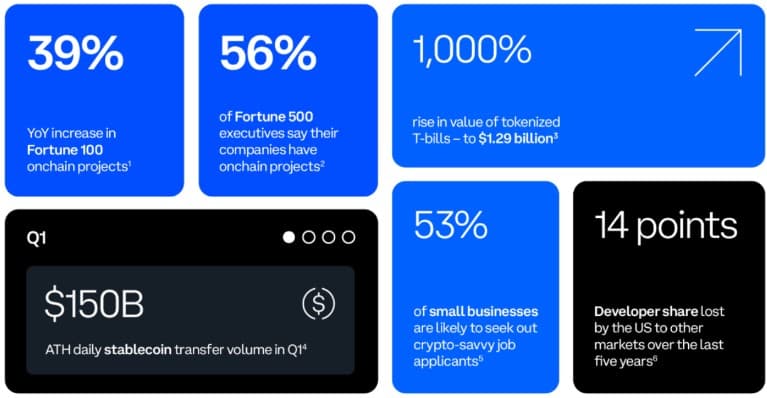
According to the results of an analysis of web3 initiative activity by Fortune 100 companies from Q1 2020 to early June 2024, “the number of cryptocurrency, blockchain or web3 initiatives announced by Fortune 100 companies has increased 39% year-over-year and hit a record high in Q1 2024.”
The analysis was conducted by The Block Pro Research in conjunction with Coinbase.
Expanding to include all Fortune 500 companies, the survey found that 56% of executives for these firms say their companies are working on on-chain projects, including consumer-facing payment applications.
“The increased activity underscores the urgency for clear rules for crypto that help keep crypto developers and other talent in the US, fulfill crypto's promise of better access, and enable US leadership on crypto globally,” Coinbase said. “Many of the most trusted names and products in finance are embracing blockchain technology and crypto, driving innovation and providing on-ramps for widespread adoption.”
The largest exchange in the U.S. noted that currently, the total assets under management of spot BTC ETFs is more than $63 million, and the Securities and Exchange Commission’s approval of spot Ether ETFs on May 23 has “further [scaled] access to spot crypto in familiar, trusted products and spurring adoption.”
“Beyond ETFs – onchain government securities are driving new interest in real-world asset tokenization,” they added. “Recent high interest rates have boosted demand for safe, high-yielding T-bills onchain, sending the value of tokenized US Treasury products over 1,000% since the start of 2023, to $1.29 billion.”
Among other notable developments was the launch of the BlackRock USD Institutional Digital Liquidity Fund (BUILD), which is represented by the BUIDL token on the Ethereum (ETH) network and backed by U.S. Treasury bills, repo agreements and cash.
“BUIDL, at $382 million, recently passed Franklin Templeton’s $368 million fund to become the largest,” Coinbase noted. “Crypto hedge funds and market makers are using BUIDL as collateral for trading coins and tokens. By 2030, the tokenized asset market is expected to hit $16 trillion – the size of the EU’s GDP today.”
The report also cited growth in the stablecoin sector, with Coinbase, Circle, and global payments giants PayPal and Stripe working to make stablecoins easier to use than ever before.
“Via Circle, merchants on Stripe can now accept payment in USDC via Ethereum, Solana, and Polygon – with payments automatically converting into fiat currency,” they noted. “PayPal is supporting cross-border transfers for stablecoin users across about 160 countries – with no transaction fees, versus 4.45% to 6.39% in average charges in the $860 billion global remittance market. The annual settlement volume of stablecoins hit $10 trillion in 2023, more than 10x the amount of remittances worldwide.”
And it's not just the largest firms in the U.S. that are jumping on the bandwagon as “small business, the most trusted institution in the US, is also venturing into crypto,” Coinbase said. “About seven in 10 (68%) believe crypto can help address at least one of their financial pain points, the biggest of which are transaction fees and processing times.”
But in order for adoption in the U.S. to continue to improve, Coinbase said “It’s imperative that the US cultivate increasingly needed talent rather than continuing to lose it overseas. The US continues to lose developer share, down 14 points in the past five years; only 26% of crypto developers are US-based today.”
“Among Fortune 500 (F500) executives, concern about available, trusted talent is now a top blocker to adoption, more than concern about regulation,” the report said. “Among small businesses, half say they’re likely to seek out candidates familiar with crypto the next time they fill a finance, legal or IT/tech role.”
“Clear rules for crypto are key to keeping developers in the US – and to the US continuing to lead the world in cutting-edge technological innovation,” Coinbase said. “It’s also vital to ensure that the technology fulfills its promise of better access – both for crypto-using companies needing financial services and even more crucially, for underserved people in need of financial services.”
The report noted that for the underbanked and unbanked, “about half (48%) of F500 executives say that crypto has the potential to increase access to the financial system and ability to create wealth. For companies that use crypto, one F500 executive noted that banks can do more to encourage innovation by finding more ways to work with them.”
Coinbase stressed the need for the U.S. to exert leadership in the space, noting a high level of interest from F500 executives in this regard. “79% would want to work on initiatives with a partner in the US (up from 73% a year ago), and 72% agree that having a USD-backed digital currency (versus the Yen) keeps the US economy competitive globally,” the report said.
Paul Ryan promotes stablecoin adoption
Coinbase’s argument for greater adoption of blockchain technology and stablecoins got support from an unexpected source on Thursday in the form of an opinion piece in the Wall Street Journal written by Paul Ryan, former speaker of the U.S. House of Representatives, who argued that stablecoins could help safeguard America’s financial future amidst mounting national debt concerns.
“The American experiment is being tested. Nowhere is this more evident than in the trajectory of the national debt,” Ryan said. “The U.S. is headed toward a predictable yet avoidable debt crisis. If nothing is done, the economy will stall while government promises of healthcare and retirement security will be broken. Cuts to national defense will put the country at risk.”
“With no fiscal solution in sight, the crisis is likely to start with a failed Treasury auction forcing an ugly surgery on the budget,” he said. “As the economy contracts, the dollar will suffer a major confidence shock, further imperiling prospects for growth. The obvious answer is to deal with the root causes of the problem. Entitlement programs are driving the debt and require reform, but politicians can’t find the courage to do what needs to be done. The country thus proceeds down this perilous path.”
Pivoting to potential solutions, Ryan suggested that “We might start by taking stablecoins seriously.”
“According to the Treasury Department and DeFi Llama, a cryptocurrency analytics site, dollar-backed stablecoins are becoming an important net purchaser of U.S. government debt,” he noted. “If fiat-backed dollar stablecoin issuers were a country, it would sit just outside the top 10 in countries holding Treasurys – smaller than Hong Kong but larger than Saudi Arabia. If the sector continues to grow, stablecoins could become one of the largest purchasers of U.S. government debt and a reliable source of new demand.”
Paul called the emergence of stablecoins as a mechanism for promoting the dollar “timely.” He said that while the “U.S. benefits from the dollar’s status as the primary international reserve currency… As the global economy becomes more digital and multipolar, the dollar’s primacy is constantly under threat.”
“China understands what’s happening. Financial authorities in Beijing have made digital currency a pillar of the country’s international-development strategy and foreign policy,” Paul wrote. “The Chinese government is using physical and digital infrastructure investment in emerging markets, coupled with financial engineering, to embed the yuan in a network it can control to project influence.”
He warned “The U.S. can’t afford to sit idly as its largest international competitor taps latent demand for safe and convenient digital money. The framework for understanding how the dollar gets its power needs to be updated for a changing world.”
“Setting aside the problems with growing U.S. government debt (of which there are many), the fact that Uncle Sam has been able to sell debt consistently on the international market, often at low rates, is evidence of something important: The rest of the world has an insatiable demand for dollars,” he said. “There are signs, however, that the status quo could be changing—and fast.”
Paul highlighted that China and Saudi Arabia, which have historically been large buyers of U.S. debt, “are gradually retreating from the market. They are also increasingly looking for options for settling payments outside the dollar system.”
“There is, meantime, growing risk that the U.S. government could soon experience a failed debt auction,” he added. “Such an event would roil markets and severely undermine U.S. credibility.”
“If other countries are successful at bolstering their currencies’ influence while dumping Treasury debt, the U.S. will need to find new ways to make the dollar more attractive,” Paul warned. “Dollar-backed stablecoins are one answer.”
He noted that most stablecoins are “held by investors in countries with weak economies and underlying institutions that are looking for ‘better’ money,” and highlighted comments by former CFTC chair Timothy Massad that “stablecoins are analogous to eurodollars, the offshore dollar-denominated liabilities that turbocharged dollar pre-eminence during the Cold War.”
“Promoting dollar-backed stablecoins would follow a well-trodden path and offer clear near-term benefits,” Paul argued. “There would be an immediate, durable increase in demand for U.S. debt, which would reduce the risk of a failed debt auction and an attendant crisis.”
“Unlike China’s digital financial infrastructure, dollar-backed stablecoins issued on public, permissionless blockchains come packaged with the deeply American values of freedom and openness,” he concluded. “A sound, predictable regulatory framework for stablecoins has bipartisan support in Congress and would help dramatically expand the use of digital dollars at a critical time. In an election year, given all the ugly politics to come, we sure could use a win.”
