

(Kitco News) – Institutional investors used last week’s price dip in the crypto market as a prime buying opportunity, as the latest digital asset fund flows report from CoinShares shows that a total of $441 million flowed into crypto funds amid large tranches of selling by the German government and the threat of Mt. Gox tokens being dumped on the market.
The inflows were a welcomed sight after three straight weeks of outflows that coincided with Bitcoin's (BTC) price falling from $69,000 to below $55,000.
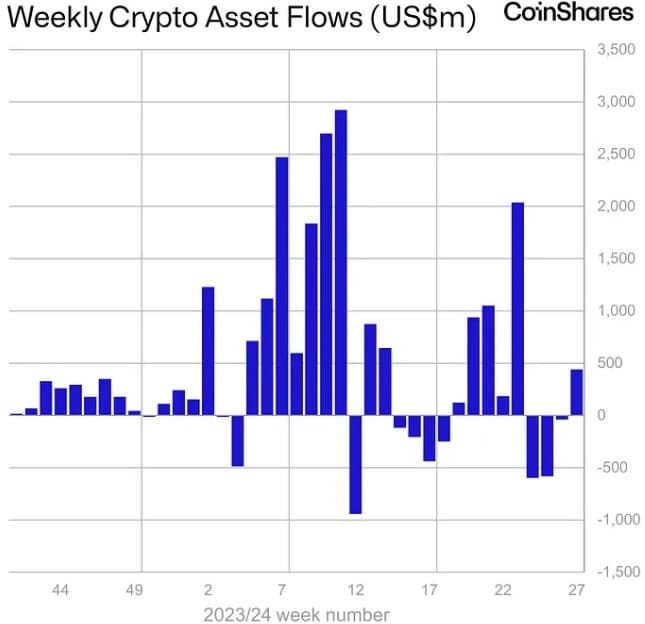
“Volumes in Exchange Traded Products (ETPs) remained relatively low at US$7.9 billion for the week, reflecting the typical seasonal pattern of lower volumes in the summer months,” said James Butterfill, head of research at CoinShares. “This represents a 17% lower participation rate compared to the total market for trusted exchanges.”
The bulk of inflows were seen in U.S.-listed products, which saw a $384 million increase in assets under management, “although opportunistic buying was seen across a broad set of countries, most notable were Hong Kong, Switzerland and Canada, seeing US$32m, US$24m and US$12m respectively,” Butterfill said.

Germany was the main outlier with $23 million in outflows.
“Bitcoin saw US$398m inflows but unusually represented just 90% of total inflows as investors chose to invest across a much broader set of altcoins,” Butterfill said. “Most notable of which was Solana, seeing US$16m last week, bringing year-to-date (YTD) inflows to US$57m, making it the best-performing altcoin from a flows perspective.”
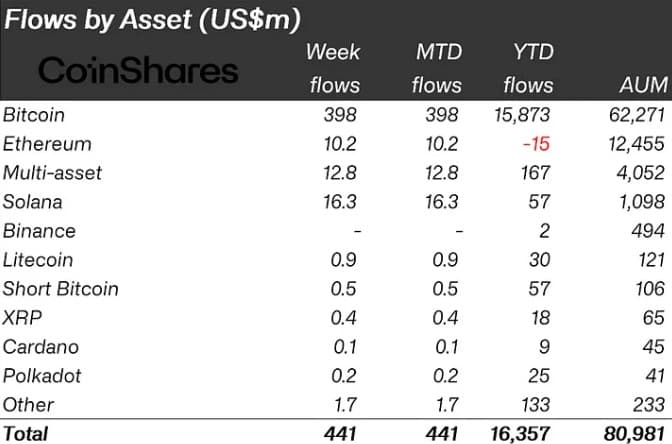
Ethereum (ETH) saw an uptick in sentiment that translated into $10 million worth of inflows, but still has some ground to make up as it “remains the only ETP to have seen net outflow YTD,” he noted.
While many see a potential change of fortune for Ether in the coming weeks as the first spot ETH ETFs are expected to receive approval for trading in the U.S., Konstantin Shulga, CEO and co-founder of Finery Markets, warned it could take a little longer for Ether’s price to see a meaningful benefit.
“It typically takes 6-9 months for innovative financial products to be integrated into the product portfolios of financial firms for widespread adoption,” he said. “This process involves significant time and resources, including training sessions, updates to IT and operational systems, and adjustments to sales processes.”
“The adoption process follows a pattern of pioneers, followers, and mass users, with the key factor being the legitimization of ETH as a mainstream asset rather than the timing of adoption,” he added. “Moving forward, competition will drive the development of infrastructure to meet the growing demand, as evidenced by the record-breaking inflows into the BTC ETF following its approval.”
The one thing that could extend this process is the uncertainty surrounding Ether from a regulatory perspective, as the debate about it being a commodity or security continues.
“The surge of cryptocurrency as a unique and highly desired asset class poses a significant conundrum for financial regulators, who are struggling to determine how to categorize these digital assets within established classifications like commodities, currencies, and securities,” Shulga said. “Differing viewpoints among regulators regarding the classification of assets such as ETH have resulted in ongoing difficulties in oversight and regulation.”
“Despite ongoing debates, the main point is that over the past ten years, this up-and-coming asset class has consistently drawn interest from both retail and institutional investors,” he concluded. “Therefore, we observe the conventional trend of regulations trailing behind innovations, and this crypto adoption process is unidirectional. It is simply a matter of time.”
While both Bitcoin and Ether saw a bounceback in inflows amid the decline in sentiment, the one sector of the crypto market that continued to struggle is blockchain equities, which “saw a further US$8m outflows last week bringing YTD outflows to US$556m,” Butterfill said.
Overall, last week’s sell-off helped clear the market of excess froth as derivatives traders saw their long positions liquidated en masse.
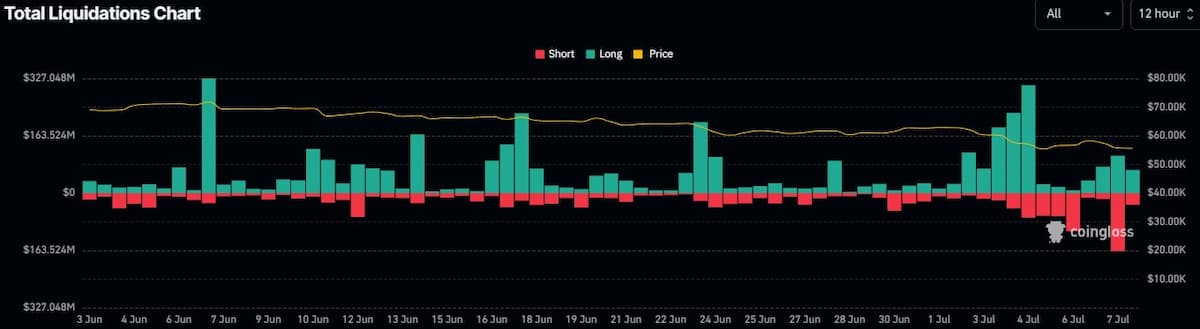
According to analysts at Hyblock Capital, prior to the pullback, “76% of accounts on Binance that were in a position on BTC were net long. This represented a substantial increase from 71% just 24 hours prior. The 76% long position put this metric in the 99th percentile, making it a massive outlier over the last 90 days.”
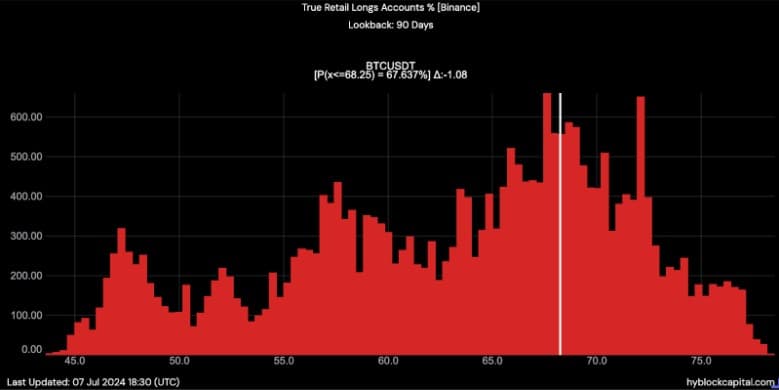
“Retail accounts holding long positions on Binance have reduced from 76% pre-crash to 68% post-crash,” the analysts said. “As the price is reversing, it is important to keep an eye on this metric to see what retail investors are doing.”
Data provided by Alternative shows that the Crypto Fear & Greed Index is now firmly in “Fear” territory, which has often been a sign for traders that it's time to get back into the market and be “greedy when others are fearful.”
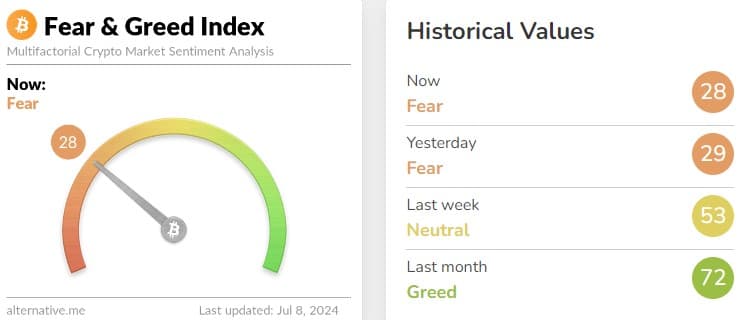
“Currently, the index stands at 29, indicating fear,” said analysts at Hyblock Capital. “The last time we saw these levels on the index was post-FTX crash in late 2022 and early 2023. Monitoring this index can provide insights into potential market movements.”
