

(Kitco News) – Determining the global rate of cryptocurrency adoption has been a challenge for analytical firms as many crypto users appreciate their privacy, leading to varying estimates on the global level of uptake.
As previously reported by Kitco Crypto, a report from digital currency payment provider Triple-A found that the global user base for digital currencies climbed to 562 million people in 2024, up from 420 million in 2023. That represents an increase of 33.8% – equivalent to 6.8% of the global population.
Instead of attempting to identify the number of users, CoinWire utilized a different approach to determine mainstream acceptance and adoption of crypto: analyzing crypto trading volumes.
“By analyzing 136 countries, we have estimated the crypto trading volume of each country using four critical factors: Web Traffic, Website Language, Headquarters location, and Trading Time Zone,” a report from CoinWire said. “This multifaceted approach allows us to provide a nuanced understanding of the major players in the crypto market.”
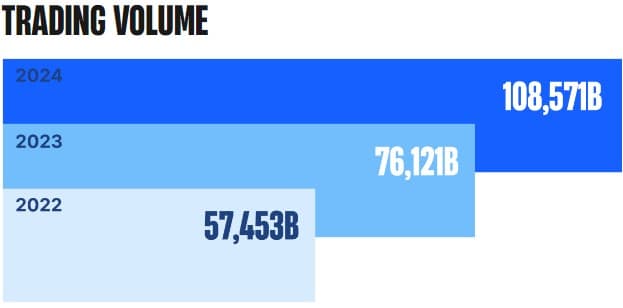
CoinWire looked at a list of centralized exchanges (CEX) with trust scores above 6 from CoinGecko for their study and found that the global cryptocurrency trading volume in 2024 is expected to exceed $108 trillion, a figure that is “nearly 90% higher than in 2022.”
The study also determined that “The United States holds the title for the country with the highest estimated crypto trading volume in 2024, surpassing $2 trillion.”
“Global cryptocurrency trading volume has surged dramatically, increasing by 42% since 2023,” CoinWire analysts wrote. “Over the past three years, the market has expanded by an impressive 89%, reflecting the growing acceptance and adoption of digital assets on a global scale.”
While the U.S. has the highest estimated trading volume, Europeans lead the world in the value of crypto transactions. “Europe has emerged as the leader in this burgeoning market, accounting for 37.32% of global cryptocurrency transaction value,” the analysts said.
“Europe is a hub for crypto innovation and investment due to progressive regulatory frameworks and a tech-savvy populace,” they wrote. “Hot on Europe's heels, Asia ranks second, contributing 36.17% to the world's cryptocurrency transaction value. High mobile penetration, a robust tech infrastructure, and rising institutional interest are all contributing factors to the region's rapid uptake.”

The U.S. ranks fifth in transaction value behind South America, showing that while Americans like to trade crypto on exchanges, they aren’t as interested in using crypto in their daily lives as much as those in Europe, Asia, Africa, or South America.
Looking closer at each specific region, CoinWire found that “Russia leads Europe in cryptocurrency trading, ranking among the top five globally, with an estimated trading volume exceeding $633 billion.”
“The United Kingdom follows closely, with a trading volume surpassing $624 billion, making it the second-largest market in Europe and the sixth worldwide,” the report said. “According to a study, London was positioned as a highly crypto-ready city, which bolsters the UK's prominence thanks to its advanced financial services and supportive government policies.”
Slovenia “boasts the highest monthly cryptocurrency expenditure per capita, with individuals spending an average of $2,609 per month on crypto, over 3.46 times their monthly rent.” Meanwhile, citizens of Ukraine utilize cryptos “as a crucial alternative to fiat currency amid economic instability with citizens spending nearly three times their monthly rent on crypto, equivalent to 2.58 times their monthly wage.”
In Asia, Turkey led the region “with an estimated trading volume exceeding $1 trillion in 2024.”
“Turkish citizens spend an average of $1,352 per month on cryptocurrency, which is over three times the average monthly wage and 2.5 times the rent,” CoinWire said. “This high expenditure highlights the increasing reliance on digital currencies as a hedge against economic instability.”
In Singapore, the average per capita monthly spend on cryptocurrency is $2,681, “nearly equivalent to the average monthly rent. This significant investment underscores the country's progressive regulatory framework and the population's strong belief in the future of digital assets,” the report said.
Nigeria and South Africa account for the largest trading volumes on the African continent.
“Africa is leading in crypto trading growth, with 2024 volumes projected to be five times higher than in 2022,” CoinWire said. “Estimated trading volumes are expected to reach $10.8 trillion in 2024, up from $2 trillion in 2022 and $2.7 trillion in 2023.”
There has also been significant growth and adoption in South America over the past three years, with the crypto trading volume jumping “over 3.42 times.”
“Estimated trading volumes are projected to reach $7.82 trillion in 2024, up from $2.29 trillion in 2022 and $3.03 trillion in 2023,” the report said.
The South American countries with the highest level of transaction volume are Brazil and Chile.
“Brazil stands out as the leading country in cryptocurrency trading, with a projected trading volume exceeding $354 billion in 2024,” the analysts noted. “Following Brazil is Chile, with a crypto trading volume exceeding $105 billion.”
“Chile is notable not only for its trading volume but also for the high monthly expenditure on cryptocurrency by its citizens,” they added. “On average, Chileans spend $447 per month on crypto, which amounts to 65% of their monthly income and nearly matches their monthly rent expenses. This substantial investment reflects the growing confidence in digital assets as a viable financial tool in Chile.”
Looking at North America, “The United States remains the leading crypto trading country, not just in North America but globally, with an estimated trading volume surpassing $2 trillion in 2024,” the report said. “Following closely is Canada, with over $333 billion in estimated crypto trading volume.”
“Despite the high trading volumes, US citizens spend relatively modestly on crypto, averaging $507 per month, which constitutes nearly 12% of their monthly wage,” the analysts noted. “This indicates a cautious but significant investment approach among Americans.”
The final region studied was Oceania, which has seen crypto trading volumes triple since 2022.
“In 2024, the estimated trading volume is projected to reach $2.44 trillion, up from $805.7 billion in 2022 and $1.07 trillion in 2023,” the report said. “Australia leads Oceania's crypto market, with an estimated trading volume surpassing $208 billion in 2024. In contrast, New Zealand's crypto trading volume is much smaller, at just $29 million.”
“Australians are actively investing in digital assets. On average, each individual spends $659 on crypto each month,” the analyst said. “This significant expenditure reflects the country's growing confidence in cryptocurrency as a viable investment. Despite the lower trading volume, New Zealanders are still engaging with the crypto market, spending around $469 per month on digital assets. This substantial personal investment indicates a strong interest in and belief in the potential of cryptocurrencies, even in a smaller market.”
When it comes to which cryptocurrency exchange is most popular among traders, CoinWire found that “Binance leads the crypto exchange market, dominating in 100 countries with a staggering trading volume of $2.77 trillion.”
“This positions Binance as the most influential and widely used exchange globally,” the analysts said. “Close behind, Binance US also dominates in 100 countries, but with a significantly lower trading volume of $3.9 billion.”
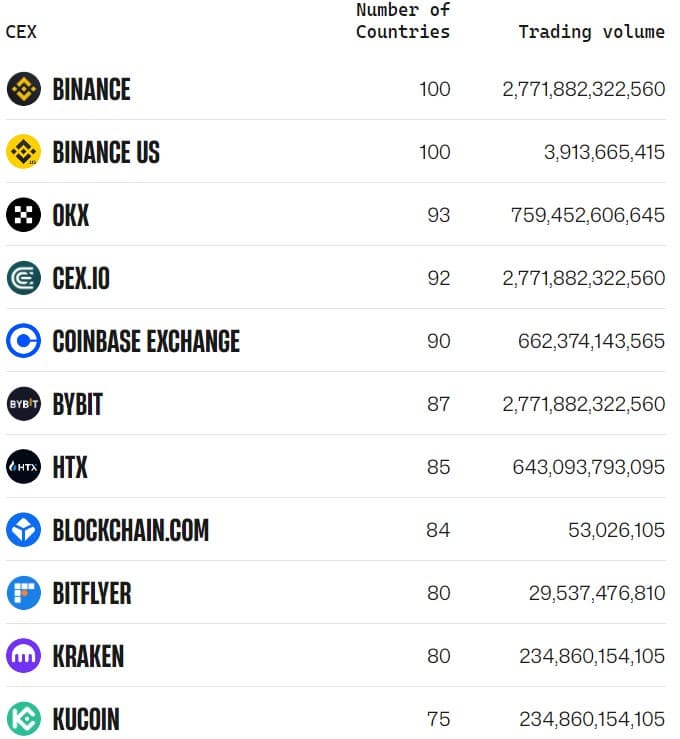
Other honorable mentions include OKX and CEX.io, which lead in “93 and 92 countries, respectively, with trading volumes of $759 billion and $1.83 billion.”
“Coinbase Exchange and Bybit follow, each dominating 90 and 87 countries, with trading volumes of $662 billion and $1.14 trillion, respectively,” they wrote. “These figures highlight the competitive landscape of crypto exchanges, with Binance maintaining a substantial lead both in terms of geographical dominance and trading volume, underscoring its pivotal role in the global cryptocurrency market.”
“Cryptocurrency use and exchange are continuously changing economic landscapes on a global scale, with Europe and Asia leading the way and significant contributions from other regions,” the report concluded. “As this market continues to develop, it will be essential to closely observe these patterns and how they affect both the global financial system and individual economies.”
