
(Kitco News) – Monday’s price action across financial markets was one for the record books – though not in a good way – as asset prices fell across the board following a sharp downturn in Japan’s Nikkei, which sent negative reverberations across global markets.
“The recent turmoil in the Japanese stock market, which saw the Topix index record its most significant two-day decline since the 2011 tsunami, marks a severe reversal from its record highs in July,” said analysts at Bitfinex. “This downturn was triggered by the Bank of Japan's unexpected rate hike on Wednesday and the hawkish tone adopted by Governor Kazuo Ueda, plunging both the Topix and the Nikkei 225 into a technical correction.”
“Simultaneously, Wall Street experienced a deepening of losses on Friday, August 2nd, with a significant decline in US equities and Treasury yields reaching multi-month lows,” they added. “This was spurred by a disappointing jobs report, intensifying concerns that the US Federal Reserve has delayed interest rate cuts, thereby heightening the risk of a more pronounced economic slowdown in the US.”
“These events underscore the fragility and interconnectedness of global financial markets, highlighting how policy shifts and economic indicators can precipitate rapid changes in investor sentiment and market dynamics,” the analysts said. “Economic and political developments are exerting significant influence across all markets, not just cryptocurrencies.”
The knock-on effect of Japan’s economic struggles on global markets has been severe, as evidenced by the declines seen in the U.S. markets on Monday. At the closing bell, the S&P, Dow, and Nasdaq all recorded significant declines, finishing the day down 3.0%, 2.60%, and 3.43%, respectively.
“This broader market instability has also led to notable downturns in stock markets, indicating a widespread impact of current global events,” Bitfinex analysts said. “Since BTC and the SPX have experienced positive correlation since mid-July, we expect the oscillating nature of the correlation to play out and the correlation across risk assets to increase moving forward. However, if the stock market continues to be plagued by downside, it is increasingly likely that BTC might continue to face downward pressures in such a scenario.”
Even the established safe-haven assets of gold and silver fell under the weight of declining sentiment, trading down 0.80% and 3.79% respectively at the time of writing.
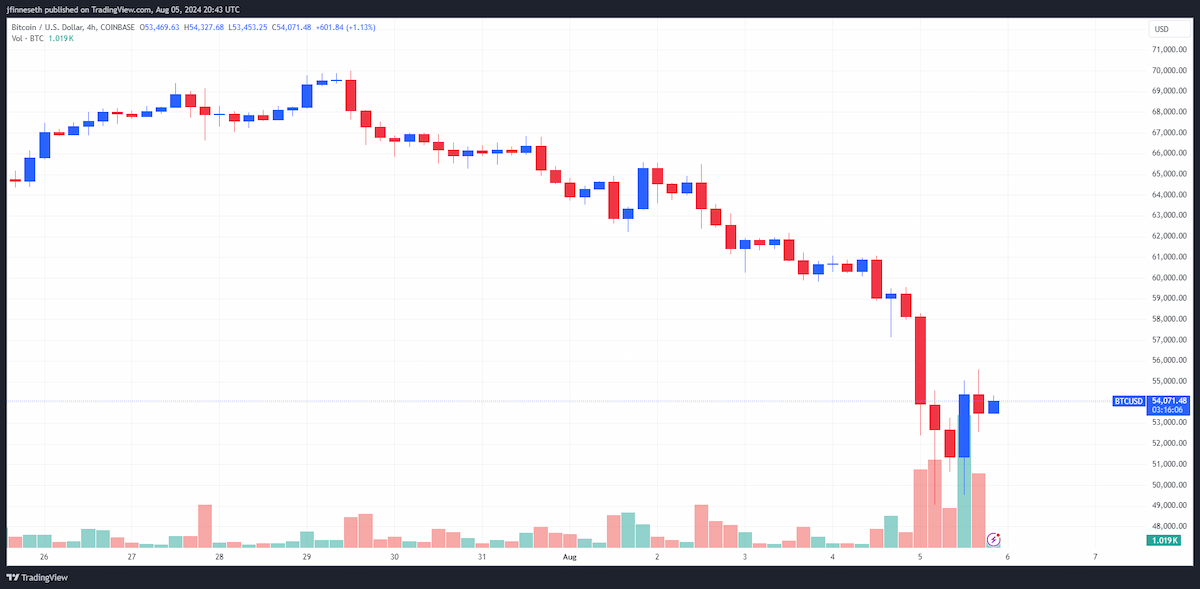
Data provided by TradingView shows that Bitcoin (BTC) broke below support at $59,000 in the early hours on Monday and fell to a low of $49,053 before dip buyers arrived in force and pushed it back above $54,000.
BTC/USD Chart by TradingView
At the time of writing, Bitcoin trades at $54,046, a decrease of 8.19% on the 24-hour chart.
Panic mode
"Right now, the market is in a panic mode for three reasons: fear of recession, US Fed concerns and over-hyped tech stocks,” said Warren Anderson, co-founder of Exocore, in a note to Kitco Crypto. “There are a lot of fears surrounding a potential recession and digital assets being a victim in the unwinding yen carry trade.”
“Not only do investors have to adjust to higher interest rates in Japan, but they’re also battling a drastic increase in hedging costs based on volatility in the USD-JPY trading pair,” he noted. “However, Wall Street fears of a recession may lead to an emergency rate cut from the Federal Reserve, which many argue has been overly patient on cutting rates.”
“The sudden shift could lead to the US bond market and treasury yields dropping to their lowest level in a year,” Anderson added. “This could become a positive for Bitcoin and the broader DeFi market. Recall that Bitcoin was created for times like these, where investors could have a safe haven asset that isn’t correlated with the other recessionary asset classes. If history rhymes, traders are going to look to alternative assets to continue building their portfolio and this could become Bitcoin’s time to shine.”
“Crypto is coming from a weekend for the books,” said analysts at Abra. “Every asset crashed; main currencies dropped 20-30% from Friday to Monday. Vol levels hit year's high today, which can impact prices in either direction. News flow has turned bearish with a few notes looking at this drop as a buy-in opportunity, which should not be ruled out.”
“Post this year’s highs BTC and ETH are trading at the lowest price point, and options open interest is now focusing on downside,” they added. “The driver for this massive selloff could be a combination of global tensions, fears of a recession, and an excess of long leveraged positions coming from a bull trending month. What will happen in the following days is uncertain.”
While the future is unknown and more downside is possible, Abra analyst Bohan Jiang said “this selloff remains a great opportunity for long-term buyers – but picking a bottom is always difficult when volatility is so high.”
“Given this sell-off has been macro-driven, I would look for signs of improvement on the macro side before attempting to get long here,” he said. “I would also make the case that perhaps the worst of the crypto sell-off has already been exhausted, as the only market open during the weekend.”
“This was the highest spot-vol beta we’ve seen in the VIX since Covid – with the S&P just over 10% down from its highs, and the VIX printing just over 65 this morning,” Jiang noted. “It’s clear to me that this move has been positioning driven, with concentrated positioning in structurally short vol carry trades: you can argue that the BOJ hike last tuesday leading to a massive sell-off in USDJPY and the Nikkei, the 2s10s curve uninverting off a weak NFP report, concentrated positioning in the Mag 7, as well as increased geopolitical tensions in the Middle East have all contributed to this move.”
“Nevertheless, the cross-asset moves have made it clear where positioning was offsides: gold was sold into these moves, the DXY was weaker (driven by EUR, JPY, CHF), while US treasuries moved higher during this selloff,” he observed. “Front-end US rates are now pricing in ~63% probability of 4 cuts and 26.5% probability of 5 cuts now until YE’24, with 9 cuts now priced in until YE’25.”
“This pricing now screens rich in my view: I don’t believe that the July FOMC meeting was a policy error and the cause of this sell-off, nor do I think emergency rate cuts are in play: this sell-off was simply induced by a volatile cascade of deleveraging across concentrated positioning,” Jiang concluded. “With that said, despite the recent economic weakness, I ultimately think that this event will reveal itself to many opportunities in risk assets over the short term – though I would watch for the VIX to come down and the yield curve to uninvert before attempting any longs.”
Altcoin bloodbath
Altcoins were hammered amid the cascading sell-off across global markets, with only five tokens in the top 200 recording a gain of more than one percent on Monday.
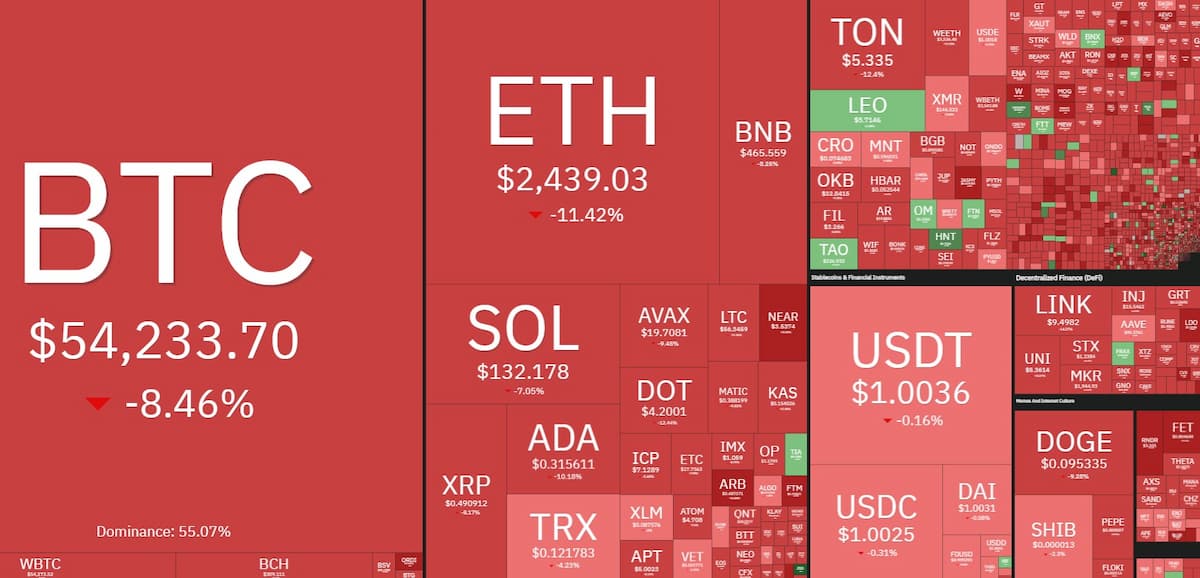
Daily cryptocurrency market performance. Source: Coin360
“The prevailing negative mood is particularly detrimental to altcoins, many of which are experiencing severe volatility and market cap erosion,” said Bitfinex analysts. “Some of these altcoins may not survive the ongoing market correction.”
FTX Token (FTT) was the biggest gainer, increasing 4.6%, while Galxe (GXE) climbed 3.2%, and SATS (1000SATS) gained 3%. Popcat (POPCAT) was the biggest loser, falling 27.8%, followed by a 25% loss for SKALE (SKL), and a 23.5% decline for Mog Coin (MOG).
The overall cryptocurrency market cap now stands at $1.89 trillion, and Bitcoin’s dominance rate is 55.8%.
