

(Kitco News) – Bitcoin’s (BTC) price slid back below support at $62,000 in early trading on Tuesday, erasing the gains enjoyed following Friday’s Jackson Hole speech from Fed Chair Jerome Powell, where he said the central bank was ready to start lowering interest rates as long as inflation measures continue to improve.
“The crypto market failed to grow steadily, with total capitalization falling 1.6% to $2.21 trillion,” noted Alex Kuptsikevich, senior market analyst at FxPro. “This is a slight correction following the unimpressive performance of the equity market. The Sentiment Index fell back into neutral territory, losing 7 points on the day to 48.”
“Bitcoin fell below [$62K], losing [2.3]% in 24 hours and dropping below its 200-day moving average,” he added. “It's too early to tell if this line has become resistance.”
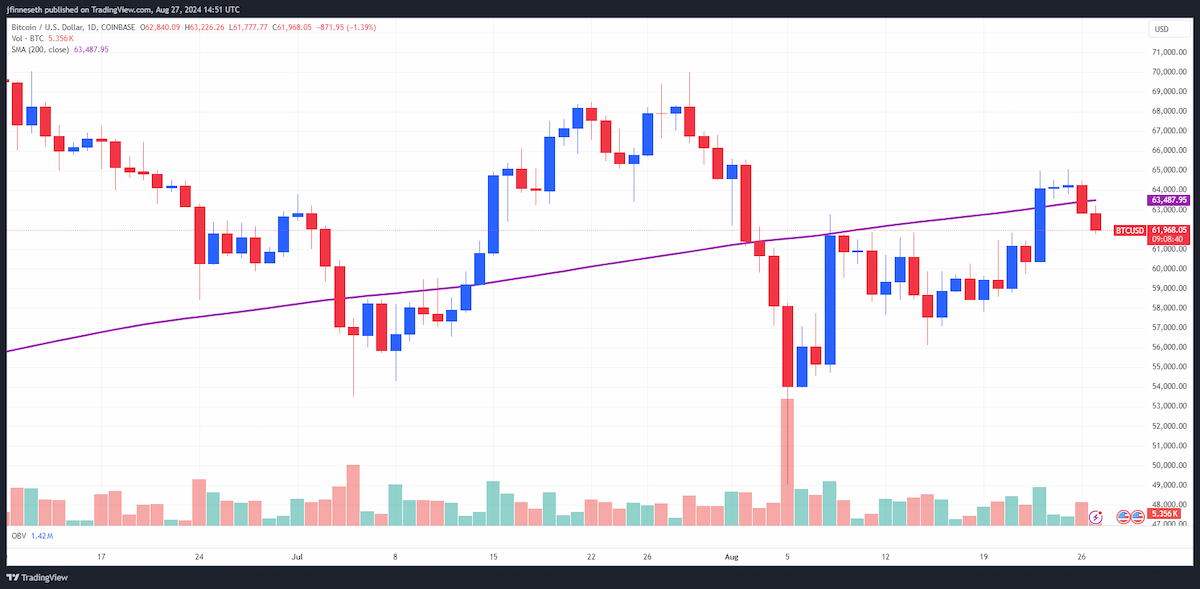
BTC/USD Chart by TradingView
“Ethereum (ETH) fell [4.4]% to $2600, remaining in the lower half of the range from the July highs to the August lows,” Kuptsikevich said. “The $2800 area served as strong support on the dips from April to July this year and now provides important resistance.”
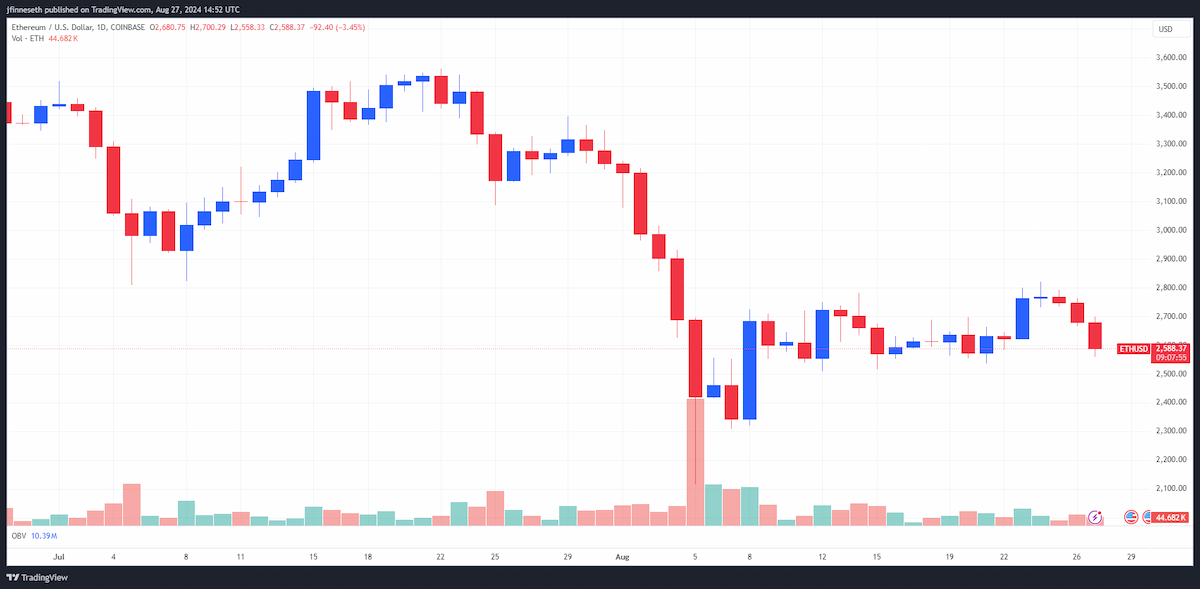
ETH/USD Chart by TradingView
The weakness in early trading on Tuesday comes as market watchers remain tepid ahead of Nvidia’s (NVDA) earnings report on Wednesday, with investors curious to see if the chipmaking powerhouse can continue to outperform – and boost the broader market along with it.
Also top-of-mind for traders is Friday's reading on the PCE price index, the Fed’s preferred inflation gauge, which could be the deciding factor between a 25 bps cut and a 50 bps cut in September.
While the crypto market is struggling to gain momentum, recent inflows into spot Bitcoin exchange-traded funds (ETFs) suggest that institutional demand is slowly creeping higher as an interest rate cut draws closer.
“Last week, these ETFs saw about $500 million in net inflows, followed by an additional $200 million yesterday (Monday, 26th August),” said Matteo Greco, Research Analyst at Fineqia International. “BTC spot ETFs have now recorded eight consecutive trading days of positive inflows, and for the first time, surpassed $18 billion in net inflows since their inception, setting a new all-time high.”
“Trading activity also remained robust, with BTC spot ETFs trading approximately $7.6 billion over the past week, confirming trading volumes not seen since April,” he added. “This contrasts with the typically quieter trading periods in Q3, particularly in July and August, and shows strong demand for BTC.”
While BTC ETF inflows have been a bright spot for the market, Ether ETFs continued to bleed, putting downward pressure on ETH prices.
“Ethereum ended the week at approximately $2,750, reflecting a 5.1% increase from the previous week's closing price of around $2,610,” Greco noted. “During the same time, ETH spot ETFs experienced approximately $43 million in outflows last week, followed by $13 million in outflows yesterday (Monday, 26th August), continuing a trend of negative flows. Unlike BTC spot ETFs, ETH spot ETFs have seen eight consecutive trading days of net outflows, indicating a contrasting sentiment in recent weeks.”
Unlike Bitcoin, which recorded heavy inflows in the weeks and months following launch, Ether ETFs have thus far recorded net outflows of $478, Greco highlighted. “It’s worth noting that these recent outflows have been heavily influenced by withdrawals from the Grayscale Ethereum ETF (ETHE), following its conversion from a trust to an ETF, like what occurred when the Grayscale Bitcoin Trust began trading as an ETF,” he said.
“Last week, ETH spot ETFs traded a cumulative $830 million, showing significantly lower trading activity compared to BTC, even when adjusted for market capitalization,” he added. “This suggests that, despite positive price action for ETH, traditional finance investors have not yet shown sustained demand for financial products tied to Ethereum.”
“Comparing the first 25 trading days of BTC and ETH spot ETFs, BTC has seen 19 days of net inflows and 6 days of outflows, while ETH has experienced 8 days of net inflows and 17 days of outflows,” Greco said. “This stark difference in demand, favoring BTC over ETH among traditional finance investors, is not surprising and should not be seen as a negative outcome.”
“The conversation around including altcoins in ETFs in the US only started less than a year ago, after BTC spot ETFs started trading. ETH spot ETFs received rapid approval, whereas BTC spot ETFs had been under discussion for years before gaining the green light,” he explained. “As a result, BTC spot ETFs have an established investor base that was built up over several years, while issuers are still working to attract new investors and demand for ETH, and potentially other altcoins, aiming to boost digital asset adoption in the coming months and years.”
At the time of writing, Bitcoin trades at $61,935, a decrease of 2.21% on the 24-hour chart, while Ether trades at $2,593, a decline of 4.48%.
