
(Kitco News) – Amid the growing ranks and strength of the BRICS bloc and talk of de-dollarization, reports indicate that two of the group’s largest members – Russia and India – have already opened covert channels for trade as a workaround to U.S. sanctions.
According to a report from FT, Russian state correspondence seen by the outlet indicates that Russia has been secretly obtaining sensitive goods from India and has explored constructing facilities in the country to aid in its war efforts.
The documents show that Moscow’s industry and trade ministry, which is responsible for overseeing Russia’s defense production, drafted confidential plans in October 2022 to spend roughly $1 billion to acquire critical electronics via channels unmonitored by Western governments.
Russian banks had acquired a “significant reserve” of rupees through oil sales to India, and the plan detailed the use of these reserves to fund the covert operations to obtain crucial goods “previously supplied from unfriendly countries.”
The focus of the operation was on dual-use technologies – items that have both military and civilian applications – that are included on the sanctions control list, the documents showed. The leaked files also showed that Ruissa made plans to invest in Russo-Indian electronics development and production facilities.
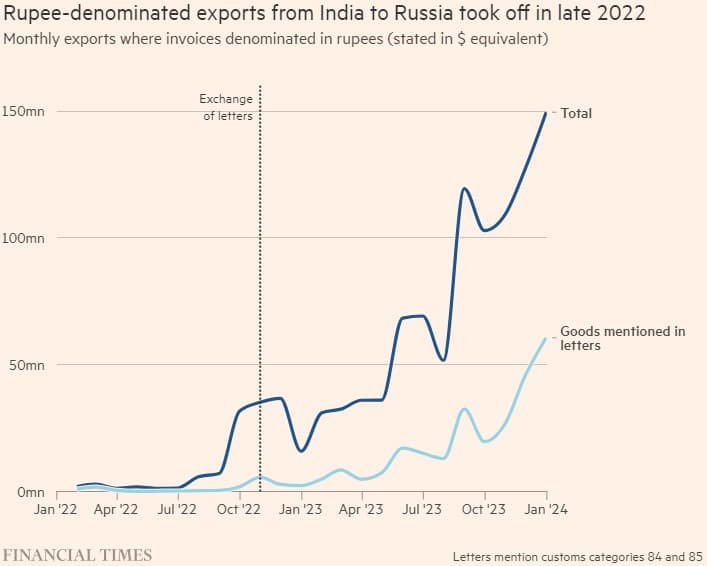
It’s unclear how much of the clandestine operation was enacted, but detailed trade flow data indicates the trade relationship between India and Russia has deepened for the specific categories of goods outlined above.
The agreement came despite India establishing closer ties with the U.S. and warnings from Wally Adeyemo, Deputy Secretary of the U.S. Treasury, that “any foreign financial institution that does business with Russia’s military-industrial base risks being sanctioned itself.”
“This heightened sanctions risk exists regardless of the currency used in a transaction,” Adeyemo said in a letter addressed to three of India’s top business organizations.
It is well documented that India extended an economic lifeline to Russia following Western sanctions and has maintained an official status of neutrality and non-aligned foreign policy regarding the conflict in Ukraine.
The country’s reluctance to oppose Russia’s actions likely stems from its established trade ties.
Russia supplies more than half of India's military equipment, including tanks, weapons, and fighter jets, often offering them cheaper than arms from Western countries. This is especially pertinent given India’s contentious relationship with several neighboring countries, including fellow BRICS member China.
Over the past two years, multiple skirmishes have broken out along its contested border with China to the east, and there's constant tension along the line of control in disputed Kashmir on India's western border with Pakistan.
India has also been a major buyer of Russian crude oil in recent years despite the sanctions, with the total trade between the two countries hitting an all-time high of $66 billion during the 2023-24 financial year. This figure is five times higher than the trade that occurred in the year before the invasion of Ukraine. It is through these trading activities that Russian banks have obtained a stockpile of rupees.
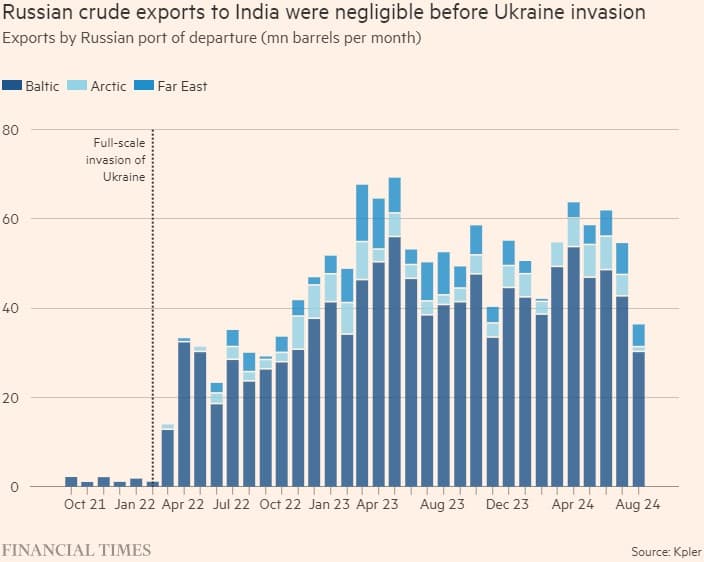
Holding the rupee has also enabled Russian groups to trade gold and purchase goods to evade the sanctions, according to people involved in the trade and Western officials. This has helped the Kremlin in its oil profit repatriation efforts.
One Russian central government official referred to heavily in the leaked documents is Alexander Gaponov, deputy head of the industry and trade ministry’s radio-electronics division. The reason for his involvement is due to Russia’s reliance on foreign-produced electronics for use in missiles, drones, and electronic warfare.
In October 2022, Gaponov reportedly reached out to the Consortium for Foreign Economic Activity and International Interstate Cooperation in Industry – a Moscow-based organization with ties to Russian security services – regarding the plan to acquire critical components from India.
Vadim Poida, the consortium’s president, responded by saying they had developed “specific plans” with the Russian electronics industry and “representatives of the relevant Indian state and private businesses” that had “high potential” for making use of the Kremlin’s rupees.
The plan included five stages that detailed how Russia could spend its rupees and establish a steady supply of dual-use components. Podia said the plan included Russia setting up a “closed payment system between Russian and Indian companies” beyond the oversight of Western countries, “including by using digital financial assets.”
The consortium calculated that Russia could spend up to 100 billion rupees on various components, including parts for “telecommunication, server, and other complex electronic equipment” that were previously acquired from Western countries.
Poida noted that consortium members had already begun pilot projects for producing Russian-designed components in India and conducted “detailed work on the issue of hiding information about the participation of Russian individuals and corporate entities, as well as the logistics of supply via third countries.”
He also said that any additional funds could be used to fund joint ventures creating electronic factories in India that could “meet the needs of Russian critical information infrastructure.”
According to the leaked correspondence, the plan was for Russia to pay for two specific customs categories of goods, types of electronics and machinery, in rupees. Subsequent filings from the Russian government show that trade in these two categories has risen sharply from the “negligible volumes” reported before 2022.
A customs filing from India-based Innovio Ventures shows the firms supplied at least $4.9 million worth of electronic equipment, including drones, to Russia, along with $600,000 in goods shipped to Kyrgyzstan, all of which were settled in rupees.
The shipments to Russia reportedly included $568,000 in electronic equipment sent to Testkomplekt, a Russian company under U.S. and EU sanctions for being central in Moscow’s military procurement system.
