
(Kitco News) – While presidential candidate Donald Trump has tripled down on his outreach to the cryptocurrency community, promising to unveil a plan to turn the U.S. into the “crypto capital of the planet,” several data points suggest that the asset class won’t factor into voters decisions as much as Trump thinks as more pressing matters remain top-of-mind.
For starters, Senate Majority Leader Chuck Schumer (D-NY) released a letter on Sunday that outlined what he sees as priorities for the Senate before this session ends. The letter made no mention of crypto but did discuss artificial intelligence (AI).
“In the remaining months of this Congress, we can continue this momentum in even more key policy areas, but of course we will need republican cooperation,” Schumer wrote. “There are still opportunities for bipartisan cooperation on NDAA, rail safety, lowering the cost of insulin and prescription drugs, and artificial intelligence, among others. While we won’t be able to achieve all of these goals before the election, it is my hope that our Republican colleagues will work with us to make as much progress as possible.”
“Finding compromise is never easy, but we know it is the only path to achieving results for the American people,” Schumer concluded. “Our caucus unity has been the key to our success, so I want to thank each of you for all your work to find compromise whenever possible.”
Schumer did not address crypto despite his promise at a Crypto4Harris town hall last month to support efforts to pass meaningful crypto regulation by the end of the year, saying, “Washington cannot just look away from crypto.”
His call for unity and compromise comes amid bipartisan efforts to prevent a government shutdown, with government funding set to expire on September 30.
Another sign that Democrats don’t see crypto as a key voting issue is the fact that at last month’s Democratic National Convention, the Democratic National Committee (DNC) unveiled its official platform, a nearly 100-page document that made no mention of cryptocurrency or blockchain technology.
This is in stark contrast with the Republican platform, which contains several pro-crypto positions, including a pledge to “defend the right to mine Bitcoin and ensure every American has the right to self-custody of their digital assets.”
While Vice President Kamala Harris, the Democratic nominee for president, has shown some signs that her administration would be more of an ally to the crypto community than the Biden administration. But the community has been unimpressed with her outreach thus far, leading many to wonder if she is sincere and whether Democrats see the crypto voting bloc as needed support.
According to Ravi Sarathy, professor of international business and strategy at Northeastern University and author of Enterprise Strategy for Blockchain, the softening regulatory stance on crypto in the past several months might lead more Americans on both sides of the political spectrum to engage with digital currencies, which, in theory, would create a larger constituency of voters with a shared interest around decentralized finance (DeFi).
“Both Republicans and Democrats own crypto, and so the question becomes what kind of attitudes lead investors or speculators to dabble in digital currency,” Sarathy said, adding that for a “healthy, blockchain-based tokenized economy” to exist, further regulatory clarity about digital investments is needed.
“Any candidate that wants to win in 2024, especially those running in the battleground states that can make or break federal elections, must account for the young, pro-crypto constituency,” he added.
Sarathy noted that the January launch of spot Bitcoin (BTC) exchange-traded funds (ETFs) and the follow-up launch of Ethereum (ETH) ETFs have helped pave the way for more people to invest in cryptocurrencies.
“The amount of people who are now aware of and investing in Bitcoin has grown compared to before these ETFs were approved,” he said. “It's fair to say that the constituency for Bitcoin has grown in size.”
A poll conducted by Fairleigh Dickinson University shows that crypto-curious voters are a diverse cohort, with roughly one in every seven voters saying they own cryptocurrency. While young men are disproportionately represented in the group as a whole, the poll showed that “self-identified liberals, moderates, conservatives, progressives, and MAGA voters are all about equally likely to say that they own cryptocurrencies.”
Despite this diversity, the poll found that Trump is widely considered the pro-crypto candidate.
“Voters who say that they own cryptocurrency or related assets favor former President Donald Trump over Vice-President Kamala Harris in the 2024 US Presidential election by 12 points, a degree not explained by other factors,” the report said. “According to the latest results from the FDU Poll’s national survey of voters in the US, Trump leads by 12 points among likely voters who own crypto (50 to 38), while Harris leads by 12 among those who say that they don’t own crypto (53 to 41).”
More than adhering to any one political ideology, a researcher associated with the poll noted that “the ideology underlying crypto is based on distrust of existing power structures, and that makes it a reasonable fit for Trump.”
Sarathy said that closely aligns with the libertarian ethos responsible for the initial launch of Bitcoin, which he described as anti-government and pro-individual. “Anything that smacks of regulation is anathema to someone who is a libertarian,” Sarathy said.
Meanwhile, Nick Beauchamp, associate professor of political science at Northeastern University, pushed back against the assertion that crypto voters will have a meaningful impact on the 2024 election.
“The crypto 'voting block' is not voters but donors,” Beauchamp says. “Crypto appears on almost no one's list of important issues, and most people are either unaware of it or have rudimentary opinions.”
“However, there are a number of crypto-associated donors who care very much, and these people are the only reason that the campaigns are making crypto statements, and probably the only reason many Republicans and some Democrats like Chuck Schumer are resisting regulation,” he added.
Backing Beauchamp’s view of crypto adoption is a survey from the Federal Reserve Bank of Philadelphia’s Consumer Finance Institute (CFI), which found the rate of cryptocurrency ownership isn’t growing in tandem with the crypto market’s recent resurgence.
“Recent growth in the [crypto] market has not been accompanied by an increase in ownership in our survey population,” a report from the CFI said.
“Beginning in October 2023, CFI has collected quarterly LIFE Survey data on cryptocurrency ownership, allowing us to track ownership rates during a time of market growth,” the authors wrote. “We find that, while ownership measurably decreased during the price drops of the crypto winter, it has not increased at a commensurate pace during the recovery. However, the recent increase in prices does seem to correspond to an increase [in] the percentage of respondents who are likely to purchase crypto in the future.”
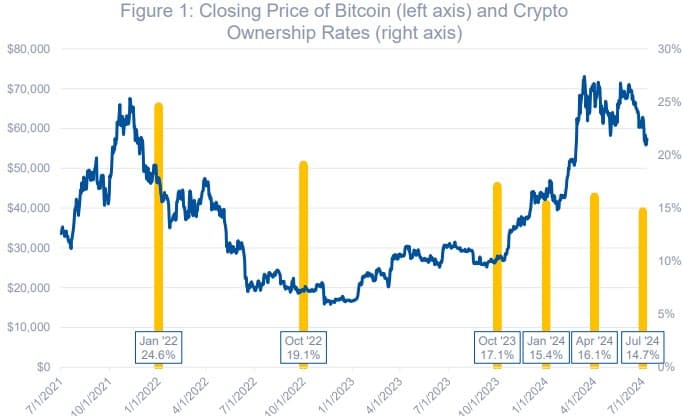
The CFI found that crypto ownership decreased during the 2022 ‘crypto winter’ bear market, with ownership rates falling from 24.6% of the surveyed population in January 2022 to 19.1% in October 2022.
And despite Bitcoin’s price recovering to hit a new all-time high over the next 18 months, ownership rates did not correspondingly increase. Only 15.4% of those surveyed in January 2024 said they owned crypto, and while ownership rates rose slightly to 16.1% in April, they fell to 14.7% in July.
Bitcoin price in Harris vs. Trump administrations
While pundits continue to debate how much of a role crypto will factor into the election, analysts at Bernstein say Bitcoin will see starkly different outcomes depending on who wins, with Trump being decidedly better for the future of crypto as Bitcoin is a “Trump trade.”
According to a Monday note to clients from Bernstein analysts Gautam Chhugani, Mahika Sapra, and Sanskar Chindalia, if Trump wins, they expect Bitcoin to reclaim new highs and reach close to the $80,000 to $90,000 range by the end of Q4.
If, on the other hand, Harris wins, they predicted Bitcoin would lose support at $50,000 and head back to test the $30,000 to $40,000 range, where it traded when the spot BTC ETFs launched.
They explained their reasoning by noting that Trump’s campaign has shown “more warmth” to the crypto industry. “While crypto industry leaders have been more open-minded with the Harris campaign, and are hoping for a more constructive policy, we expect the delta between the two political outcomes to be wide.”
They argued that while the regulatory scrutiny the industry faced in the wake of the collapse of platforms like FTX and Terra/Luna was justified, the subsequent regulatory actions against major crypto companies like Coinbase and Uniswap have eroded trust and pushed the industry into partisan debates.
Trump has also been clearer on messaging, saying he intends to make the U.S. “the bitcoin and crypto capital of the world,” while Harris has not addressed crypto in any of her speeches or policy statements, they noted.
They also suggested that a favorable regulatory environment could remove risk barriers for financial institutions to participate, which would help digital assets compete with traditional assets for institutional flows and spurring innovation.
“Elections remain hard to call, but if you are long crypto here, you are likely taking a Trump trade,” the analysts said.
