

(Kitco News) – U.S. Rep. Maxine Waters (D-CA), the top Democrat on the House Financial Services Committee, has been one of the more vocal critics of crypto in recent years, but during an interview with Punchbowl News on Wednesday, she acknowledged that the political environment around the industry has changed in recent months and admitted that its continued growth is “inevitable.”
Waters was asked how she felt about the digital asset industry following the recent pro-crypto pivot from presidential candidate Kamala Harris.
“Crypto is inevitable,” Waters said. “There are countries that are way ahead of us.”
But the long-time politician is not throwing in the towel on trying to establish firm consumer protections around the industry and vowed to continue to work to make cryptos safe for all.
“The crypto companies want support the way they want to have it,” she said. “We can’t do that. There’s got to be guardrails so that we protect consumers. But, you know, people are going to have to come to an agreement that yes, we are not afraid of crypto, we’re not opposed to crypto, but we are very much aware that investors have to be protected.”
Despite her efforts to bring the industry to heel during much of the 118th Congress, Waters said she is “not opposed to crypto” and instead reiterated that the U.S. risks falling behind in the race to develop and integrate the ecosystem into the broader financial markets. “I think we may even be behind, as I look worldwide, on digital,” she said.
Based on the comments she made during a Securities and Exchange Commission (SEC) oversight hearing on Tuesday, Waters’ priority is currently on passing a “grand bargain” on stablecoins.
“I want us to strike a grand bargain on stablecoins and other long overdue bills,” Waters said to the committee's chairman, Rep. Patrick McHenry (R-NC). “I strongly believe we can reach a deal that prioritizes strong protections for our nation's consumers and strong federal oversight.”
For his part, McHenry, who is set to retire at the end of the year, said it is his hope “that we can come to terms on stablecoin legislation this Congress” but noted that “the nature of how we do that is where things get a little tougher, and the votes are a little tougher.”
Waters responded by warning “We're running out of time to pass this,” after months of working on a bipartisan compromise bill on stablecoin regulation have fallen flat. With the 2024 election approaching and the current congressional session waning, the opportunity window to pass meaningful legislation is closing.
A growing ecosystem of stablecoins
Waters’ focus on stablecoins is understandable, as they are a bedrock of the cryptocurrency ecosystem and account for roughly 7.6% of the total crypto market cap, according to CCData.
And the need to regulate the stablecoin market is only expected to increase moving forward as more firms start to wade into the stablecoin waters as a way to enter into the broader crypto ecosystem.
According to a report from Bloomberg, companies from Robinhood Markets to Revolut are looking to launch stablecoins as they see the regulations put around the sector by the EU’s Markets in Crypto Assets (MiCA) legislation as helping diminish the dominance of Tether (USDT) – the leading stablecoin which accounts for 69.2% of the total stablecoin market.
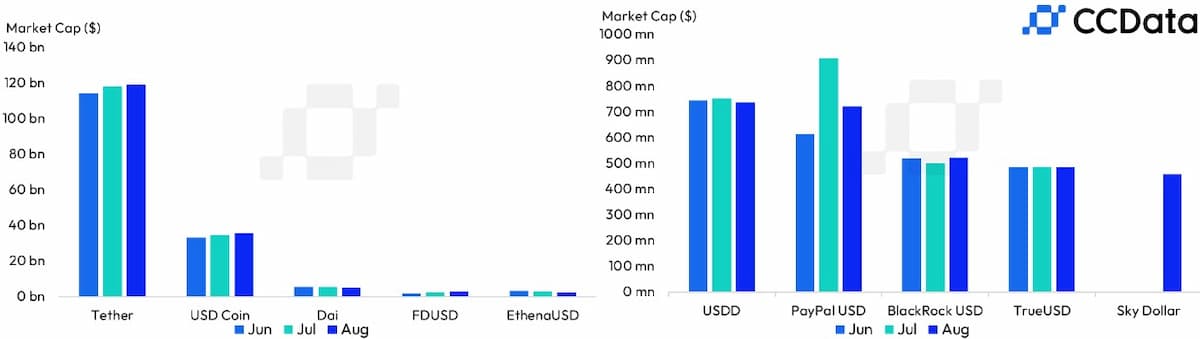
The rules established by MiCA governing stablecoins in the EU went into effect in June and require stablecoin issuers to have an electronic money license in an EU member state and hold up to two-thirds of the assets backing their token at independent banks, among other criteria.
At the end of 2024, an implementation period of up to 18 months for regulation of all other crypto platforms in the EU will start. But several large exchanges, including OKX, Uphold, and Bitstamp, have already started to partially delist stablecoins like Tether in the EU as they look to get compliance on track to avoid any fines or delays.
“Robinhood and Revolut, two of the most valuable fintechs, have both been kicking the tires on issuing their own stablecoins, but the firms could still opt not to proceed,” analysts at Bloomberg wrote. “But with the European Union poised to fully adopt wide-ranging crypto rules at the end of this year, Tether faces heightened uncertainty. Under regulations known as MiCA, crypto exchanges operating in the EU may be forced to delist stablecoins from issuers like Tether who don’t have the appropriate permits.”
The biggest competitor to Tether’s USDT, Circle’s USDC, has a leg up in this regard, as Circle has already acquired the required EU license, and the firm has also revealed intentions to launch an initial public offering in the U.S.
According to a Robinhood spokesperson, the company has “no imminent plans to launch this offering,” Bloomberg reported, while a spokesperson from Revolut told the outlet that the company plans to “further grow” its crypto product suite but didn’t confirm or deny a future stablecoin.
Stablecoins have enjoyed a rising stature in global finance over the past five years as they’ve evolved from a tool to move funds on and off of crypto exchanges to become a relied-upon payment method, especially in regions without a reliable or widely accessible banking system.
In May, reports circulated alleging that Russian companies have been increasingly turning to USDT to pay for imports, allowing them to bypass Western sanctions placed on the country after it invaded Ukraine.
For emerging markets like Brazil, Indonesia, Turkey, India, and Nigeria, U.S. dollar-pegged stablecoins allow people to save their money in dollars instead of their devaluing currencies. A survey from Castle Island Ventures, Brevan Howard Digital, and Artemis found that nearly 40% of users in these regions utilize stablecoins to pay for goods or services, while over one-fifth receive or pay salaries in these tokens.
In September of this year, crypto custodian BitGo announced the launch of its own stablecoin, while PayPal launched its PayPal USD (PYUSD) in September of 2023. Even the U.S. state of Wyoming has announced its intention to launch a state-issued dollar-pegged stablecoin in 2025 in response to the Fed’s policy of supporting ‘too big to fail’ banks
As the market continues to grow, with new entrants looking to capitalize on the money-making opportunity, the industry risks “hyper-fragmentation of stablecoins,” according to Nuri Chang, head of product at BitGo.
Chang described the scenario where “Different financial apps may run their own stablecoins, and swapping between tokens would become so seamless that end users wouldn’t even notice.”
“Mainstream retail brands, neobanks and exchanges will think about issuing. The credit-card companies, too,” Christian Catalini, founder of the MIT Cryptoeconomics Lab, told Bloomberg. “There’s dawning realization that Tether and Circle have massive power in this market.”
