
(Kitco News) – Cryptocurrencies saw a rise in legitimacy in 2024 after the launch of spot Bitcoin (BTC) and Ethereum (ETH) exchange-traded funds (ETFs) in the U.S. opened the asset class to institutional investors, and according to one study, nearly half of all hedge funds now have exposure to BTC.
“2024 has been a year filled with significant developments and transformative events that continue to shape the digital assets industry in profound ways,” wrote the authors of the 6th Annual Global Crypto Hedge Fund Report from the Alternative Investment Management Association (AIMA).
From the ETF approvals to advancements in cryptocurrency regulation, 2024 saw “the crypto market experience exhilarating highs that saw a remarkable surge in asset prices, captivating the attention of investors worldwide,” they said. “Given recent market activity, the industry finally appears ready to move past the events of 2022, which saw several high-profile fraud cases and a general lack of maturity across the wider digital assets landscape.”
The 2024 survey, which was conducted by PwC and the AIMA, included responses from both “‘traditional’ (noncrypto focused) and crypto-focused hedge funds,” and, in short, found that “Traditional hedge funds are returning to digital asset investing after last year’s drop-off, and they are doing so in increasingly sophisticated ways.”
The study was conducted in Q2 2024 “across a sample of close to 100 hedge funds from both
traditional (42%) and digital asset focused hedge funds (58%) from over six geographical regions with an estimated aggregate of $124.5B in asset under management (AUM),” the report noted. A digital asset-focused hedge fund is defined as one that has at least 50% of AUM invested in digital assets.
“The digital assets landscape is rapidly evolving,” the report said. “Our survey shows that the average AUM for respondents is $1.5B, while traditional hedge funds average $3.14B. This difference between traditional hedge funds and digital asset hedge funds highlights the relative newness of digital assets as a primary investment strategy.”
The study found that “Hedge funds are increasingly diversifying their portfolios by incorporating digital assets, employing a variety of investment strategies to navigate this emerging market and its complexities.”
The most popular digital asset strategies among traditional hedge funds include market neutral and discretionary long only, each adopted by 33% of respondents.
“When it comes to the types of digital assets that traditional hedge funds are investing in, spot was the most popular amongst digital asset hedge funds, selected by 88% of respondents,” the report said. “Spot trading and exchange-traded products (ETPs) are also popular amongst traditional hedge funds, each used by 25% of respondents.”
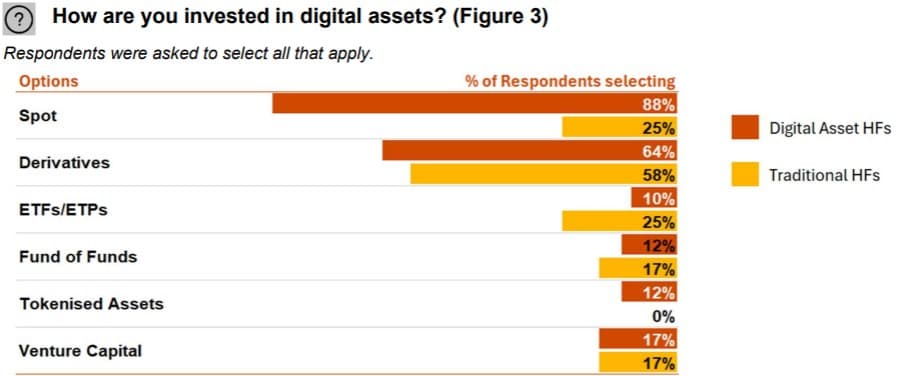
Derivatives were also a popular option, with 58% of traditional hedge fund respondents and 64% of digital asset hedge fund respondents indicating their use.
“There has been a notable shift towards derivative trading in digital assets by traditional hedge funds, with its use rising to 58% in 2024 (up from 38% in 2023), while spot trading dropped to 25% this year after peaking at 69% last year,” the authors noted. “This signals growing sophistication in hedge fund strategies. Some derivatives offer a way to gain exposure to digital assets without directly holding them, providing a hedge against volatility and potential downside risks.”
“Furthermore, 17% of traditional and digital asset hedge funds each invest in digital assets through venture capital, indicating a longer-term belief in the growth and development of blockchain technologies and related innovations,” the report said. “Fund of funds, another investment method, is used by 17% of traditional hedge fund respondents and 12% of digital asset hedge funds, allowing them to diversify exposure by investing in a portfolio of other funds that hold digital assets.”
The survey found a rising interest in tokenization despite the regulatory challenges the asset class has faced.
“Interest in fund tokenization is also growing, with 33% of hedge fund respondents either committed to or exploring tokenization, compared to around a quarter of traditional hedge funds last year,” they wrote. “Among digital asset focused hedge funds, 12% are already investing in tokenized assets, although regulatory challenges remain the biggest hurdle to wider adoption.”
“We are seeing the emergence of tokenization as an important growth area for digital asset
hedge funds,” said Anthony Bassili, Head of Allocators and Tokenization at Coinbase Institutional. “Today, that is largely tokenized treasury products for yield, but increasingly, we are seeing exposures such as tokenized reinsurance risk, tokenized carbon markets, and tokenized credit/loans.”
“Bringing this exposure on-chain will allow digital asset hedge funds to have more options for generating alpha and managing risk in the crypto markets,” Bassili said.
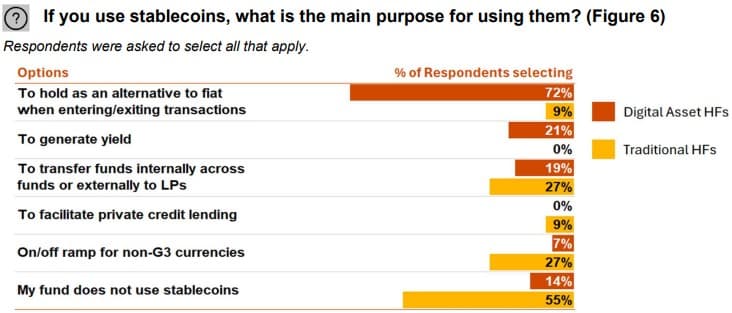
Stablecoins are also of particular interest regarding tokenization, with 72% of respondents indicating they prefer to use them as an alternative to fiat when entering and exiting transitions. “Other uses that digital asset hedge funds cite for stablecoins include generating yield (21%) and transferring funds internally or externally (19%),” the report said.
“Traditional hedge funds are using diverse strategies to navigate the digital asset markets, including derivatives, spot trading, ETPs, and both centralized and decentralized exchanges,” the authors summarized. “This reflects growing confidence and a more mature market as hedge funds take more strategic approaches to optimize returns and manage risk.”
On the client side of the equation, the survey found that “respondents reported rising interest in digital assets from institutional investors, with two-thirds of all hedge fund managers surveyed noting increased interest.”
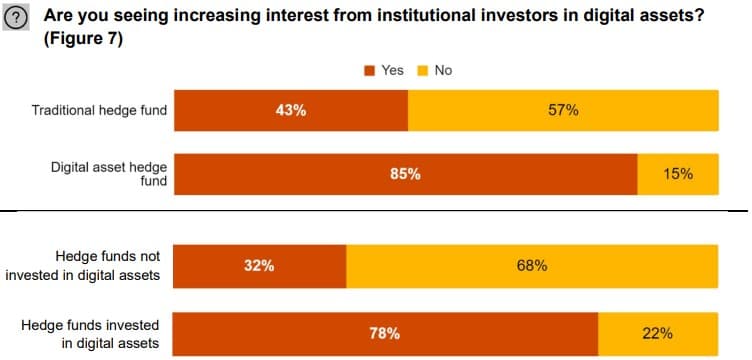
“The survey results paint an intriguing picture of the growing interest in digital assets among institutional investors,” the authors said. “Among hedge funds that have already dipped their toes in the digital asset waters, a significant number (78%) have noticed increasing interest from institutional investors.”
For hedge funds that have yet to venture into digital assets, 1 in 3 reported an uptick in cryptocurrency interest.
“This could be a sign that institutional investors are more inclined to explore digital assets with hedge funds that already have developed some experience in this asset class,” the authors suggested. “When analyzed by hedge fund type, notable differences emerge. 85% of digital asset hedge funds have reported increased interest from institutional investors, compared to 43% of traditional hedge funds.”
“Regardless, increased regulatory clarity appears to be enhancing investor confidence as the digital asset markets progress beyond previous instances of fraud and extreme volatility,” they said.
Combined, “43% of traditional hedge funds—whether invested or not in digital assets—are seeing increased interest from institutional clients,” the report noted. “Currently, family offices and high-net-worth individuals (HNWIs) remain the largest investor categories in digital asset focused hedge funds, followed by fund of funds.”
Regarding the ETF launches, “64% of all respondents believe that these approvals will create more opportunities for future product launches and enhanced strategies.”
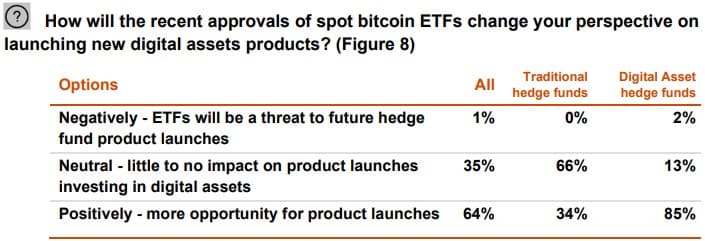
“Future product launches could include bi-directional levered ETFs and potentially staking
and yield-enhancing products, which have already been explored by issuers,” the report said.
“Among the digital asset hedge funds surveyed, the sentiment is even stronger, with 85% viewing the approvals as an opportunity for launching new digital asset-focused products and services,” the authors noted. “By comparison, traditional hedge funds remain largely unaffected by the approval of spot Bitcoin ETFs, with 66% stating that the development will have little to no impact on their plans to launch new digital asset products.”
“Hedge funds have varied approaches to using Bitcoin ETFs,” they added. “Two-thirds of traditional hedge funds do not plan to incorporate Bitcoin ETFs into their current digital asset strategies, and only a quarter of digital asset hedge funds are considering this option.”
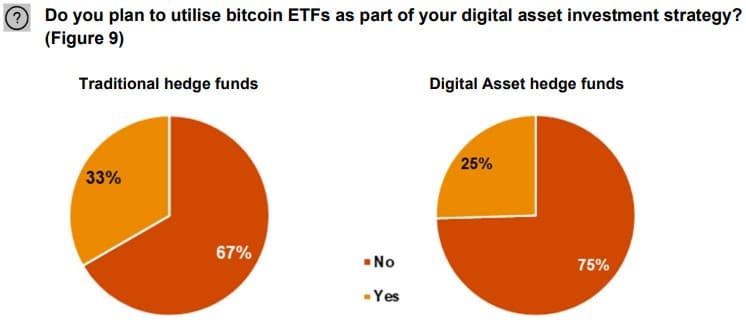
“This suggests that, while hedge funds may not be adopting Bitcoin ETFs widely, they may still view them favorably for their role in the broader digital assets industry,” they said.
As for the challenges to further growth, a lack of regulatory clarity was the most cited reason for not investing in digital assets.
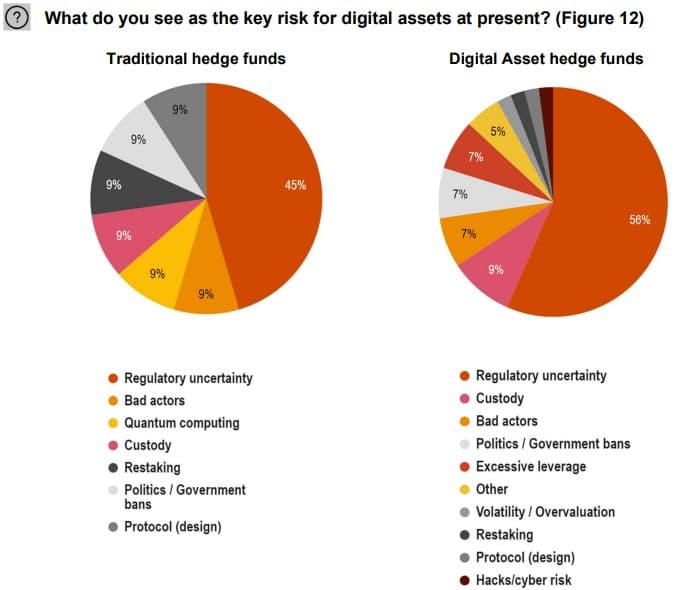
“Despite the industry’s growth, many traditional hedge fund managers remain hesitant, with 76% of those not currently invested in digital assets unlikely to enter the space within the next three years, up from 54% in 2023,” the survey found. “The top barrier, cited by 38% of funds, is the exclusion of digital assets from investment mandates, rising from fourth place last year. While regulatory uncertainty remains a key concern, it has eased somewhat due to the adoption of clearer regulatory frameworks like the EU’s MiCA.”
On the whole, the survey found that “Nearly half (47%) of traditional hedge funds surveyed this year have exposure to digital assets, up from 29% in 2023 and 37% in 2022, driven by increased regulatory clarity and the launch of spot cryptocurrency ETFs in Asia and the U.S.”
“Among those already invested, 67% plan to maintain the same level of capital employed while the remaining 33% plan to invest more capital by the end of 2024,” the authors added.
“With increasing interest from institutional investors and a maturing trading landscape, the crypto hedge fund industry is well-positioned for further growth and development,” the report concluded.
