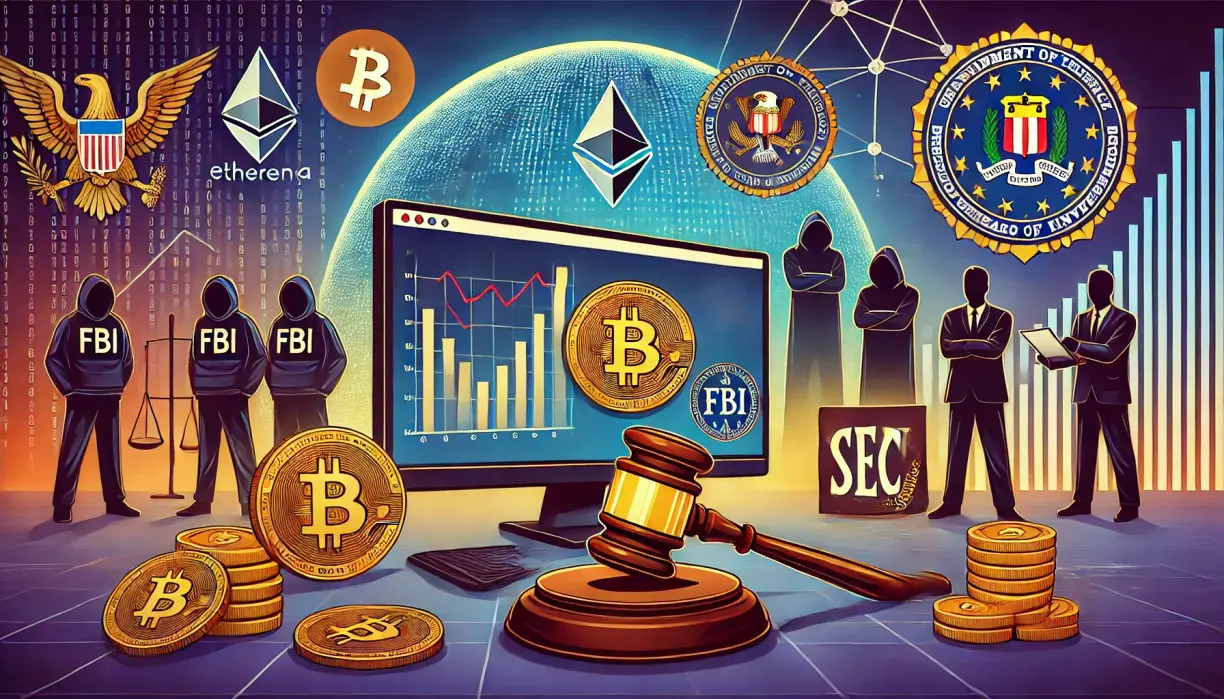
(Kitco News) – In a groundbreaking operation that involved cooperation between the Federal Bureau of Investigations (FBI), the Securities and Exchange Commission (SEC), and the U.S. Department of Justice (DOJ), eighteen individuals and entities have been charged with widespread fraud and manipulation in the cryptocurrency markets.
According to documents filed by the DOJ, the parties involved created fake cryptocurrency companies, made false statements about the native tokens for these platforms, and then “executed sham trades in those tokens (‘wash trades’) to create the appearance of trading activity that would make the tokens look like good investments.”
“These deceptive tactics allegedly attracted new investors and purchasers, which resulted in an increase in the tokens’ trading prices,” the DOJ said. “The defendants are then alleged to have sold their tokens at the artificially inflated prices, a fraud commonly known as a ‘pump and dump.’ The largest of these cryptocurrency companies, Saitama, at one point had a multi-billion-dollar market value.”
As part of their scheme, the companies allegedly hired several market makers to wash-trade their tokens in exchange for payment.
To catch the perpetrators in the act, the FBI launched its own Ethereum-based token called NexFundAI, which was used to secure the services of the individuals and entities involved.
Jodi Cohen, Special Agent in Charge of the FBI’s Boston Division, said the sting, dubbed Operation Token Mirrors, “targeted nefarious token developers, promoters, and market makers in the crypto space.”
“What we uncovered has resulted in charges against the leadership of four cryptocurrency companies, and four crypto ‘market makers’ and their employees who are accused of spearheading a sophisticated trading scheme that allegedly bilked honest investors out of millions of dollars,” she said. “The FBI took the unprecedented step of creating its very own cryptocurrency token and company to identify, disrupt, and bring these alleged fraudsters to justice.”
The market makers in question include ZM Quant, CLS Global and MyTrade, and they, along with their employees, have been charged with “allegedly wash trading and/or conspiring to wash trade on behalf of NexFundAI, a cryptocurrency company and token created at the direction of law enforcement as part of the government’s investigation. A fourth market maker, Gotbit, its CEO, and two of its directors are also charged for perpetrating a similar scheme.”
“This investigation, the first of its kind, identified numerous fraudsters in the cryptocurrency industry,” said Acting United States Attorney Joshua Levy. “Wash trading has long been outlawed in the financial markets, and cryptocurrency is no exception. These are cases where an innovative technology – cryptocurrency – met a century-old scheme: the pump and dump.”
“The message today is, if you make false statements to trick investors, that’s fraud. Period,” he said. “Our Office will aggressively pursue fraud, including in the cryptocurrency industry. These charges are also a stark reminder of how vigilant online investors must be and that doing your homework before diving into the digital frontier is critical. People considering making investments in the cryptocurrency industry should understand how these scams work so that they can protect themselves.”
According to one market maker defendant, who has agreed to plead guilty, the “objective on the secondary markets” was to find “other buyers from the community, people you don’t know about or don’t care about,” because “we have to make [the other buyers] lose money in order to make profit.”
Along with the DOJ charges of market manipulation, wire fraud, conspiracy to commit wire fraud, market manipulation and/or to conduct an unlicensed money transmitting business, and conspiracy to commit money laundering, the SEC has also announced fraud charges against “three companies purporting to be market makers and nine individuals for engaging in schemes to manipulate the markets for various crypto assets being offered and sold as securities to retail investors.”
“As alleged, the schemes were intended to induce investor victims to purchase the crypto assets by creating the false appearance of an active trading market for them,” the SEC said in a press release.
“According to the SEC’s complaints, crypto asset promoters Russell Armand, Maxwell Hernandez, Manpreet Singh Kohli, Nam Tran, and Vy Pham (Promoters) hired so-called market makers ZM Quant and Gotbit to provide market-manipulation-as-a-service, which included generating artificial trading volume or manipulating the price of crypto assets that the Promoters offered and sold as securities to retail investors in unregistered transactions,” the regulator explained. “The SEC also alleged that ZM Quant and a third so-called market maker, CLS Global, undertook similar schemes to manipulate the market of a crypto asset offered and sold as a security that was created at the direction of the Federal Bureau of Investigation as part of its parallel investigation into potential market manipulation in the crypto asset industry.”
The SEC filed five complaints in the U.S. District Court for the District of Massachusetts, which “allege that all defendants violated the antifraud and market manipulation provisions of the securities laws and that certain defendants violated registration provisions,” the SEC said. “The complaints seek permanent injunctions, conduct-based injunctions, disgorgement of allegedly ill-gotten gains plus interest, and civil penalties against all the defendants, as well as officer and director bars against certain defendants.”
“Today’s enforcement actions demonstrate, once more, that retail investors are being victimized by fraudulent activity by institutional actors in the markets for crypto assets,” said Sanjay Wadhwa, Deputy Director of the SEC’s Division of Enforcement. “With purported promoters and self-anointed market makers teaming up to target the investing public with false promises of profits in the crypto markets, investors should be mindful that the deck may be stacked against them.”
