
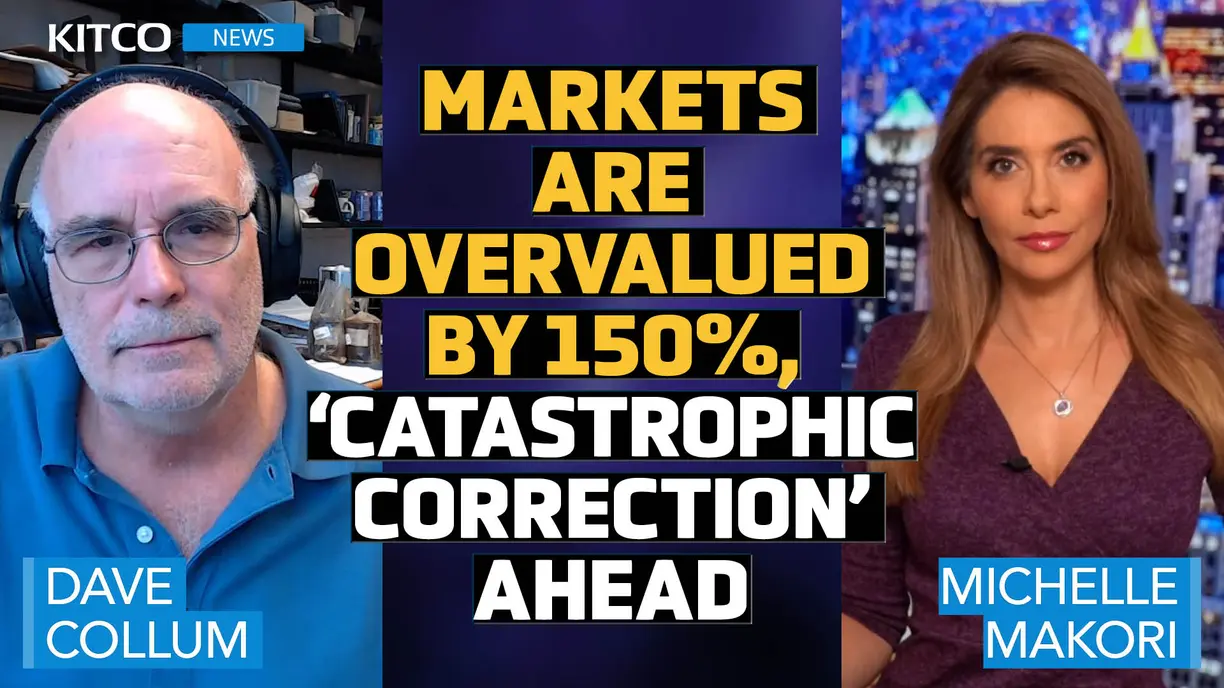
(Kitco News) - The next decade could be "gruesome" for investors, warns Dave Collum, Professor of Organic Chemistry at Cornell University and Zero Hedge Contributor, who sees the market as overvalued by 150%, with the next big selloff triggering panic selling.
"The economy is starting to roll over despite what some people say," Collum told Michelle Makori, Lead Anchor and Editor-in-Chief at Kitco News. "All the indicators say that we are rolling over."
Macro data sets are 'dishonest'
Collum takes issue with how inflation and GDP indicators are measured. Watch the video above to see how these macro gauges miss the real picture on the ground.
"I think the numbers are dishonest. They're not just inaccurate. We've long since passed the point where they're trying to get it right," he said. "The Fed's entire purpose for being is to throw us out of equilibrium."
Market selloff coming
Collum sees the U.S. stock market as overvalued by 150%, which he warns could trigger a "catastrophic" selloff. The further from equilibrium the markets and data are, the more violent the return to the mean is, and "150% is too far," he said.
The markets left orbit around 1994, noted Collum citing the Case-Shiller P/E Ratio and pointing to a surge in debt levels at that time. "Debt picked up massively from that point. Then the 2008 correction got back to fair value, but not cheaper," he noted.
For how Collum gets to the 150% overvaluation number, watch the video above.
The first plot is the Case-Shiller P/E from 1880-1994. The red line is my eyeball guess for historical normal valuation. The second shows valuations leaving orbit over the next 30 years. That kinda puts a 60% correction in our future to regress to the mean and >80% correction to… pic.twitter.com/8GqkdD8KVe
— Dave Collum (@DavidBCollum) October 9, 2024
"If you accept my argument that the markets are at least 150% over a fair value, you also have to accept my premise that at some point, you will be so angry with yourself for not getting out of the way of that disaster," Collum said.
According to Collum, that disaster can take several forms. "One, markets can drop 90% like they did between 1929 and 1933. Or you can correct it like between 1967 and 1981 when the markets treaded water without inflation correction. But with inflation correction, they dropped 70%."
For what to own and how to position yourself during a major market selloff, watch the video above.
"I do believe we are going to have a serious correction. When the selling starts everything's going to sell. People are going to start selling the shirts off their backs at some point. "You don't really want to own anything when the selling starts."
Currently, markets are at a top, but there is one major warning sign. "We have never been at a top with people in such a grumpy mood," Collum described. "You got people who are talking about civil war and authoritarianism. Emotionally, it looks like a bottom. This gets you into fourth-turning thinking. What happens in the next ten years could get pretty gruesome."
In 40 years, Collum sees market returns as being at zero when adjusted for inflation. For his four-decade outlook, watch the video above.
'The U.S. dollar is going to collapse at some point'
One key concern going forward is the growing U.S. national debt levels, which are approaching $36 trillion.
"The federal government is growing its debt at 7% a year, which means we're pulling consumption from the future forward. Why can't they keep doing it? Because the dollar, at some point, is going to collapse. Then we're going to give it all back. We will give it all back in a catastrophic correction," he said.
In addition to the rising debt levels, the accelerating de-dollarization trend threatens the U.S. dollar as a reserve currency. "The de-dollarization story will happen much sooner … with massive geopolitical movement to shift alliances," Collum said, pointing to the upcoming 16th annual BRICS summit in Kazan, Russia, on October 22-24.
"If Russia is not buying our debt, China is not buying our debt, and Saudi Arabia stops buying our debt, there's no one left to buy our debt. This means the Federal Reserve has to buy our debt, which means we're monetizing debt, which means the dollar will get smacked," he added.
On top of that, BRICS member countries have stepped up their gold reserve purchases, with 2024 levels remaining near record levels. Collum also pointed out that some gold purchases are likely going unreported.
"Let's say China has 87,000 tons of gold, as some people speculate. China could offer gold certificates. What would be the consequences of such a move? It's quite possible that it would destroy the dollar immediately," Collum stated. Watch the video above for insights.
This video is brought to you by Goldback --- Inflation-resistant, 24K gold currency.
Learn where to get Goldbacks at https://www.goldback.com/
