

(Kitco News) – Financial markets experienced a broad sell-off on Wednesday as doubt about future rate cuts crept into the minds of investors, who opted to reduce their exposure to the markets ahead of the expected volatility leading up to the U.S. elections in November.
Rising bond yields and a spike in the DXY also contributed to the weakness, which took a toll on risk assets as investors migrated to the safety of guaranteed income.
“On the macroeconomic front, the 10-year Treasury yield climbed to 4.25%, a peak last seen in July, propelled by strong economic indicators and concerns over the national deficit,” said analysts at Secure Digital Markets. “Concurrently, the US Dollar Index escalated to a year-high, exerting further pressure on risk assets, including cryptocurrencies.”
“The political landscape is also influencing market sentiments,” they added. “Donald Trump’s recent electoral success is viewed positively by traders, given his supportive stance on making the U.S. a leading player in the crypto arena. Conversely, Kamala Harris has taken a more cautious approach, focusing on consumer protection regulations without committing to the same level of industry promotion.”
“Despite these mixed signals, market participants are increasingly optimistic about Bitcoin’s (BTC) prospects,” the analysts noted. “Options traders, in particular, are placing higher bets on Bitcoin reaching new highs by the end of November, as reflected in the elevated implied volatility for options expiring around the election.”
At the closing bell, the major indices were all in the red, with the S&P, Dow, and Nasdaq finishing down 0.92%, 0.96%, and 1.60%, respectively.
And while gold’s streak of new record highs extended on Wednesday with a spike above $2,758/oz in the early trading hours, the celebrations were short-lived as the yellow metal’s price reversed sharply and fell to a low near $2,708/oz. At the time of writing, spot gold trades at $2,715.20 for a decline of 1.21% on the session.
Data provided by TradingView shows that Bitcoin (BTC) bears overwhelmed support at $67,000 in the early hours of Wednesday, resulting in BTC’s price dipping to a low of $65,160 before bulls managed to push it back above $66,000.
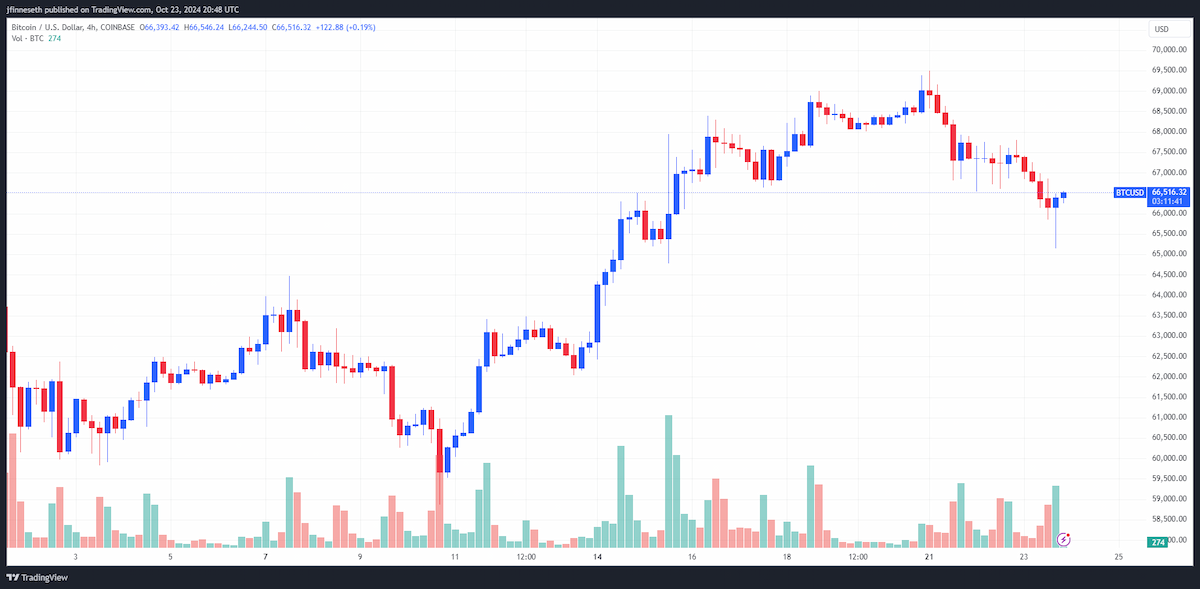
BTC/USD Chart by TradingView
“Bitcoin's recent rally faltered, possibly due to stablecoin volumes remaining stagnant since late September,” noted Secure Digital Markets analysts. “The correlation between stablecoin supply growth and upward cryptocurrency price movements is well-documented.”
“Additionally, the temporary premium on perpetual contracts observed this Monday has dissipated, with the spot market showing signs of cooling off,” they added. “The Fear & Greed Index has spiked to 72, marking its highest greed level since July.”
“In the ETF sector, Bitcoin witnessed a break in its seven-day rally, with net outflows hitting $79.1 million on notably low trading volumes, the weakest in two weeks,” the analysts said. “ARK led these outflows with $134.7 million. In contrast, Ethereum saw modest inflows of $11.9 million, primarily from Blackrock.”
At the time of writing, Bitcoin trades at $66,518, a decline of 1.44% on the 24-hour chart.
Short-term weakness on the road to new highs
Over the past few weeks, Bitcoin’s price experienced an 18% rally, climbing from $58,845 on Oct. 9 to a high of $69,495 on Monday, leading many analysts to say that a pullback and a period of consolidation was due.
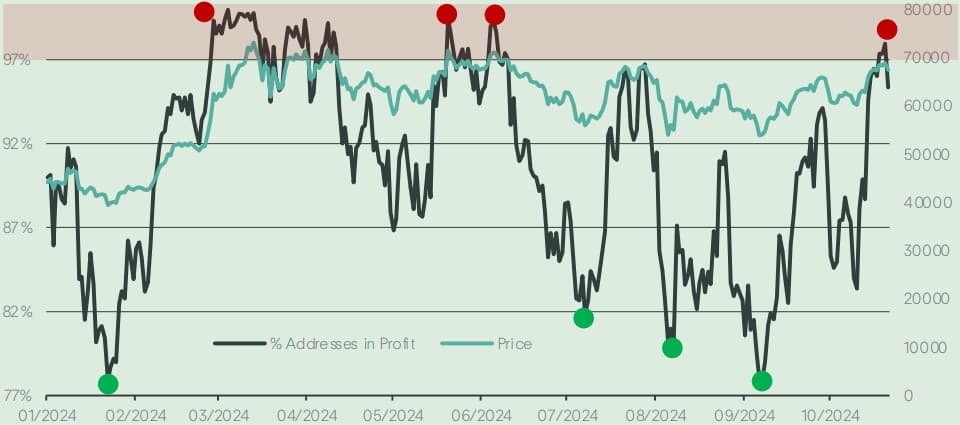
“On-chain metrics are possibly indicating that markets have run a little hot as Bitcoin tried to head towards the $70k mark,” wrote analysts at Copper Research. “A short-term top is the more likely scenario for now despite upbeat ETF inflows.”
“While there are no silver bullets, Bitcoin on-chain movement can provide insight into how many addresses are in profit based on the price at which Bitcoin was moved and the current price,” they said. “Patterns emerge, and it becomes evident that when large swings occur—where addresses move from around 75% in profit to 98% in profit (the current ratio)—markets start to experience sell pressures as investors sit on unrealized gains. This may signal a short-term top for Bitcoin ahead of the US elections.”
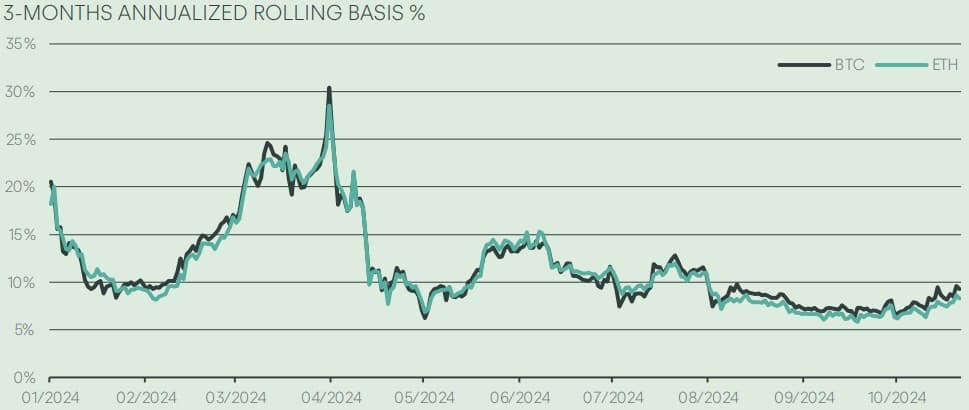
The derivatives market also shows signs of investor fatigue, with Copper Research analysts noting that “Crypto markets are relatively quiet, although some trades are gaining traction.”
“The 3-month rolling basis trade is just under 10%, its highest level since the summer,” they said. “However, this is still far from the returns that were achievable earlier this year, reinforcing the notion that markets remain soft and lack the enthusiasm to push into new all-time-high territory. Nevertheless, short-term trades remain attractive enough that volumes have stayed elevated so far this month.”
Despite the expected short-term weakness, analysts widely expect Bitcoin to hit a new all-time high by the end of 2024, with Finder’s panel of 28 crypto industry specialists predicting BTC price will be trading an average of $77,636 by year-end, down from their July prediction of $87,169.
“Our most bullish panelists see BTC trading at $125,000 by the end of 2024, while our most bearish panelist sees it dropping well below where it is now, reaching $40,000 by the end of the year,” said Richard Laycock, lead editor at Finder. “Our panelists also predict BTC will hit $113,364 by 2025 and $282,238 by 2030. The panel is more bearish than last quarter when their long-term prediction for 2025 came in at $127,494 and $383,514 for 2030.”
As noted by multiple analysts across the ecosystem, “One major theme from the report is how much the US presidential election, and the economic policies of each candidate, will impact the value of Bitcoin in the short term,” Laycock said.
In a separate report from Bernstein, their analysts predicted Bitcoin could go as high as $200,000 by the end of 2025 as the cryptocurrency enters “a new institutional era.”
“Ten global asset managers now own ~$60Bn wrapped as regulated [exchange-traded funds] compared with $12Bn in September 2022,” the report said. “By 2024 end, we expect Wall Street to replace Satoshi as the top Bitcoin wallet.”
As for BTCs price in the near term, market analyst Rekt Capital noted that “Bitcoin is now in the process of retesting the Channel Top (black) as support.”
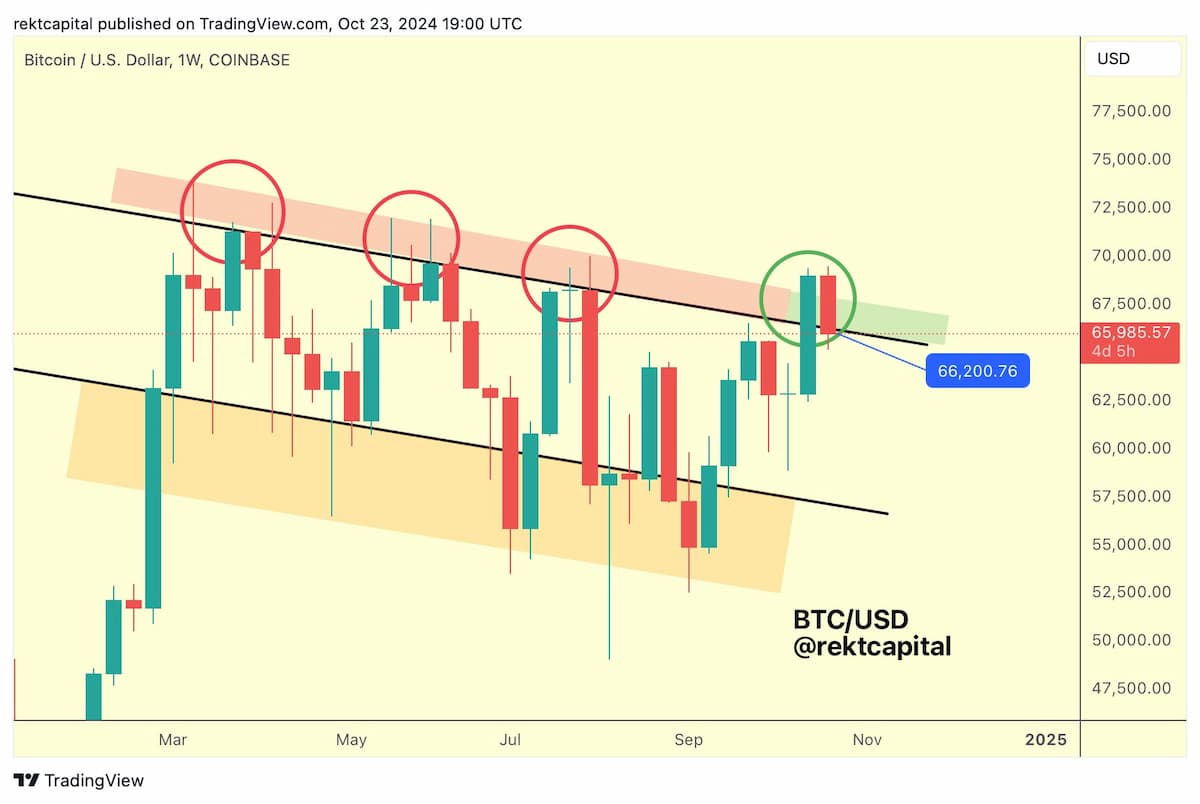
“The Channel Top represents the price point of ~$66200,” he said. “Notice how BTC has tested the late September highs on this recent downside wick. BTC needs to Weekly Close above the ~$66200 Channel Top to confirm a successful post-breakout retest.”
And on a bullish note, MN Consultancy founder Michaël van de Poppe said Wednesday’s pullback to $65,000 may have marked the low point in this correction.
Indeed, #Bitcoin dropped to the $65K area and quickly reversed upwards.
I think that this small correction is close to over.
Macroeconomic period starts, including the Elections.
Time to see those Yields drop & Crypto flourish.— Michaël van de Poppe (@CryptoMichNL) October 23, 2024
Weakness in the altcoin market
Roughly two dozen tokens in the top 200 rose above the noise to post gains on Wednesday, while the rest recorded losses.
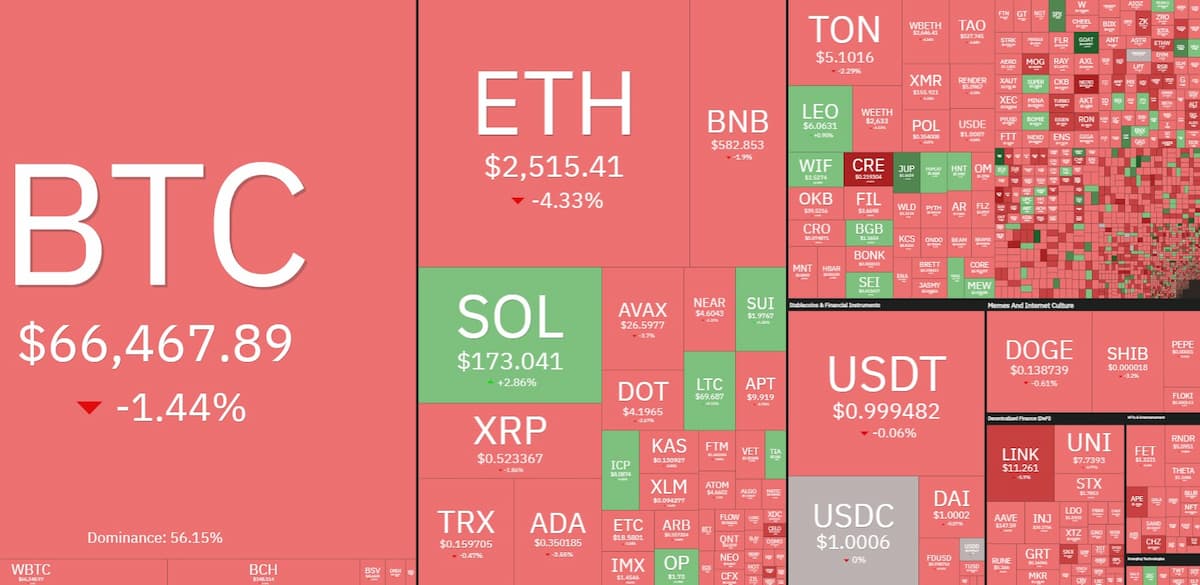
Daily cryptocurrency market performance. Source: Coin360
The top gainer was Jupiter (JUP), which climbed 5.5%, followed by increases of 4.4% and 4% for ZetaChain (ZETA) and UMA (UMA), respectively. First Neiro on Ethereum (NEIRO) was the biggest loser, falling 15%, while Baby Doge Coin (BabyDoge) and Safe (SAFE) both lost 10%.
The overall cryptocurrency market cap now stands at $2.28 trillion, and Bitcoin’s dominance rate is 57.5%.
