

(Kitco News) – The cryptocurrency ecosystem is in high spirits as the cyclical post-halving market rally is underway, with Bitcoin (BTC) trading above $73,000 and less than 2% below its all-time high. According to one analyst, the bull market could continue for another 12 months.
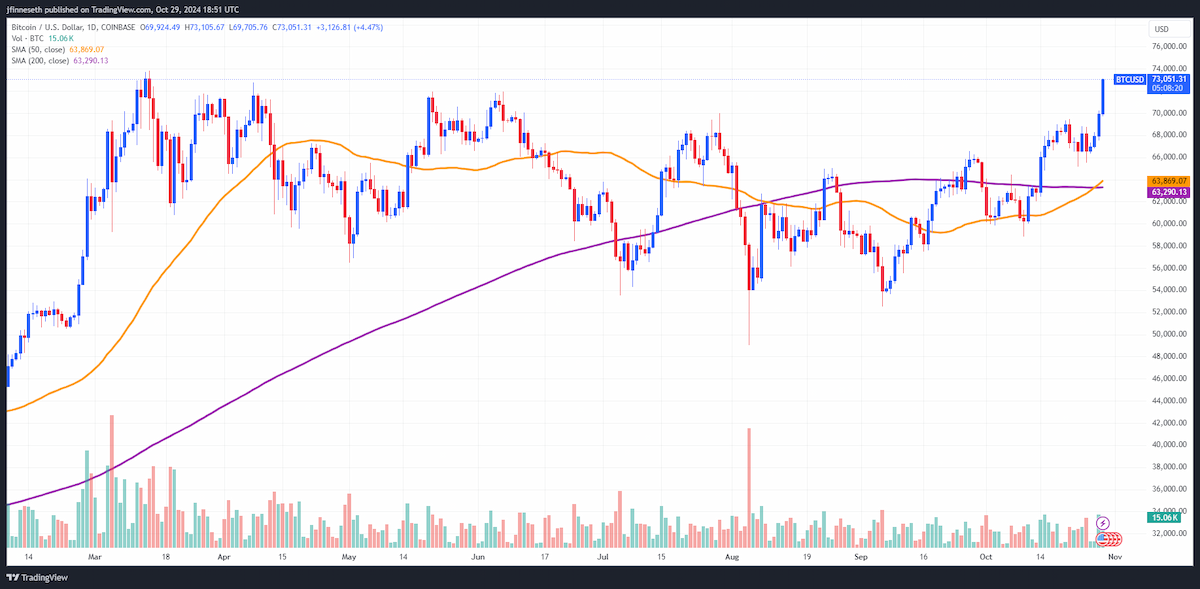
BTC/USD Chart by TradingView
“We have a constructive view on the broader crypto market for the next 18 months,” said Peter Chung, Head of Research at Presto Labs, in an interview with Kitco Crypto. “Our view rests on three main factors: global liquidity, regulatory friendliness, and low expectations.”
“We are at a juncture where three major economies that account for 75% of the global money supply simultaneously have a bias towards liquidity expansion,” Chung noted. “The U.S. is allowing organic liquidity growth or may ease policies if needed, while China and the EU face no constraints to follow suit.”
“The upcoming U.S. election represents a positive expected-value event regardless of the outcome,” he added. “After over six months of range-bound trading, investor psychology remains subdued, and expectations are low, as indicated by sentiment indicators. Considering these, the current risk-reward tradeoff favors upside potential in our view.”
Chung said the building momentum should see Bitcoin finally reach the highly prized $100,000 price point in 2025 and expects it to rise even higher before the bull cycle ends.
“I am of the view that it will pass $100K before the end of 2025. That's only 43% from the current level, which is not much, considering Bitcoin's volatility,” he said. “To put it in perspective, BTC moved over 60% in 1Q24 alone. Under the right conditions, this is not a far-fetched move.”
“For what it's worth, I would put my cycle-high target at around $150,000,” he added.
As for the increased focus on institutional adoption since the launch of spot BTC exchange-traded funds (ETFs) in January, Chung sought to clarify what exactly that entails.
“The phrase 'institutional adoption' is thrown around a lot these days, so it needs to be defined first to provide a thoughtful answer,” he explained. “My definition would be 'regulated institutions incorporating the technology into their main business in a meaningful way.' The expression 'in a meaningful way' is there to exclude the cases where institutions are simply experimenting under pilot programs, which don't really represent genuine adoption in my view.”
“Under this definition, I believe institutional adoption will continue in the areas of ETF growth, custody, and tokenization in this cycle,” he said. “Crypto ETF growth and TradFi custodians' entry into crypto represents the digital asset adoption as a store of value. Tokenization represents the acceptance of smart contract platforms such as Ethereum as the value exchange rails, replacing inefficient and outdated legacy settlement networks.”
To achieve higher levels of institutional adoption, Chung said more trusted custodians are needed to help speed up the process.
“Custodians are an important infrastructure for the existing financial system to function,” he underscored. “There are digital asset custody service providers already, but most of them are young platforms with only 5-6 years of history, which may not be sufficiently strong social proof for mainstream institutional investors. TradFi custodians' entry into the digital asset space would go a long way in bringing legitimacy to the asset class, lowering the psychological barrier associated with the new technology, and widening its appeal.”
That said, Cuhng suggested that Bitcoin will continue to see increased legitimacy on the global stage regardless of whether more traditional finance custodians start to support digital assets.
“A lot of smart people are realizing the technology's potential and are willing to look beyond the negative headlines or superficial take the mainstream media often focuses on,” he said.
With the focus now on Bitcoin’s post-halving cycle, which is part of its larger four-year market cycle, Chung said future halvings will have less of an impact on prices moving forward as ETF demand and other macroeconomic forces take center stage.
“The impact of the newly minded BTCs on the overall supply has been falling for some time now,” he noted. “Personally, I think its impact has stopped being meaningful since the 2016 halving, which brought down the BTC's inflation rate to below 10%.”
“What underpinned the 4-year cycle since then is more driven by demand than supply, in my view,” Chung said. “Given that institutional adoption is an important demand driver, it does play a role, and it will only get bigger as time goes on.”
Another important factor is the growing stablecoin market. Its significance in the overall performance of the crypto market was highlighted last week when prices rapidly sold off after reports circulated that Tether, the issuer of USDT, the largest stablecoin by market capitalization, was under investigation by the U.S. Department of Justice and Treasury Department.
“BTC's ascent to a global currency status will be a multi-decade process, if it ever gets there,” he said. “USD stablecoins can act as a bridge that helps overcome the chasm in the interim.”
“The USD stablecoin's growth so far proves that there is an excellent product-market fit between USD and the blockchain because USD is the world's settlement currency,” he added. “When you put the globally sought-after currency on the frictionless value exchange rail that is blockchain (which is what USD stablecoin is), the value proposition becomes clear.”
As for what types of innovations can further enhance adoption, Chung said that it comes down to the legacy system working to integrate blockchain into their offerings.
“In the near term, more TradFi institutions need to figure out ways to integrate crypto assets into their service offering, whether as payment solutions, investment solutions, or financing solutions,” he said. “A number of institutions such as BlackRock and Templeton have done so by tokenizing their money market funds, while Paypal and Visa have done so by incorporating stablecoins into their payment infrastructure. More TradFi institutions need to experiment and find ways to re-invent their service offerings using the technology.”
For now, the bull market is in full swing, and Chung said it’s likely to extend into 2025 before the next crypto winter begins.
“The patterns of the past three bull cycles suggest that the bull market cycle will likely conclude [sometime in 2025], though past performance doesn’t guarantee future results,” he said. “The flush-out of weak projects is an ongoing process, but since bull market euphoria tends to camouflage failing ventures, the bear market will certainly accelerate this correction.”
“To this day, blockchain remains an esoteric field to the general public, with its value proposition still not entirely obvious,” Chung said. “This is largely because much of the modern financial system is poorly understood.”
“However, when we step back and start viewing these systems more critically, I believe everyone will experience their own 'Eureka' moment,” he concluded. “Larry Fink, who was once a skeptic, went through a similar process and is now a strong advocate for blockchain technology. The same transformation could happen for Kitco readers and the broader public.”
