
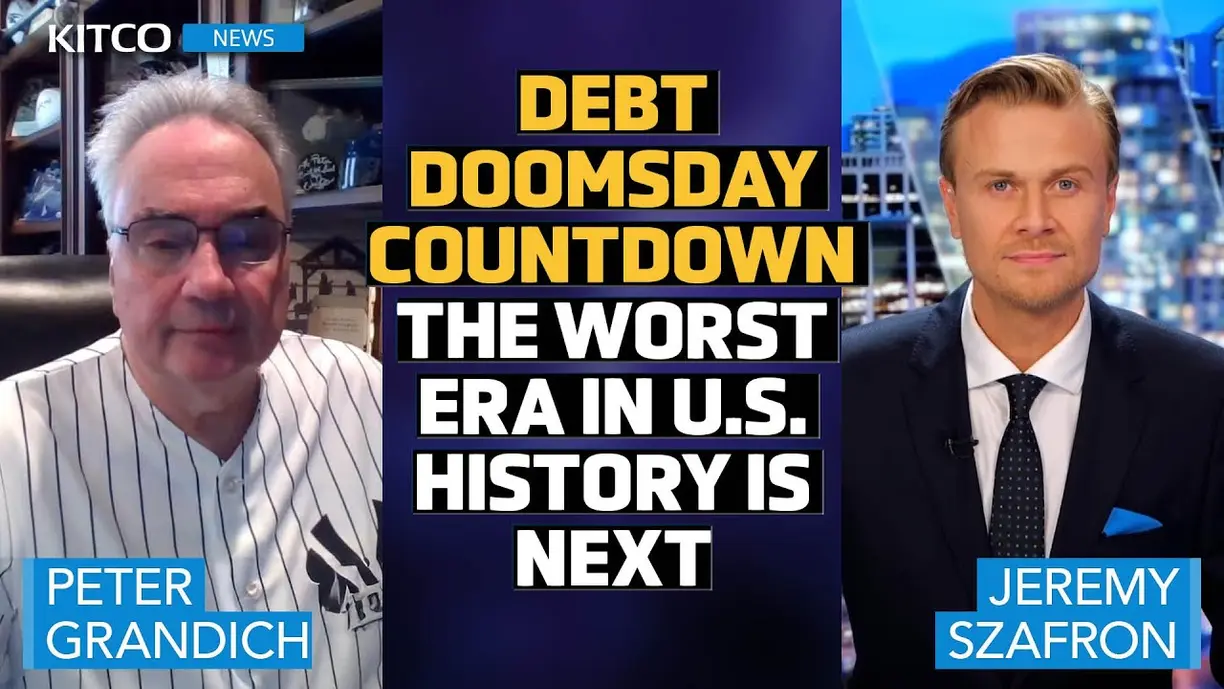
(Kitco News) - The United States is facing an economic and political reckoning that could be the most challenging period in its history, warned financial expert Peter Grandich.
Grandich told Jeremy Szafron, an anchor at Kitco News, that as the BRICS bloc continues its rapid expansion and intensifies its push for de-dollarization, the U.S. dollar's traditional dominance is under threat.
At the 2024 BRICS Summit, representatives from over 40 nations discussed alternatives to the dollar, which could reshape global trade and lead to the emergence of a gold-backed currency—a move many analysts predict would weaken the dollar's standing and increase global gold demand.
"I have called the formation of the BRICS…what they will have done to world commerce will be equated to what the industrial revolution did," Grandich said, highlighting the potential transformation in economic influence.
Additionally, with U.S. debt projected to hit $54 trillion by 2034, Grandich pointed out that rising debt and fiscal vulnerabilities are accelerating the need for capital preservation amid these structural shifts in global power dynamics.
Grandich emphasized that traditional growth-focused investing may no longer be viable, given the rising risks. "It's more important now for capital preservation than capital appreciation," he noted, pointing to Congressional Budget Office estimates that place the U.S. national debt at approximately $54.39 trillion by 2034, an increase from nearly $36 trillion today, according to Statista.
Interest payments on this debt are also expected to nearly double, from $870 billion in 2024 to $1.6 trillion by 2034, reaching the highest level in U.S. history, according to the House Budget Committee. These soaring interest payments will consume over 20% of government revenues by 2034, highlighting the unsustainable nature of current fiscal policies.
The latest BRICS summit underscored the momentum behind de-dollarization, as countries like Russia and China have moved to settle over 90% of their bilateral trade in rubles and yuan, Grandich stated. This global shift away from dollar dominance underscores the need for investors to reassess their portfolios.
Looking ahead, Grandich advised prioritizing physical assets like gold, which has demonstrated resilience amidst growing economic uncertainties and structural shifts in global finance.
In addition to central banks continuing to bolster their gold reserves in 2024, the World Gold Council (WGC) reported that global gold demand surged about 5% in the third quarter, marking a record and raising consumption above $100 billion for the first time.
Furthermore, BRICS nations are actively considering a gold-backed currency, a move that could further challenge the dollar's dominance and solidify gold's role in global financial transactions, Grandich added.
"This accumulation of gold by central banks across the board was not for an investment standpoint. It was a recognition that a major change is afoot," he explained, highlighting many countries' strategic revaluation plans in response to a shifting monetary paradigm.
Gold prices have hit multiple new record highs this year, nearing $2,800 an ounce in October. Grandich pointed to heightened geopolitical tensions and uncertainty surrounding the upcoming U.S. presidential election as just a few drivers behind the rally.
Grandich warned that for individual investors, "it's not so much about how much you make, but about how much you don't lose," suggesting a defensive investment strategy that focuses on stability rather than risk-heavy growth amid increasing geopolitical and economic uncertainties.
Don't miss out on the full insights—watch the complete Kitco News interview for an in-depth discussion on the future of global finance, gold, and economic stability.