
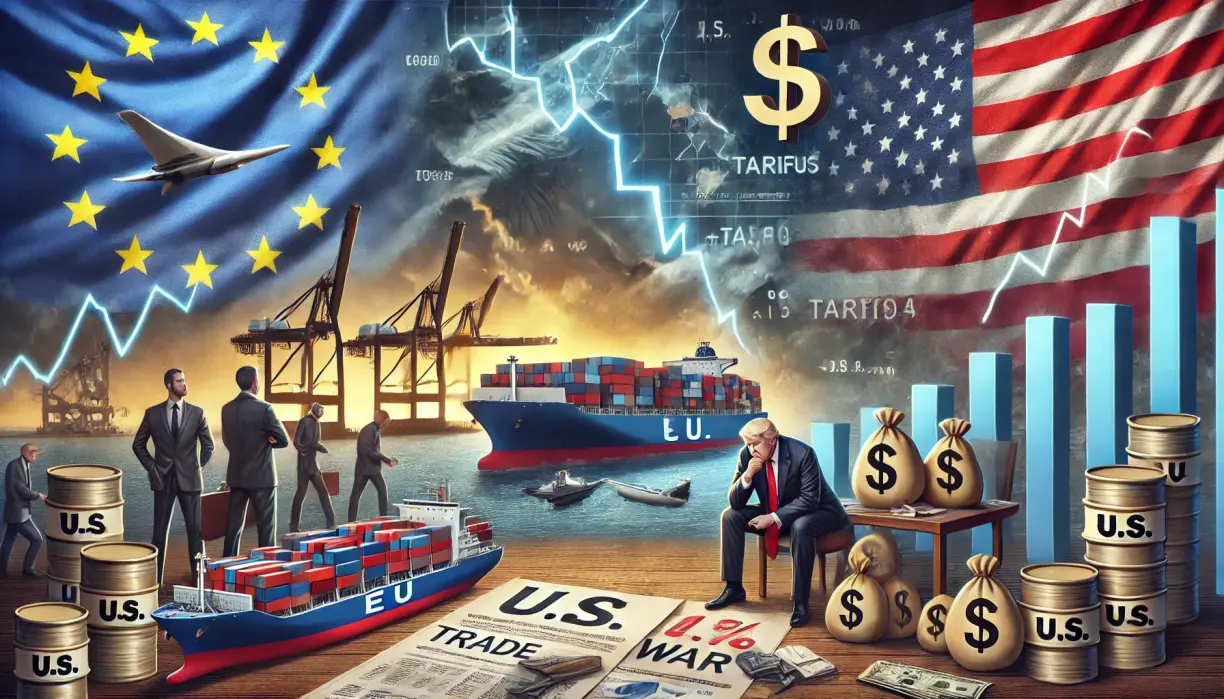
(Kitco News) – Global reactions to Donald Trump’s re-election have been mixed, with many shocked at the outcome while others say the signs have been present for a while that he would emerge victorious, and for leaders in the European Union, concerns are now rising about the potential for a re-escalation in economic warfare.
While most European officials have been quick to congratulate Trump, behind the scenes, they are concerned about what his second term in office could mean for the global economy with his focus on tariffs as a way to level the playing field.
As noted by CBNC, many leaders in the EU have been preparing for the potential of Trump's victory for more than 12 months and have focused their efforts on crafting policies that could protect the European economy from potential trade disputes, but the margin by which he won has still taken many by surprise.
“I am seeing it, [and] not wanting to believe,” one EU official, who did not want to be named due to the sensitive nature of the transatlantic relationship, told the outlet. “But I am not as shocked as last time.”
A second EU source, who also elected for anonymity because of the sensitivity of the relationship, said: “It is not great, again,” before similarly adding, “At least, I am not as surprised [as in 2016].”
The main issue for many is Trump's style of confrontational leadership, which led to several months of tension with many European countries during his first term. This was highlighted in their response to Biden’s election in 2020, which they celebrated as they saw it leading to better engagement.
The angst centers around threats by Trump to impose an additional 10% in tariffs on European nations, with the President-elect saying that the EU would have to “pay a big price” for not buying enough American goods.
His election and plans for the future of transatlantic relations are expected to be the main area of focus at a meeting between EU leaders in the Hungarian capital of Budapest on Thursday and Friday.
“There will be a first discussion [on the outcome of the U.S. election] in Budapest,” a third anonymous EU source told CNBC Wednesday. “We will see what sort of rhetoric [Trump] will have, but if it is not very different, the main challenge will be Ukraine. Our big focus is to keep the European unity.”
In 2021, bilateral trade between the U.S. and EU hit an all-time high of 1.2 trillion euros ($1.29 trillion), according to data from the European Commission, highlighting the importance of fostering a strong working relationship.
Trade with the U.S. is considered critical for the success of European nations. Analysts warn that any additional tariffs could add further pressure on the stagnant economic growth levels across the EU.
According to a research note from ING, the re-election of Trump is the “worst economic nightmare” for Europe.
“A looming new trade war could push the eurozone economy from sluggish growth into a full-blown recession,” the team of analysts, led by James Knightley, said. “The already struggling German economy, which heavily relies on trade with the U.S., would be particularly hard hit by tariffs on European automotives.”
“Despite European politicians' claims of being prepared for a second Trump presidency, it remains unclear whether Trump could indeed prompt deeper integration, given the domestic challenges many European governments face,” they added. “Europe will likely wait to see what policies Trump actually implements.”
According to comments made by German Finance Minister Christian Lindner at the IMF annual meetings in Washington, D.C., last month, the EU is prepared to retaliate if Trump initiates a new trade war with the Union.
“We need diplomatic efforts to convince whoever enters the White House that it's not in the best interest of the U.S. to have a trade conflict with [the] European Union,” he said, adding, “We would have to consider retaliation.”
