

(Kitco News) – Gold has been recognized as a trusted store of value for centuries, allowing holders to maintain their wealth during times of uncertainty, and sometimes, hidden away treasures resurface in the modern age, as was the case for a Civil War-era coin stash recently found in Kentucky.
As reported on a special episode of Kentucky Life, a farmer in the state made a valuable discovery in 2023 that’s come to be known as The Great Kentucky Hoard, comprised of a cache of gold and silver coins dating to the Civil War era.
“I initially found the 1856 Seated Liberty Half Dollar probably 20 to 30 feet from where the hoard was located,” the farmer told Kentucky Life. “I would have never believed what came next. Things that only happen in dreams. When I continued walking and saw the glint of gold – a thick reeded edge.”
“When I pulled the coin from the ground, I was astonished when I realized I was holding a $20 Double Eagle from the 1860s,” he said. “After I flipped the first clump of dirt over the next 45 minutes to an hour, the coins kept coming. I knew it was hundreds.”
When his digging was complete, more than 700 gold coins were unearthed, and when combined with the silver found, more than 800 coins were pulled from the ground.
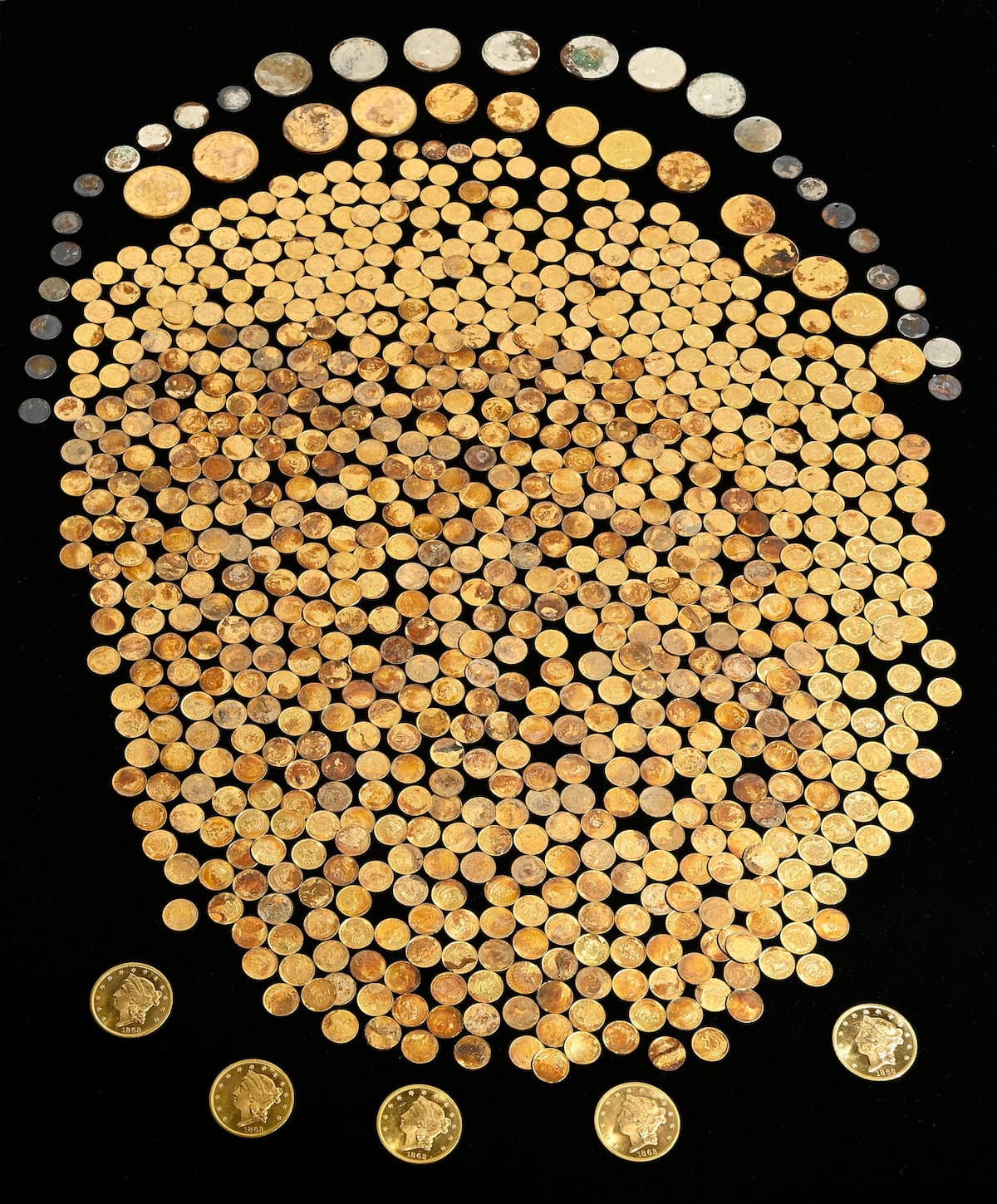
Source: KET
Initially, the farmer kept his discovery to himself and sought to remain anonymous, fearing a barrage of fortune seekers descending upon his property.
That changed with the story’s appearance on Kentucky Life, and while the farmer has continued to embrace anonymity, both regarding his identity and the location where the coins were found, The Great Kentucky Hoard has now been enshrined in the record books.
To tell his tale, the farmer sent a three-page summary to Chip Polston, host and producer of Kentucky Life.
“I completely understand why he wants to remain anonymous,” Polston said. “He doesn't want to open up his front blinds some Saturday morning and there be 70 people with shovels and metal detectors... What would happen to his farm? It could be a huge mess for him.”
During the recap, the farmer recounted his youth, mentioning that he would walk with his grandmother along nearby stream beds searching for interesting items – but he never imagined he would actually discover treasure.
Included in the cache were special one-dollar, ten-dollar, and twenty-dollar gold coins that are rare and highly sought after by collectors.
Each double eagle is worth up to $4,000, and altogether, the stash is estimated by some experts to be worth north of $2 million.
The farmer sent a picture of one of the coins to Jeff Garrett, an expert in rare coins, who then rushed to assist with the assessment and classification of the artifacts. A numismatic company subsequently prepared the valuable finds for sale.
The farmer ultimately sold the hoard on GovMint.com, an online rare coin shop, for an unknown total.
“It's a remarkable story,” Polston said. “He caught a glimpse of something gold and metallic. He's digging through the ground, and these gold coins are literally spilling out," Polston said about a reenactment of the discovery.
Thus far, the origin of the coins remains unknown. They were minted between 1840 and 1863 – a period during which raiding Confederate forces continued to plunder Kentucky, Ohio, and Indiana under the leadership of John Hunt Morgan.
Various hypotheses about its origin have been put forth, including speculation that a rich landowner buried them for protection or that a thief hid the cache while on the run, never to return.
