

(Kitco News) – The U.S. service sector weakened last month, but remained in expansionary territory, according to the latest data from the Institute for Supply Management released Wednesday morning.
The ISM said its Services Purchasing Managers Index declined to 52.1 in November, down from October’s reading of 56. The data was worse than expected, as economists were looking for a reading of 55.5.
“Economic activity in the services sector expanded for the fifth consecutive month in November,” said Steve Miller, chair of the Institute for Supply Management Services Business Survey Committee. “The Services PMI registered 52.1 percent, indicating expansion for the 51st time in 54 months since recovery from the coronavirus pandemic-induced recession began in June 2020.”
Readings above 50 in such diffusion indexes signify economic growth and vice-versa. The farther an indicator is above or below 50, the greater or smaller the rate of change.
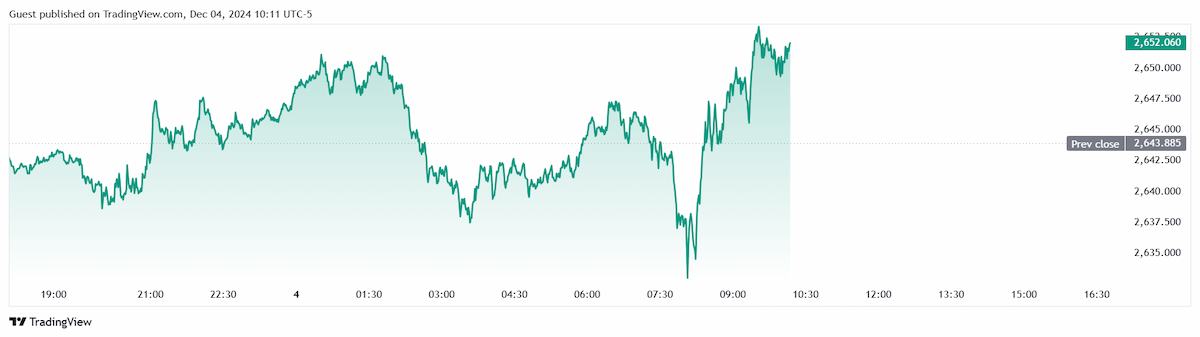
Gold prices were trading near session highs following the 10 am EDT release, with spot gold last trading at $2,651.92 for a gain of 0.31% on the daily chart.
The components of the report showed declines across the board. The New Orders Index fell to 53.7 in November, down from the previous month’s reading of 57.4. At the same time, the Business Activity Index declined to 53.7, compared to October’s reading of 57.2.
Inflation pressures also ticked up in the sector, with the Prices Index coming in at 58.2 in November, slightly higher than October’s reading of 58.1.
The service sector labor market also declined in November, but remains in expansionary territory, with the Employment Index falling to 51.5, below the prior month’s 53 level. “The Employment Index landed in expansion territory for the fourth time in five months,” Miller said. “[T]he reading of 51.5 percent is a 1.5-percentage point decrease compared to the 53 percent recorded in October.”
“The decrease in the Services PMI in November was driven by decreases in each of the four directly impacting subindexes (Business Activity, New Orders, Employment and Supplier Deliveries),” Miller said. “However, 14 industries reported business activity growth, and 13 indicated new orders expansion; both figures are improvements compared to October. This reinforces the view over the last several months that the services sector has returned to sustained growth.”
“Generally, respondents’ comments were neutral to positive, and both positive and negative impacts were attributed to seasonality,” he added. “Not surprisingly, election ramifications and tariffs were mentioned often, with cautionary outlooks related to the potential impact on respondents’ specific industries.”
