
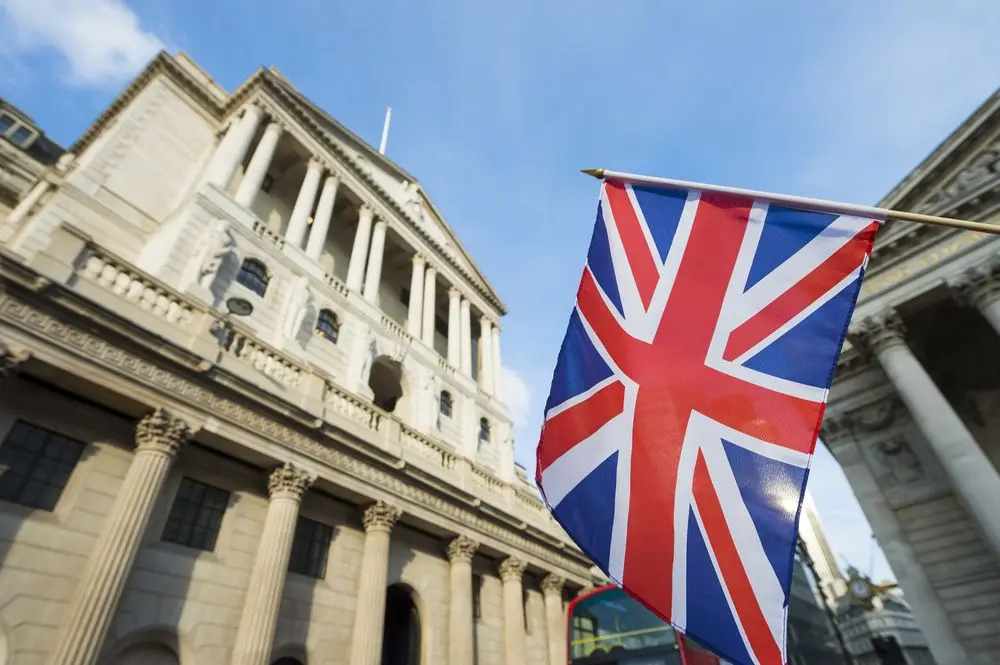
(Kitco News) - Gold prices are pushing higher against the British pound as the Bank of England (BoE) left interest rates unchanged, but remains in a difficult position as inflation rises while economic activity weakens.
As expected, the British central bank left the Bank Rate at 4.75%. However, the 6-to-3 vote in favor of holding rates steady was slightly more dovish than anticipated. Economists had forecasted a 7-to-2 vote.
The BoE noted in its decision that inflation last month came in hotter than expected, rising 2.6%, up sharply from the 1.7% reported in September. The central bank also sees inflation risks increasing.
“Headline CPI inflation is expected to continue to rise slightly in the near term. Although household inflation expectations have largely normalized, some indicators have increased recently,” the central bank said in its monetary policy statement.
However, the BoE is stuck between a rock and a hard place as it also observes slowing economic growth.
“Most indicators of UK near-term activity have declined. Bank staff expect GDP growth to have been weaker at the end of the year than projected in the November Monetary Policy Report,” the BoE said. “There remains significant uncertainty around developments in the labor market.”
In broader currency markets, gold managed to attract some bullish momentum following the BoE’s decision. Spot gold against the British pound last traded at $2,076.92 an ounce, up more than 1% on the day.
The BoE’s decision comes a day after the Federal Reserve cut rates following its final monetary policy meeting of the year. Analysts have been closely watching England’s monetary policy because it has been leading the global cycle. The BoE was the second major central bank to cut rates this year and is one of the first to slow its easing cycle.
On Wednesday, the Federal Reserve signaled that it could cut interest rates only twice next year, as inflation remains a growing threat to the economy. In September, the central bank was anticipating four rate cuts.
Although the BoE left interest rates unchanged, analysts have said that the easing cycle hasn’t ended.
“Looking ahead, my base case is for the MPC to deliver the next 25bp Bank Rate cut at the February meeting, providing that further disinflationary progress is made over the winter. Beyond this, policymakers are likely to deliver further such cuts on a quarterly basis, likely at meetings which coincide with the release of an updated Monetary Policy Report,” said Michael Brown, Senior Research Strategist at Pepperstone. “Risks to this base case, though, are tilted towards a more dovish outcome, amid increasing signs of overall economic momentum stalling, and with risks to the labour market tilted to the downside. The MPC will likely be reluctant to pivot away from the current ‘slow and steady’ stance too soon, particularly as the UK economic backdrop becomes an increasingly stagflationary one, lending further support to the case for ‘gradual’ rate cuts for the time being.”
