

(Kitco News) – The U.S. service sector strengthened further into expansionary territory last month, but the prices index spiked higher once again, according to the latest data from the Institute for Supply Management (ISM).
The ISM announced on Wednesday morning that its Services Purchasing Managers Index rose to 53.5 in February, up from January’s reading of 52.8. The data was better than expected, as economists were looking for a reading of 53.
“February was the third month in a row with all four subindexes that directly factor into the Services PMI® — Business Activity, New Orders, Employment and Supplier Deliveries — in expansion territory, the first time this has happened since May 2022,” said Steve Miller, chair of the Institute for Supply Management Services Business Survey Committee. “Slightly slower growth in the Business Activity Index was more than offset by growth in the other three subindexes.”
Readings above 50 in such diffusion indexes signify economic growth and vice-versa. The farther an indicator is above or below 50, the greater or smaller the rate of change.
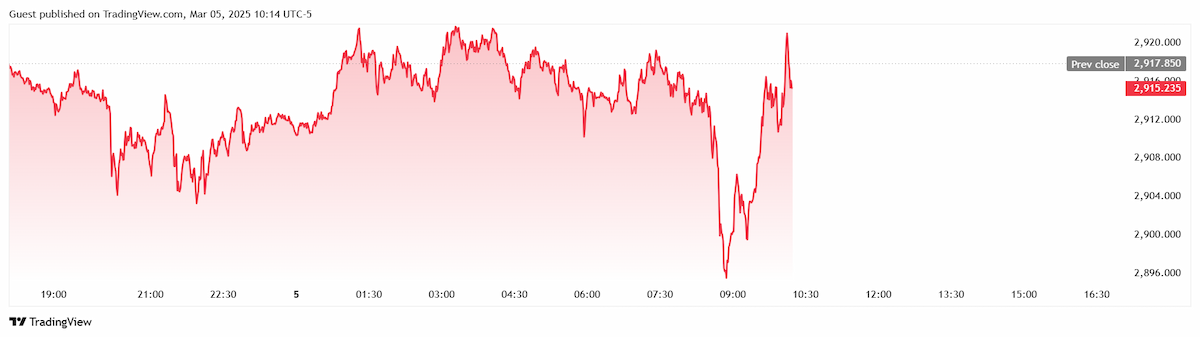
Gold spiked to a session high of $2,922.67 per ounce following the 10 am EDT release. Spot gold last traded at $2,915.26 for a slight loss of 0.09% on the daily chart.
The components of the report largely showed improvement. The New Orders Index rose to 52.1, up from 51.3 in January. At the same time, the Business Activity Index ticked down to 54.4, compared to January’s reading of 54.5, and the Supplier Deliveries Index rose to 53.4, up from 53 recorded the prior month.
Inflation pressures continued to rise in the sector, however, with the Prices Index coming in at 62.6 in February, up from the 60.4 posted in January. “The index registered a third consecutive reading above 60 percent for the first time since March 2023,” Miller said.
The service sector labor market improved in February, with the Employment Index rising to 53.9, above the prior month’s 52.3 level.
“Anxiety continues, however, over the potential impact of tariffs,” Miller warned. “Some respondents indicated that federal spending cuts are having negative impacts on their business forecasts.”
