
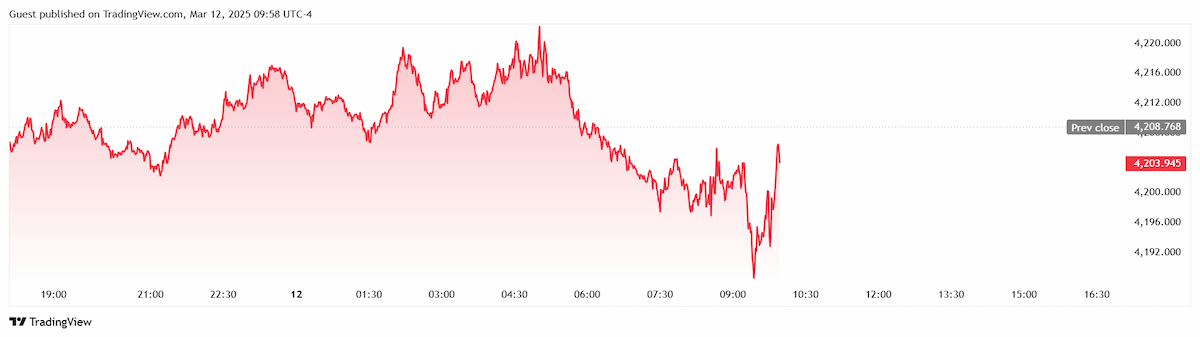
(Kitco News) – Spot gold rose above C$4,200 per ounce after the Bank of Canada cut interest rates while warning about the impacts of a trade war with the United States.
In a widely anticipated move, Canada’s central bank lowered its overnight bank rate by 25 basis points to 2.75%. At the same time, the BoC signaled that trade tensions with the U.S. have made the policy environment more uncertain.
“The Canadian economy entered 2025 in a solid position, with inflation close to the 2% target and robust GDP growth,” the central bank stated in its monetary policy statement. “However, heightened trade tensions and tariffs imposed by the United States will likely slow the pace of economic activity and increase inflationary pressures in Canada. The economic outlook continues to be subject to more-than-usual uncertainty because of the rapidly evolving policy landscape.”
Gold sold off against the Canadian dollar just before the rate announcement, but recovered in the minutes afterward, last trading at C$4,204.41 per ounce for a small decline of 0.10% on the day.
The BoC noted that Canada’s economy grew by 2.6% in Q4 2024, better than projected at the time of the January MPR. “However, economic growth in the first quarter of 2025 will likely slow as the intensifying trade conflict weighs on sentiment and activity,” they warned. “Recent surveys suggest a sharp drop in consumer confidence and a slowdown in business spending as companies postpone or cancel investments. The negative impact of slowing domestic demand has been partially offset by a surge in exports in advance of tariffs being imposed.”
“Monetary policy cannot offset the impacts of a trade war,” the central bank added. “What it can and must do is ensure that higher prices do not lead to ongoing inflation.”
“The Bank is committed to maintaining price stability for Canadians,” they concluded.
Speaking to reporters after the announcement, Bank of Canada Governor Tif Macklem said that quantifying the effects of U.S. tariffs on the economy is very difficult.
“I can’t put a number on it, the scenario is changing every day,” he said, adding that the Canadian dollar’s depreciation and rising input costs from U.S. suppliers – along with pervasive uncertainty – are already impacting Canada’s businesses.
Another reporter asked whether Canadians should be bracing for a recession this year. “The short answer to that question is that it’s going to depend a lot what the U.S. does with their trade policy,” Macklem said.
