

(Kitco News) – Gold prices are rangebound following the recent pullback as traders have turned their attention to PCE inflation data and tariff updates for direction on the next move in the gold market, according to analyst James Hyerczyk at FX Empire.
“Gold prices are holding steady at the start of the week, pausing after last week’s sharp two-day pullback,” Hyerczyk wrote. “Monday’s trade remains confined within Friday’s range, signaling indecision as traders await fresh catalysts. The precious metal remains in a broader uptrend, but near-term correction risks persist, especially with key macro data and tariff-related headlines on the horizon.”
The U.S. dollar is supporting gold prices at their current levels, with the dollar index pulling back 0.1% on Monday, adding to its 3.4% decline in March. “A softer dollar typically supports gold by making it more affordable for overseas buyers,” he noted. “This dollar weakness has helped stabilize gold prices following the recent retreat, offering short-term support around the $3,000 level.”
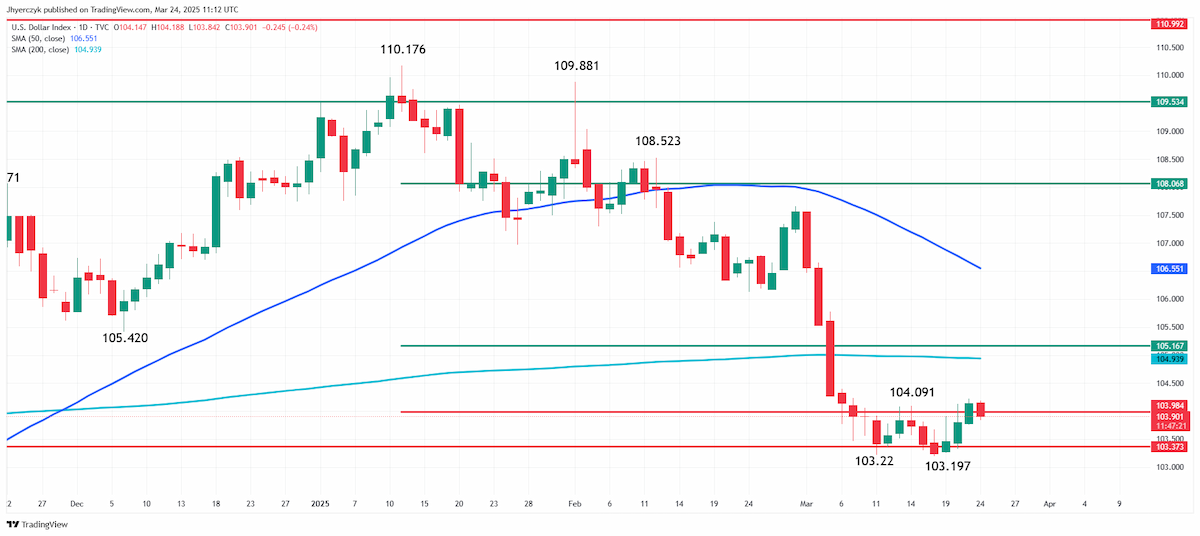
Hyerczyk said the ongoing uncertainty surrounding U.S. trade tariffs is also keeping safe-haven demand strong.
“Markets remain alert to potential economic fallout from U.S. President Donald Trump’s proposed tariffs, set to take effect on April 2,” he wrote. “While Trump hinted at possible flexibility, concerns remain that retaliatory measures could stoke inflation and slow economic growth. Analysts suggest that a more aggressive tariff stance could push gold toward the $3,100 level, while a less severe outcome may open the door for brief dips below $3,000.”
In terms of the interest rate environment, Hyerczyk said that gold remains well-supported by the Federal Reserve’s relatively dovish stance, with the central bank still projecting two rate cuts in 2025. “Traders are now turning to Friday’s release of the U.S. Personal Consumption Expenditures (PCE) report — the Fed’s preferred inflation metric — for further policy clues,” he said. “Lower interest rates reduce the opportunity cost of holding non-yielding assets like gold, reinforcing its appeal.”
Turning to the technical picture, Hyerczyk said that gold is now consolidating after reaching a new all-time high of $3,057.59 last week. “A break above that level would resume the uptrend with open-ended upside potential,” he wrote. “Key near-term support lies at $2,968.92, while the 50-day moving average at $2,874.97 remains the critical level for longer-term bulls.”
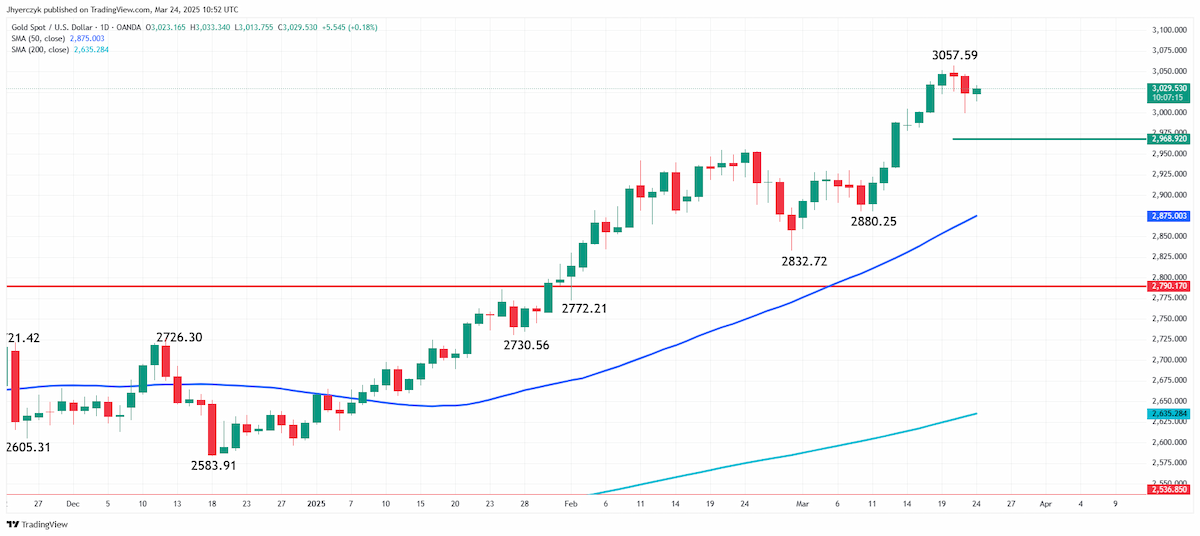
Going forward, Hyerczyk said he expects gold demand to remain firm with support on the back of a weakening dollar, dovish central bank policy, and tariff uncertainty. “Unless inflation data surprises to the upside or tariff fears ease substantially, dips are likely to be shallow,” he said. “As long as gold holds above $2,968.92, the broader bullish structure remains intact, keeping $3,100 and potentially $3,150 in focus over the near term.”
Gold prices have seen a fair amount of volatility to start the week, with spot gold testing near-term support at $3,014 late Sunday night before trading as high as $3,033 by 6:30 am EDT.
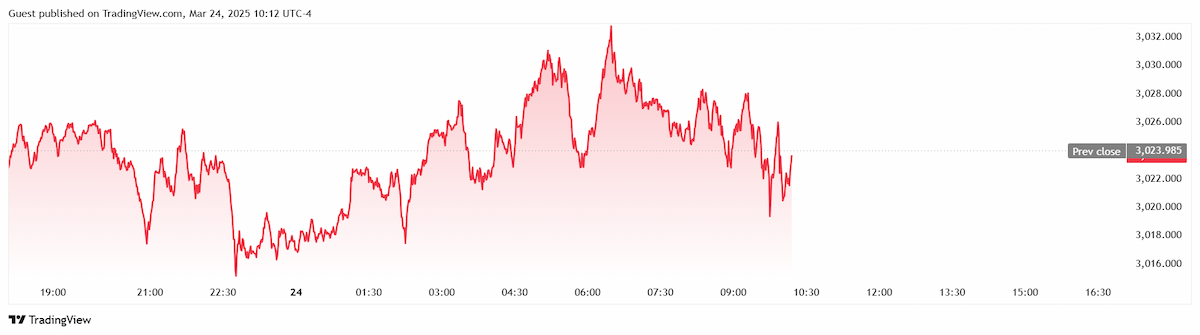
Spot gold last traded at $3,023.54 and is virtually flat on the session at the time of writing.
