
(Kitco News) - The gold market is trading near all-time highs ahead of the weekend after the latest data showed consumer sentiment in the U.S. deteriorating beyond all expectations, while inflation expectations and recession fears rose dramatically once again.
The University of Michigan announced on Friday that the preliminary reading of its Consumer Sentiment survey was 50.8 in April, well below March’s final reading of 57. The data was far worse than expectations, as the consensus forecast of economists called for a 54.5 reading.
“Consumer sentiment fell for the fourth straight month, plunging 11% from March,” said Surveys of Consumers Director Joanne Hsu. “This decline was, like the last month’s, pervasive and unanimous across age, income, education, geographic region, and political affiliation. Sentiment has now lost more than 30% since December 2024 amid growing worries about trade war developments that have oscillated over the course of the year.”
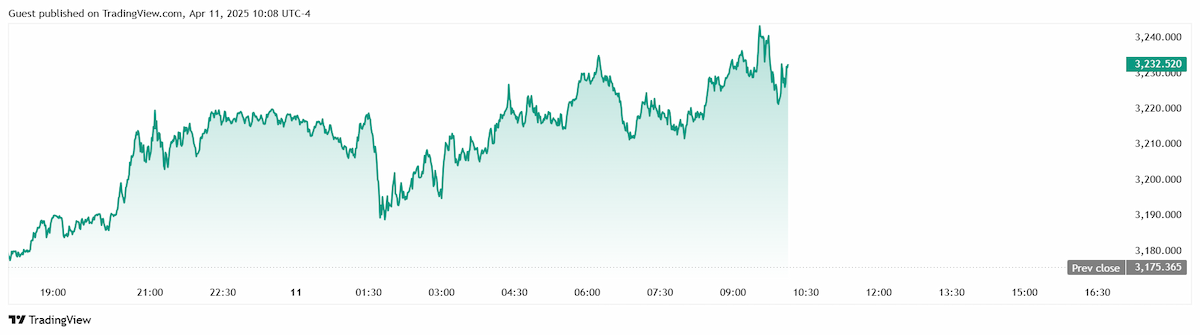
Gold prices are approaching the fresh all-time highs from earlier this morning following the 10 am EST data release, with spot gold last trading at $3,232.91 per ounce for a gain of 1.81% on the day.
The components of the index showed very acute concern about the potential for higher inflation and recession in the coming years.
“Consumers report multiple warning signs that raise the risk of recession: expectations for business conditions, personal finances, incomes, inflation, and labor markets all continued to deteriorate this month,” Hsu said in the report. “The share of consumers expecting unemployment to rise in the year ahead increased for the fifth consecutive month and is now more than double the November 2024 reading and the highest since 2009. This lack of labor market confidence lies in sharp contrast to the past several years, when robust spending was supported primarily by strong labor markets and incomes.”
“Year-ahead inflation expectations surged from 5.0% last month to 6.7% this month, the highest reading since 1981 and marking four consecutive months of unusually large increases of 0.5 percentage points or more,” she added. “This month’s rise was seen across all three political affiliations. Long-run inflation expectations climbed from 4.1% in March to 4.4% in April, reflecting a particularly large jump among independents."
Harry Chambers, assistant economist at Capital Economics, said stagflation is now clearly on consumers’ minds.
"The further fall in the University of Michigan Consumer Sentiment Index in April, along with the rise in both one- and five-year inflation expectations, suggests that the tariff-related fears which had soured sentiment over the past couple of months are here to stay," he wrote in a note to Kitco News. "The press release also noted that 'The share of consumers expecting unemployment to rise in the year ahead is the highest since 2009', suggesting that confidence in the labour market is waning too. Another notable detail from the press release is the large fall in confidence among Republicans."
"Despite the slump in energy prices, one-year inflation expectations surged from 5.0% to 6.7%, which is likely a direct reflection of the imposition of tariffs last week," Chambers noted. "More concerning though, five-year inflation expectations jumped again, to 4.4% and now sit at their highest level since 1991. Households appear to have come to the same conclusion as markets: the tariffs will do lasting damage to the US economy."
