
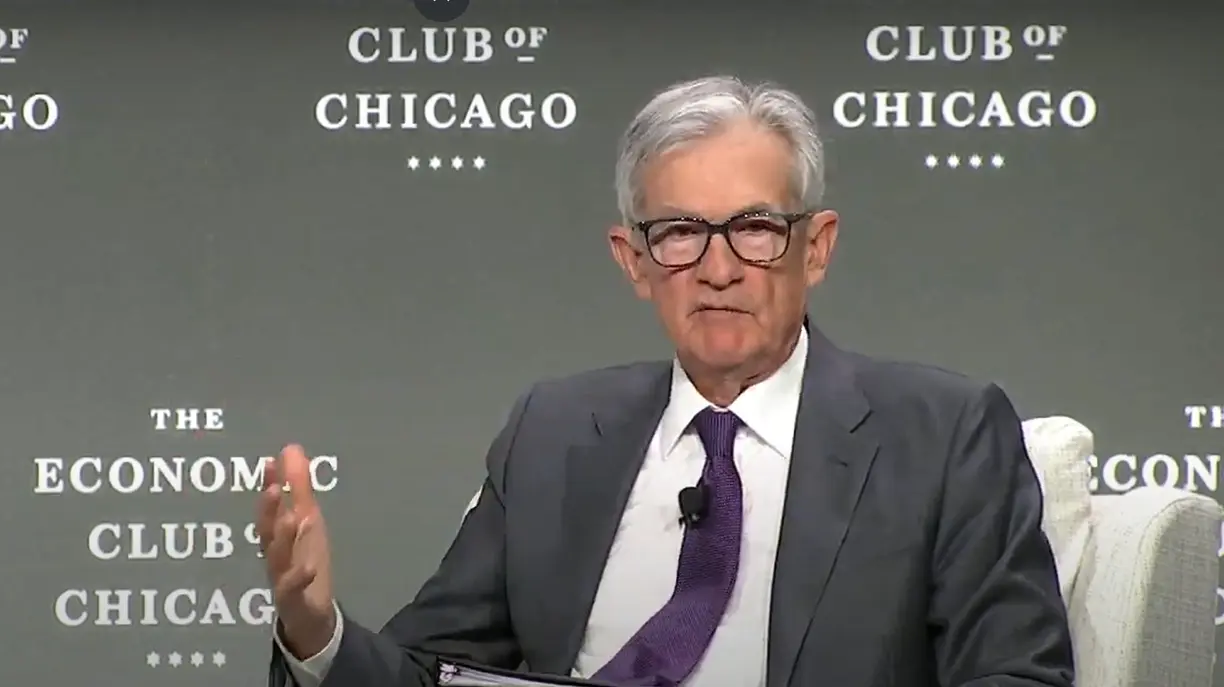
(Kitco News) – Federal Reserve chair Jerome Powell was more candid and direct about the new administration and the potential impacts of their policies than he had been to date when he spoke at the Economic Club of Chicago on Wednesday afternoon.
At the outset, Powell was asked what he thinks about the rising expectations for a U.S. recession in 2025, and he pointed to the state of the economy toward the end of 2024.
“2024 was a year where the economy grew 2.4%,” he said. “Unemployment remained in the low fours, close to mainstream estimates of maximum employment, and inflation came down and was running at the end of the year around 2.5%. That's the economy that we had.”
“Where we are now, is the administration is implementing significant policy changes, and particularly trade now is the focus, and the effects of that are likely to move us away from our goals,” Powell said. “Unemployment is likely to go up as the economy slows, in all likelihood, and inflation is likely to go up as tariffs find their way, and some part of those tariffs come to be paid by the public. That's the strong likelihood.”
“We're always going to be aiming for maximum employment and price stability, that's what we do,” he added. “I do think we'll be moving away from those goals probably for the balance of this year – or at least not making any progress – and then we'll resume that progress as we can.”
Powell said one of the lessons of the pandemic is that supply chain disruptions are more impactful over the longer term than simple price increases.
“If you look back at the pandemic, there was a shortage of semiconductors, and that led to a shortage of cars at a time of extremely high car demand,” he said. “And it was a prolonged shortage because production couldn't keep up, and that was one of the things that led to an extended period of inflation. So when you think about supply disruptions, that is the kind of thing that can take time to resolve and that can lead what would have been a one-time inflation shock to be extended, perhaps more persistent. And we would worry about that. In this case, you can look at the car companies, their supply chains seem to be on track to be disrupted significantly, and you would worry that process will take some years and that the inflationary process might be extended.”
Powell also addressed the specter of ‘stagflation’, where the Fed would be faced with both higher levels of unemployment as well as potentially higher inflation.
“Most of the time when the economy is weak, inflation is low and unemployment is high, and both of those call for lower interest rates to support activity, and vice versa,” he said. “ So most of the time the two goals are not in tension.”
“Now the labor market is still strong, but the, the shock that we're experiencing, the impulses we're feeling are for higher unemployment and higher inflation,” Powell warned. “Our tool only does one of those two things at the same time, so it's a difficult place for central banks to be in.”
The Fed chair was also asked whether investors should believe in the so-called ‘Fed put’, where the central bank could be expected to intervene with an emergency rate cut if the markets declined dramatically.
“I'm going to say no, with an explanation, Powell replied. “Markets are processing what's going on, particularly the trade policy. The question is, where's that going to come in? Where's that going to land? And we don't know that yet. So markets are struggling with a lot of uncertainty, and that means volatility. But having said that, markets are functioning, conditional on being in such a challenging situation, markets are doing what they're supposed to do. They're orderly and they're functioning just about as you would expect them to function.”
On the recent spike in Treasury yields, Powell again took a measured tone.
“I think it's very premature to say exactly what's going on,” he said. “Clearly there's some deleveraging going on among hedge funds… again, the market's processing historically unique developments and with great uncertainty. You'll probably see continued volatility, but I wouldn't try to be definitive about exactly what's causing that. I would just say markets are orderly and they're functioning as you would expect them to in this time of high uncertainty.”
Asked how a potential decline in Treasury prices would impact the Fed’s balance sheet, Powell said the central bank debated halting their bond sales at the last meeting, but ultimately settled on cutting them by 75% instead.
“We thought about pausing and we decided to slow the pace instead,” he said. “People really came to see the merits of that, because the slower we go, the smaller the balance sheet can get without disruptions. That means we can go on for a longer amount of time, and we'll be able to reach very carefully what we think is the right level of reserves.”
When asked about the U.S. deficit and debt, Powell said politicians and the public tend to focus on the wrong things when they talk about cutting.
“U.S. federal debt is on an unsustainable path, it's not at an unsustainable level,” Powell said. “No one really knows how much further we can go, but we're running very large deficits at full employment, and this is a situation that we very much need to address.”
“It's not the Fed's issue, but if you look at a pie chart of federal spending, the biggest parts, and the parts that are growing, are Medicare, Medicaid, social security, and now interest payments,” he said. “That's really where the work has to be done, and those are issues that can only be touched on a bipartisan basis. All of domestic discretionary spending, which is essentially where one hundred percent of the conversation is, is small as a percentage of federal spending, and is already declining as a percentage of federal spending.
“When people are focusing on cutting domestic spending, they're not actually working on the problem,” Powell emphasized. “Domestic discretionary spending is already going down. I like to make that point because so much of the dialogue that the politicians offer is about domestic discretionary spending, which is not the issue.”
The Fed chair was also asked about possible challenges to the central bank’s independence, particularly with the Supreme Court considering whether the executive can fire leaders at other independent federal agencies.
“Our independence is a matter of law,” Powell replied. “Congress has in our statute that we're not removable except for cause. Congress could change that law, but I don't think there's any danger of that. Fed independence has pretty broad support across both political parties and on both sides of the hill.”
“I don't think [the Supreme Court] decision will apply to the Fed, but I don't know,” he added. “It's a situation that we're monitoring carefully.”
