

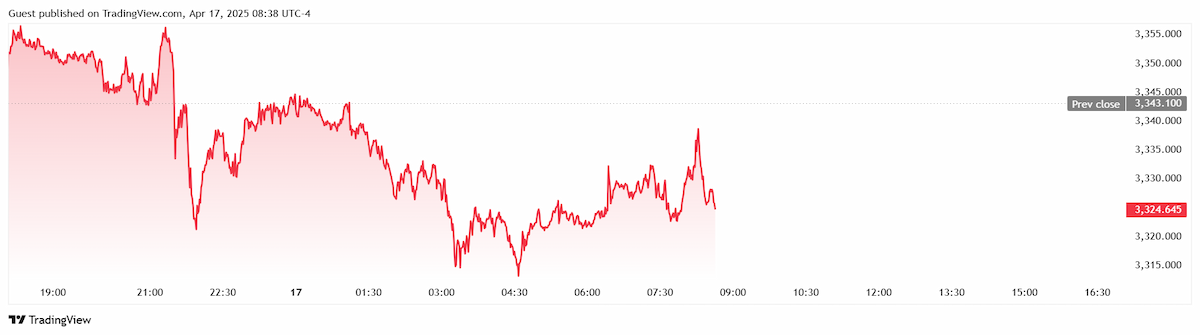
(Kitco News) - The gold market is trading near $3,324 per ounce after the Philadelphia Federal Reserve's manufacturing sector survey declined far beyond expectations this month.
On Thursday, the regional central bank said its manufacturing business outlook for April fell to -26.4, compared to March’s reading of 12.5. The data was far worse than expected, as economists were looking for a reading of 2 this month.
“Manufacturing activity in the region declined this month, according to the firms responding to the April Manufacturing Business Outlook Survey,” the report said. “The survey’s indicators for general activity, new orders, and shipments all fell and turned negative. The employment index registered a near-zero reading, suggesting steady employment conditions. Both price indexes continue to suggest overall price increases. The future activity indicators continue to suggest subdued expectations for growth over the next six months.”
Gold prices held fairly steady in the minutes following the manufacturing data release, which came out at the same time as weekly jobless claims and housing starts and building permits. Spot gold last traded at $3,324.41 per ounce, down 0.56% on the day.
The key components of the index worsened significantly this month. “Nearly 39 percent of the firms reported decreases in general activity this month, while 13 percent reported increases; 41 percent reported no change” the report said. “The index for new orders also fell sharply, from 8.7 in March to -34.2 this month, its lowest reading since April 2020. The current shipments index decreased 11 points to -9.1 this month.”
Firms reported mostly steady employment overall, with the employment index falling 20 points to 0.2 in April. “Most firms (84 percent) reported no change in employment, while small, nearly identical shares reported increases and decreases (6 percent),” they noted. “The average workweek index fell sharply, from 8.7 to -12.7.”
The Philly Fed report also showed prices rising well above their long-run averages, with both price indexes delivering their highest readings in over two years.
“The prices paid index edged up from 48.3 to 51.0, its highest reading since July 2022,” the report said. “Almost 54 percent of the firms reported increases in input prices, while 3 percent reported decreases; 36 percent reported no change. The current prices received index ticked up 1 point to 30.7. Almost 31 percent of the firms reported increases in the prices of their own goods, none reported decreases, and 64 percent reported no change.”
The survey’s broad indicators for future activity also declined, though they remained positive, while future price metrics shot higher.
“The diffusion index for future general activity ticked up 1 point to 6.9 in April, after declining 22 points in March,” the report said. “The future new orders index increased 4 points to 6.6, and the future shipments index decreased 6 points to 5.0, its lowest reading since June 2024. The future employment index fell 18 points to -0.6, its lowest reading since February 2016. The future prices paid index climbed to 63.1, and the future prices received index jumped 28 points to 67.7, its highest reading since June 2021.”
