
(Kitco News) – Gold demand was soft overall last month with festival buying mixed and heavy ETF redemptions, but imports showed resilience in April, and a near-term price floor could boost investors’ appetite, according to Kavita Chacko, Research Head for India at the World Gold Council (WGC).
Chacko wrote in the latest WGC update that U.S. dollar weakness, heightened geopolitical and economic uncertainties, and strong inflows into global gold ETFs helped accelerate gold’s momentum in April. “However, prices have since retreated, with the LBMA Gold PM price falling 8% so far in May,” she said. “In India, domestic gold prices mirrored the global trend. Although, the May m-t-d correction was milder at 5%, cushioned by the appreciation of the Indian rupee.”
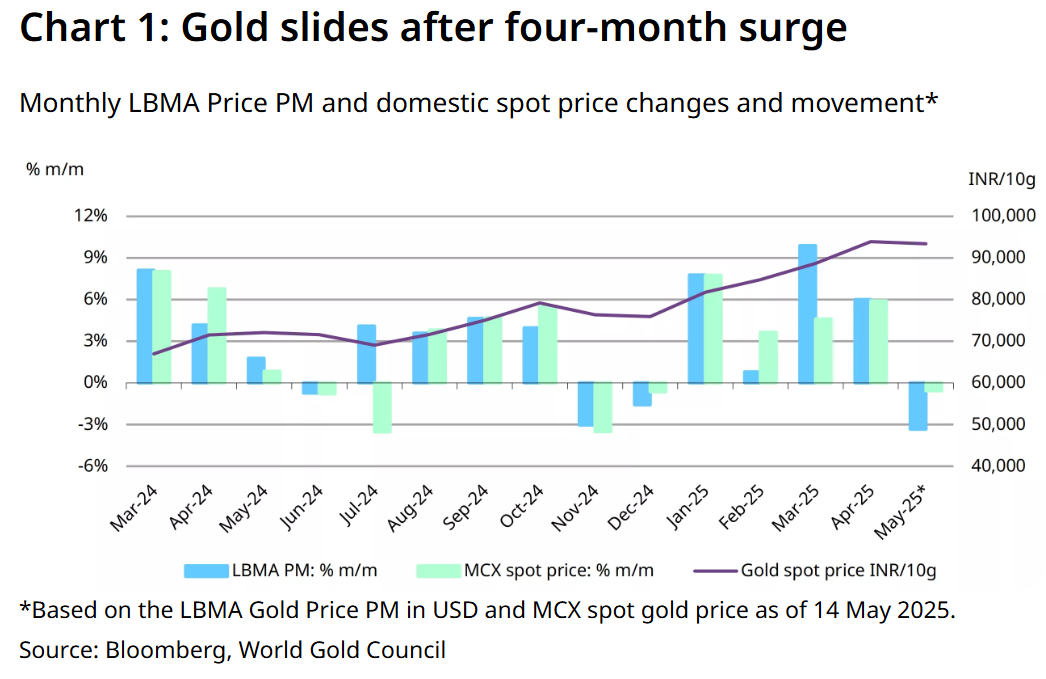
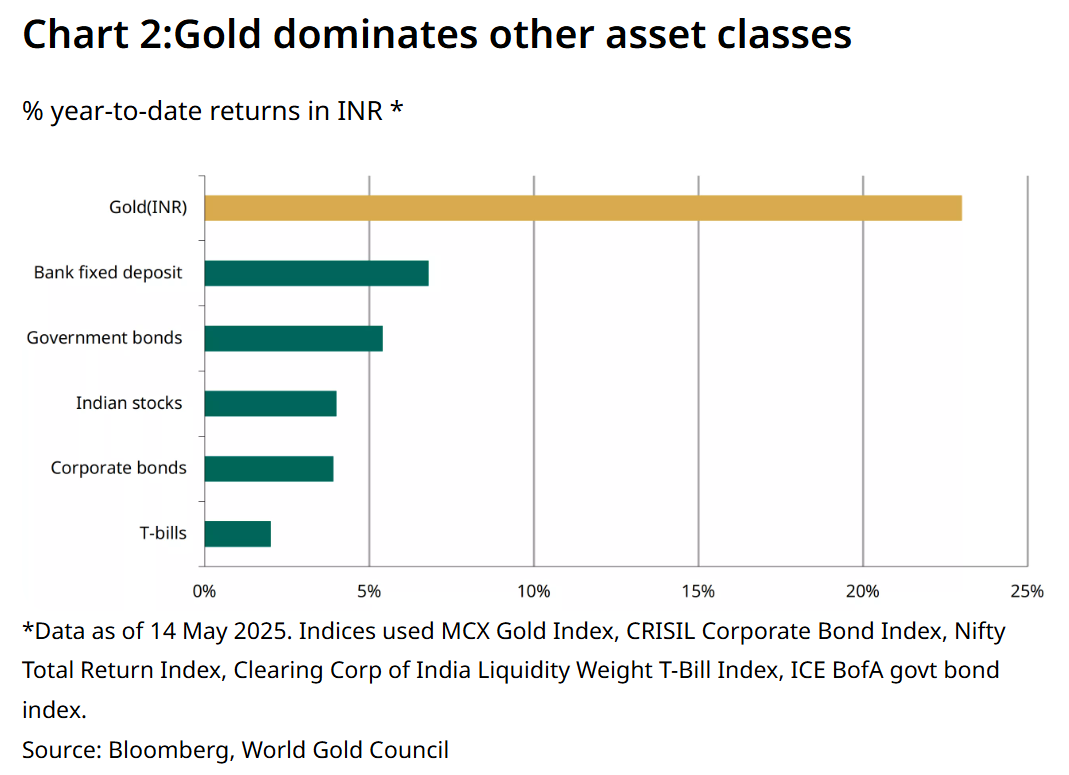
Chacko noted that while the LBMA gold price has risen $583/oz, or 22%, in 2025, the Indian domestic spot gold price is up 23%. “Despite the recent decline, gold outshines other major asset classes on a y-t-d basis,” she said.
Indian festival demand over the last several weeks has been a mixed bag. “Gold jewellery sales in India during April and early May remained subdued, except on the day of Akshaya Tritiya, due to high and volatile gold prices coupled with broader economic uncertainties,” she said. “Anecdotal evidence suggests that consumers were deferring their purchases, waiting for price stability, or opting for lighter-weight jewellery to accommodate fixed budgets and need-based buying.”
Chacko noted that “the bullion segment, bars and coins, performed better than jewellery, with low-weight coins (especially 5g) proving popular” during the festival of Akshaya Tritiya. “These were bought as ‘token’ purchases for the festival, with a notable share of sales occurring through online and e-commerce platforms. This behaviour highlights a growing consumer shift towards organised players and investment-oriented gold products.”
“Despite a likely year-on-year decline in the volume of gold sold during Akshay Tritiya, the overall value of sales is expected to have increased, reflecting the nearly 30% rise in gold prices since last year,” she noted. “This indicates a degree of resilience in Indian gold demand. Additionally, the exchange and recycling of old gold jewellery remained a prominent trend.”
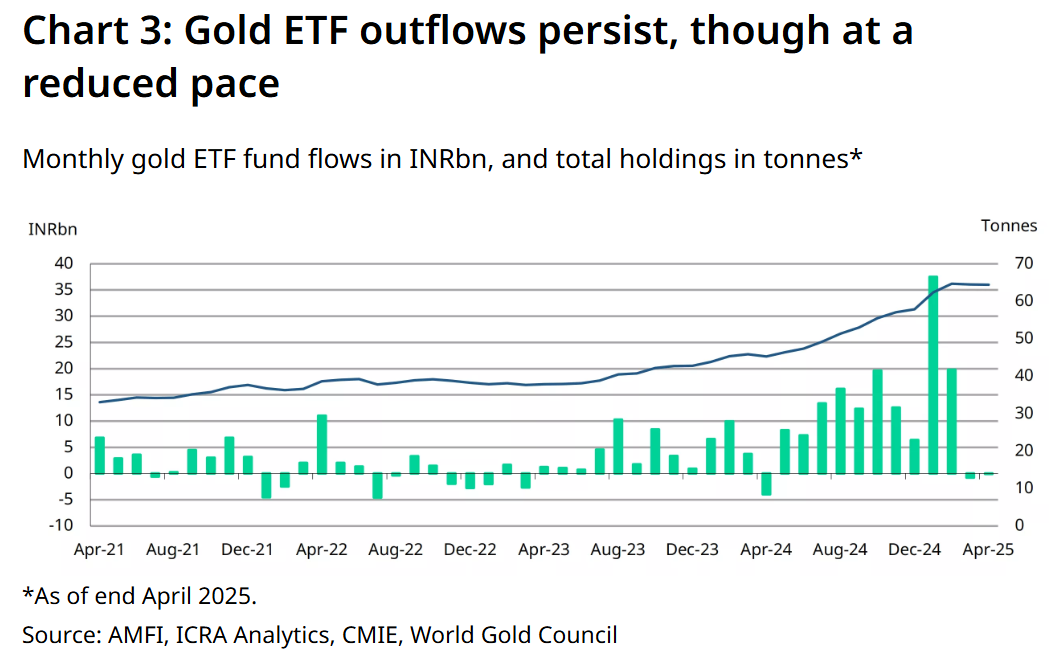
Gold ETFs also saw heavy redemptions in April, but sky-high gold prices meant assets under management and investor holdings rose nonetheless.
“For the second month in a row, Indian gold ETFs recorded net outflows in April,” Chacko wrote. “According to data from the Association of Mutual Funds in India (AMFI), redemptions hit a record high of INR 16.69bn (US$195mn) in April, suggesting profit-taking with gold prices touching fresh record highs during the month.”
Gross inflows in April were $194 million, a 50% decline from the average of January and February, with elevated and volatile gold prices keeping investors on the sidelines. “Nevertheless, inflows in April were 58% higher than in March, partially offsetting the impact of the high redemptions,” she said. “As a result, net outflows in April narrowed to INR0.06bn (US$0.7mn) from INR0.8bn (USD8.9mn) in March.”
However, cumulative assets under management (AUM) of gold ETFs rose to $7.2 billion, up 4% m/m and 87% y/y, aided by the high gold prices. “Investor interest in this asset class was upheld with 0.18mn new investor accounts (or folios) added during the month,” she noted. “This brought the total number of gold ETF investor accounts to a record 7.1mn.”
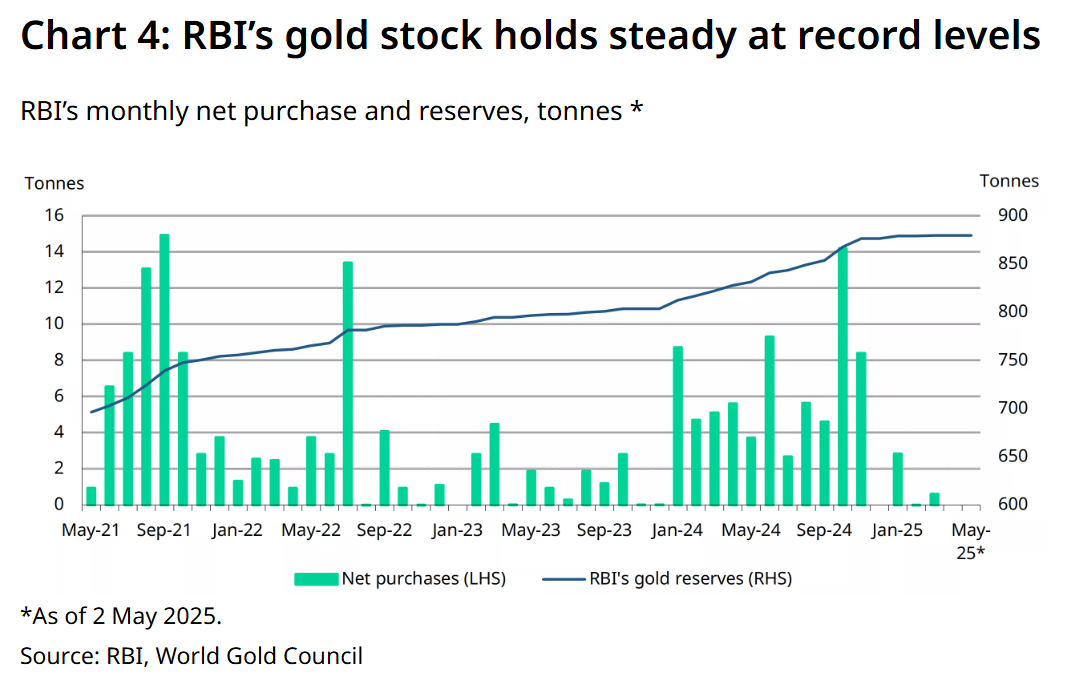
The RBI’s gold purchases have also slowed even as the percentage of its bullion held domestically continued to rise.
“So far this year, the Reserve Bank of India (RBI) has scaled back its gold purchases after the significant additions made in 2024 (73t),” Chacko wrote. “In the first four months of 2025, it added a more modest 3.4t, compared to 24.1t during the same period last year. Even so, the RBI’s gold reserves remain at a historic high of 879.6t as of end April - unchanged from the previous month.”
Gold now represents 12% of the value of India’s total forex reserves, a 4% increase from a year ago and the highest share on record. “This underscores the growing strategic importance of gold in the management of forex reserves,” she said.
The RBI's approach to managing its gold reserves also continues to evolve. “As of March 2025, 58% of its gold – about 512t – is reportedly held domestically, up from 38% in March 2023,” Chacko said. “The remaining 40% (349t) is stored with international institutions such as the Bank of England and the Bank for International Settlements. Since September,1.52t have been added to the domestic holdings, while 25t were added to the international holdings.”
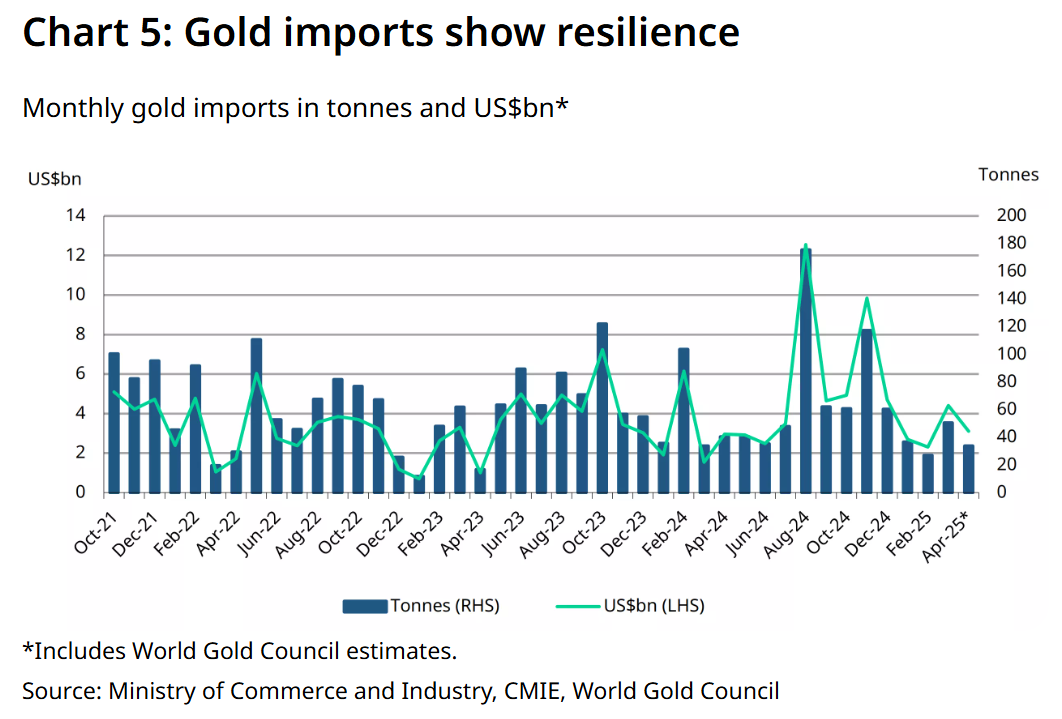
Imports, meanwhile, have remained resilient despite headwinds from high prices.
“Imports stood at US$3.1bn – nearly a third lower than March but above the January – February average of US$2.5 bn and 5% higher year-on-year, according to Ministry of Commerce data,” she said. “This points to continued underlying demand, even in a high-price environment, given that gold imports into the country are on consignment basis by nominated banks and agencies. Based on our estimates, import volumes for the month were in the range of 30t – 36t, down from 51t in March and 40t a year ago.”
Looking ahead, Chacko said the World Gold Council expects price stabilization in the global gold market could spark a resurgence in Indian demand. “Consumer sentiment that the downside to gold prices is limited would reinforce gold’s appeal as a reliable investment.”
