
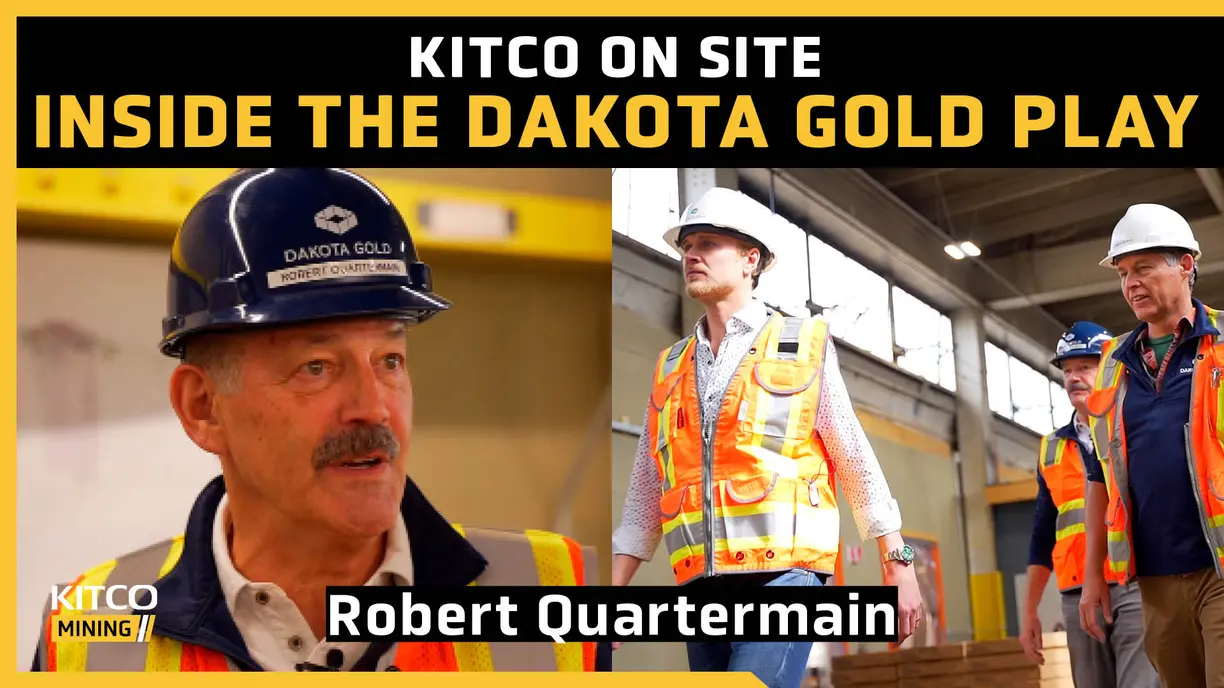
(Kitco News) - LEAD, S.D. – In the Black Hills of South Dakota, gold is no longer just history—it’s strategy. With the U.S. government now classifying gold as a critical mineral and the spot price hovering around $3,300 an ounce, Dakota Gold Corp. is moving fast to revive one of the richest mining districts in American history.
The Homestake Mine produced over 40 million ounces of gold during its 120-year run, and Dakota Gold’s co-chairman Bob Quartermain believes “a lot of the mineralization back then, which wasn’t ore, can now be ore.”
Quartermain is no stranger to building a major mine from the ground up. He previously led Pretium Resources and developed the Brucejack Mine in British Columbia—eventually sold to Newcrest for $3 billion. At Dakota Gold, he’s now focused on transforming 48,000 acres once controlled by Homestake into what he calls “one of the U.S.' next major gold mines.”
“We’ve come in and drilled our Maitland project and we have 47 intersections there, average around 11 grams per ton over four meters,” Quartermain said. “The old West ledges… were averaging around 11 grams over six meters, and that was 6 million ounces.”
At today’s prices, the economics are hard to ignore. “Wharf reported last year that they produced about over 95,000 ounces and generated almost $95 million,” he said, referencing Coeur Mining’s adjacent operation. “We’re here adjacent to them, so we expect to have a similar cross structure… We’re hoping to have a good low AISC, which is going to give us a very good margin at $3,000 gold.”
Dakota Gold recently released a S-K 1300 compliant resource for its Richmond Hill Gold Project, outlining 3.65 million ounces of oxide gold in the measured and indicated category, and 2.6 million ounces inferred. According to James Berry, Vice President Exploration, “The total resource for the oxide was 3.65 million ounces… and then the inferred was 2.6.” Quartermain added: “The largest gold resource of a heap-leachable oxide held by a junior company in the United States.”
Quartermain said Dakota Gold’s IA with cash flow—an economic study similar to a PEA—will be followed by a full feasibility study through 2026–27, with construction targeted for 2028 and production by 2029. “Because we’re on private land… we can look to do [development] and go through the permitting of it relatively quickly,” he said.
That permitting edge is rare. “We’ve got 3,000 acres of private land out at Richmond Hill… and there are very prescriptive processes that you go through,” Quartermain noted.
Dakota Gold’s access to capital is another advantage. The company raised $47 million in cash and has a $300 million non-binding construction financing proposal from Orion Mine Finance. “We actually did a $35 million equity raise with a good group of existing shareholders as well as some new portfolio managers,” Quartermain said. “We’ve got a major shareholder in Orion… they’re a major support of ours.”
With investor interest accelerating and gold added to the U.S. critical minerals list this year, the geopolitical backdrop is turning supportive. “At this point in time, gold has been defined as a critical mineral because we use it in everyday life,” Quartermain said. “It’s used in our cell phones… our computers.”
M&A speculation also surrounds the project. “We’ve seen that amalgamation going on with Equinox and Calibre,” Quartermain said. “When you have a resource like we do… I think it starts to bring M&A activity and eyes onto Dakota Gold.”
But Quartermain insists the team is focused on executing. “We’ve got such a great team and we’re enthused about drilling,” he said. “We want to get our work done this year, get the drilling off, continue to evolve through our IA with cash flow, show the real economic potential that we have in this project.”
Lead, South Dakota, once home to 300 miles of underground workings, is no longer just a memory. “Why didn’t somebody come in here 20 years ago?” said Vice President Exploration James Berry. “There’s a lot of support for getting another project going.”
In 2001, Homestake closed with gold at $270 an ounce. Now, with $3,000 gold, investor demand for U.S.-based tier-one ounces has sparked over $11 billion in recent acquisitions by majors since 2021.
And as Quartermain said, “If other individuals determine that they would like to have the privilege of mining this… that’s something we always have to look at.”
Note: Dakota Gold anticipates publishing its IA with cash flow on Monday, July 7, with a follow-up webcast on Tuesday, July 8.
This story was produced as part of Kitco Mining’s on-site reporting and was sponsored by Dakota Gold Corp.